.webp&w=384&q=75)

Loading, please wait...
Loading, please wait...

Healthcare access in India has shown remarkable improvement according to the recent National Statistical Office (NSO) 80th Round health survey. This comprehensive study highlights that government interventions have successfully expanded service delivery. Consequently, citizens now experience better affordability and utilization of public health facilities across both rural and urban sectors.
The survey reveals that the median out-of-pocket expenditure (OOPE) for hospitalization was Rs 11,285 in 2025. This figure suggests that over half of hospitalizations involve relatively low costs for patients. Furthermore, the OOPE at public health facilities is even lower, with more than half of the cases incurring only Rs 1,100. Importantly, outpatient care at public facilities now records a zero median expenditure. This change reflects the success of the Free Drugs and Free Diagnostics initiatives launched in 2015. Moreover, over 1.84 lakh Ayushman Arogya Mandirs (AAMs) have significantly strengthened the primary healthcare network nationwide.
Government-financed health insurance coverage has expanded more than threefold over the last few years. Rural coverage increased from 12.9% to 45.5%, while urban coverage rose from 8.9% to 31.8%. This growth is largely driven by schemes like the Ayushman Bharat Pradhan Mantri Jan Arogya Yojana (PM-JAY). Consequently, vulnerable populations now have better protection against catastrophic health expenses. Additionally, the AMRIT initiative provides essential drugs at massive discounts of up to 50% through its dedicated pharmacies.
The report captures a notable epidemiological transition occurring across the country. There is a steady decline in infectious diseases alongside a rising prevalence of non-communicable diseases. Conditions like diabetes and cardiovascular issues now require more proactive health-seeking behavior. Furthermore, institutional deliveries have reached impressive levels, climbing to 95.6% in rural areas. This progress demonstrates the impact of sustained motherhood programs and improved access to quality maternal services. In response to rising demand, the utilization of public facilities for outpatient care in rural areas has also surged to 35%.
Q1: What is the median out-of-pocket cost for outpatient care in public hospitals?
According to the NSO 80th round survey, the median out-of-pocket expenditure for outpatient care in public health facilities is zero.
Q2: How much has health insurance coverage grown in rural India?
Health insurance coverage in rural areas has seen a threefold expansion, increasing from 12.9% to 45.5% between the survey rounds.
Q3: What disease trends were highlighted in the survey?
The survey noted an epidemiological shift, with infectious diseases declining and non-communicable diseases like diabetes and heart disease becoming more prevalent.
Disclaimer: This content is for informational and educational purposes only. It does not constitute medical advice or replace professional judgment. Refer to the latest local and national guidelines for clinical practice.
References

Read summarized clinical updates, watch expert medical content, and earn CME certifications right from your smartphone.
Open your smartphone camera to scan and install.





The NSO 80th survey highlights a significant rise in healthcare access in India, with expanded insurance coverage and lower out-of-pocket costs for citizens...
5 months ago
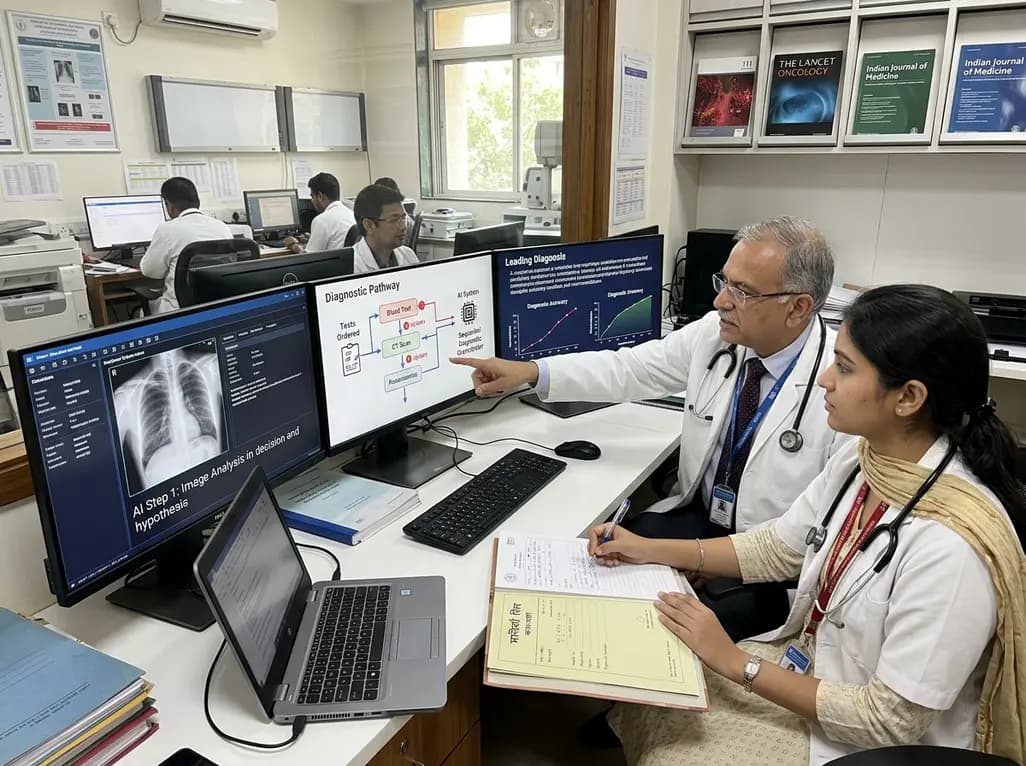
A breakthrough peer-reviewed study demonstrates that a sequential AI diagnosis system can mirror real-world clinical reasoning. By ordering stepwise tests and updating hypotheses dynamically, this multi-agent orchestrator achieved superior diagnostic accuracy while reducing investigative costs.
Today

A prenatal case highlights severe glutaric acidemia type II presenting as bilateral hyperechoic cystic kidneys at 18 weeks. Whole-exome sequencing revealed a novel homozygous ETFDH frameshift variant, demonstrating the power of rapid genetic testing in fetal renal anomalies.
Today

Review how tailored exercise programs benefit frail older patients with heart failure. Explore pathophysiological mechanisms, individualized training prescriptions, and strategies to overcome adherence barriers in clinical practice.
Yesterday

This comparative study evaluates posterior labral tears with and without glenohumeral instability, highlighting distinct demographic patterns, MRI underestimation in stable shoulders, and successful arthroscopic repair outcomes.
Yesterday

A clinical study demonstrates that early intervention with tocilizumab, either as monotherapy or bridged with corticosteroids, achieves significant proptosis reduction and resolves active inflammation in treatment-naive thyroid eye disease.
Yesterday
