.webp&w=384&q=75)

Loading, please wait...
Loading, please wait...
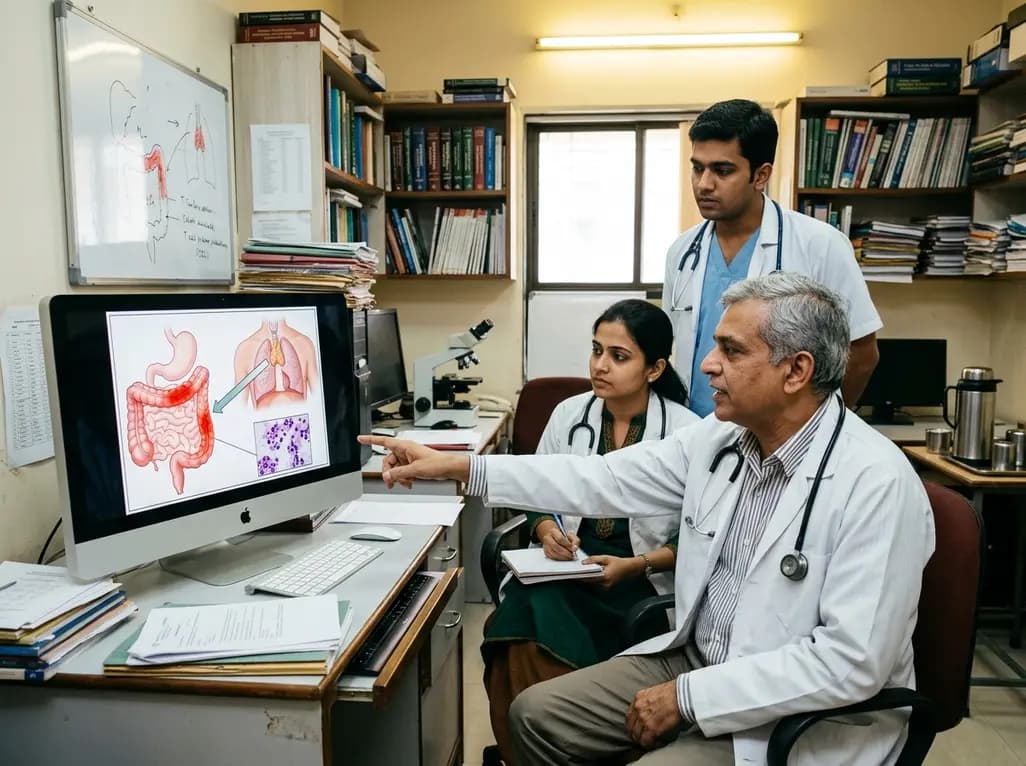
Inflammatory bowel disease (IBD) remains a complex challenge for clinicians worldwide. Traditionally, research focused primarily on local intestinal immune responses. However, emerging evidence highlights the gut-thymus axis as a pivotal regulator of systemic immune homeostasis. The thymus serves as the primary site for the development of regulatory T cells (Tregs). These cells are essential for maintaining central immune tolerance and preventing excessive inflammation in the gastrointestinal tract. Consequently, any disruption in thymic function can lead to a significant decline in Treg output, which triggers immune dysregulation in susceptible individuals.
Furthermore, the intestinal microbiota plays a critical role in this systemic communication. Microbiota dysbiosis appears to impair thymic structure and function through Toll-like receptor (TLR) signaling pathways. Specifically, microbial products can influence the thymic microenvironment, altering the selection and expansion of maturing T cells. This disruption creates a pro-inflammatory positive feedback loop. This loop not only reduces the number of protective Tregs but also accelerates the progression of chronic intestinal inflammation. Moreover, transcription factors and intercellular interactions within the thymic medulla are vital for these immunoregulatory processes.
Several pathways facilitate the crosstalk within the gut-thymus axis. Research indicates that specific dendritic cells migrate from the gut to the thymus, carrying microbial antigens. These antigens help shape the T cell repertoire by promoting the development of microbiota-specific Tregs. In contrast, when the gut barrier is compromised, pathogenic signaling can induce thymic atrophy. This atrophy reduces the diversity of the immune response, making the host more vulnerable to autoimmune attacks. Additionally, molecular signaling pathways, such as those involving AIRE and Foxp3, are essential for the maturation of these immunoregulatory cells.
Recognizing the importance of the thymus has opened new avenues for precision immunotherapy in IBD. Current experimental strategies include ex vivo expansion of Tregs and the induction of thymic microenvironment remodeling. Specifically, molecular targeting of signaling pathways aims to restore the balance of the immune system. Although these therapies are still in various stages of translational maturity, they provide a strong theoretical foundation for future clinical practice. Future studies leveraging single-cell omics and organoid models will likely clarify these complex interactions further.
The gut-thymus axis refers to the bidirectional communication between the intestinal microbiota and the thymus, which regulates the development of the immune system and maintains tolerance.
Thymic dysfunction leads to a reduced production of regulatory T cells (Tregs). Without sufficient Tregs, the body cannot effectively suppress intestinal inflammation, leading to the exacerbation of IBD symptoms.
Current research is exploring thymus-targeted strategies like Treg induction and molecular signaling modulation. While promising, these methods require further clinical validation before becoming standard treatments.
Disclaimer: This content is for informational and educational purposes only. It does not constitute medical advice or establish a doctor-patient relationship. Refer to the latest local and national guidelines for clinical practice.
References
1. Ma Y et al. Beyond the Gut: How the Thymus Reshapes the Immune Landscape of Inflammatory Bowel Disease. Compr Physiol. 2026 Jun undefined. doi: 10.1002/cph4.70188. PMID: 42219545.
2. Nakajima A, et al. The impact of the gut microbiota on T cell ontogeny in the thymus. Front Immunol. 2023;14:1225547.
3. Jain N, et al. Intestinal microbes influence development of thymic lymphocytes in early life. Proc Natl Acad Sci U S A. 2020;117(7):3708-3717.

Read summarized clinical updates, watch expert medical content, and earn CME certifications right from your smartphone.
Open your smartphone camera to scan and install.





This review discusses the gut-thymus axis and how thymic dysfunction impacts regulatory T cell production, contributing to the pathogenesis of IBD....
4 months ago

Review how tailored exercise programs benefit frail older patients with heart failure. Explore pathophysiological mechanisms, individualized training prescriptions, and strategies to overcome adherence barriers in clinical practice.
Today

Recent clinical studies reveal maternal autoantibodies targeting IL-1RA as potential triggers for preterm labor, opening avenues for targeted cytokine therapies. Concurrently, new perioperative findings show inhaled cannabis increases propofol requirements during upper endoscopy compared to oral edible consumption.
Today

In high-risk pulmonary embolism complicated by severe anemia and active uterine bleeding, systemic thrombolysis is contraindicated. Large-bore aspiration thrombectomy provides rapid hemodynamic rescue without fibrinolysis, supported by inferior vena cava filter placement and multidisciplinary critical care.
Today

This comparative study evaluates posterior labral tears with and without glenohumeral instability, highlighting distinct demographic patterns, MRI underestimation in stable shoulders, and successful arthroscopic repair outcomes.
Today

A clinical study demonstrates that early intervention with tocilizumab, either as monotherapy or bridged with corticosteroids, achieves significant proptosis reduction and resolves active inflammation in treatment-naive thyroid eye disease.
Today
