.webp&w=384&q=75)

Loading, please wait...
Loading, please wait...

Current diagnostic methods for brain tumors often require invasive procedures. Consequently, glioma liquid biopsy has emerged as a critical tool for identifying circulating tumor DNA (ctDNA) in cerebrospinal fluid. However, traditional techniques like digital PCR frequently struggle with low ctDNA abundance and rapid clearance. To address this, researchers have developed an ultrasensitive dual-channel synergistic biosensor that achieves detection limits at the zeptomolar level.
Specifically, the platform utilizes a synergistic design to enhance target-contacted sensing. This biosensor integrates a DNA tetrahedron-hybridization chain reaction-gold nanoparticle cascade. Furthermore, this multi-layered amplification system allows for a dynamic range spanning 12 orders of magnitude. Notably, the optical platform overcomes structural field confinement to deliver unprecedented sensitivity. Therefore, clinicians can now detect mutations using only a microliter of a sample.
Validation studies confirm that this strategy accurately identifies the IDH1.R132H mutation in glioma patients. Moreover, it provides vital clinical data, including tumor staging and size. In addition, the platform is label-free, rapid, and cost-effective, making it highly suitable for longitudinal disease monitoring. Ultimately, this technology offers a powerful solution for early cancer screening and molecular diagnostics in various clinical settings.
Unlike standard droplet digital PCR, this biosensor uses a dual-channel synergistic strategy and cascade amplification. As a result, it achieves a detection limit of 74 zM, which is significantly lower than existing analytical platforms.
Yes, it successfully identifies the IDH1.R132H mutation, a primary biomarker for glioma. This allows for precise staging and monitoring of the disease through a simple 1 \u00b5L sample.
Disclaimer: This content is for informational and educational purposes only. It does not constitute medical advice or a professional relationship. Always seek the advice of your physician or another qualified healthcare provider with any questions you may have regarding a medical condition. Refer to the latest local and national guidelines for clinical practice.
References
Sun Y et al. A Dual-Channel Synergistic Ultrasensitive Biosensor for Tumor Liquid Biopsy. Adv Sci (Weinh). 2026 Apr 27. doi: 10.1002/advs.75443. PMID: 42043839.
Vaishali S et al. Clinical utility of plasma cell-free DNA (cfDNA) in diffuse gliomas for the detection of IDH1 R132H mutation. Pathology - Research and Practice. 2024. doi: 10.1016/j.prp.2024.155571.
"
Read summarized clinical updates, watch expert medical content, and earn CME certifications right from your smartphone.
Open your smartphone camera to scan and install.





A new ultrasensitive biosensor detects glioma ctDNA at zeptomolar levels, offering a rapid, cost-effective tool for IDH1 mutation screening and monitoring....
5 months ago
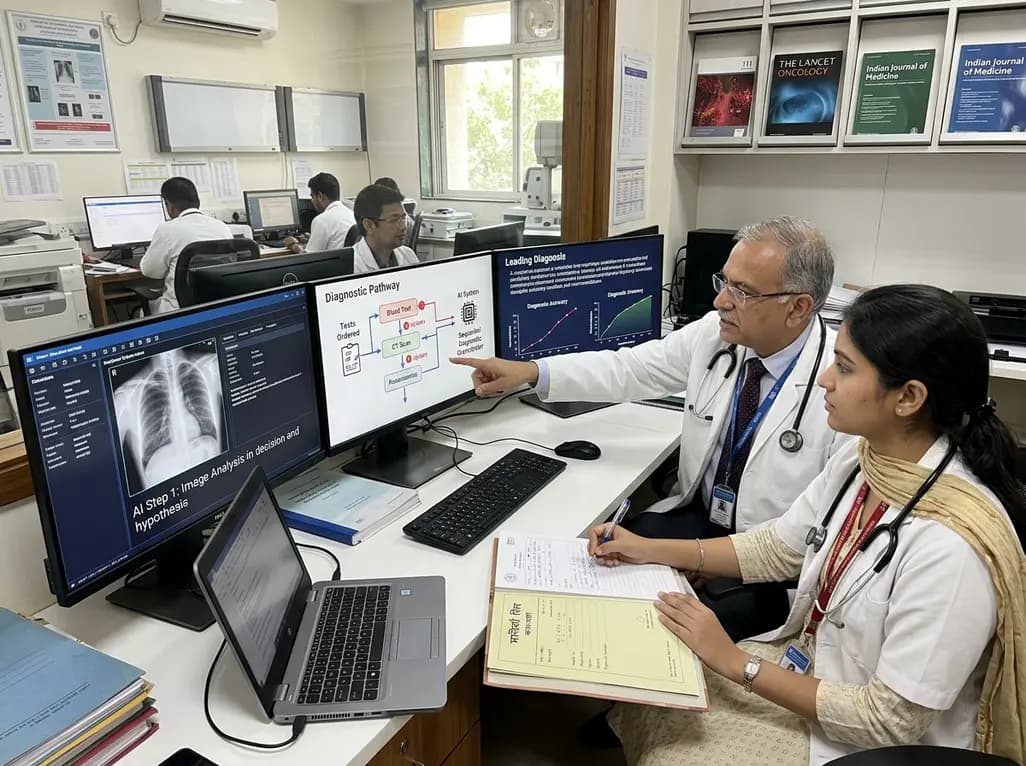
A breakthrough peer-reviewed study demonstrates that a sequential AI diagnosis system can mirror real-world clinical reasoning. By ordering stepwise tests and updating hypotheses dynamically, this multi-agent orchestrator achieved superior diagnostic accuracy while reducing investigative costs.
Today

A prenatal case highlights severe glutaric acidemia type II presenting as bilateral hyperechoic cystic kidneys at 18 weeks. Whole-exome sequencing revealed a novel homozygous ETFDH frameshift variant, demonstrating the power of rapid genetic testing in fetal renal anomalies.
Today

Review how tailored exercise programs benefit frail older patients with heart failure. Explore pathophysiological mechanisms, individualized training prescriptions, and strategies to overcome adherence barriers in clinical practice.
Yesterday

This comparative study evaluates posterior labral tears with and without glenohumeral instability, highlighting distinct demographic patterns, MRI underestimation in stable shoulders, and successful arthroscopic repair outcomes.
Yesterday

A clinical study demonstrates that early intervention with tocilizumab, either as monotherapy or bridged with corticosteroids, achieves significant proptosis reduction and resolves active inflammation in treatment-naive thyroid eye disease.
Yesterday
