.webp&w=384&q=75)

Loading, please wait...
Loading, please wait...
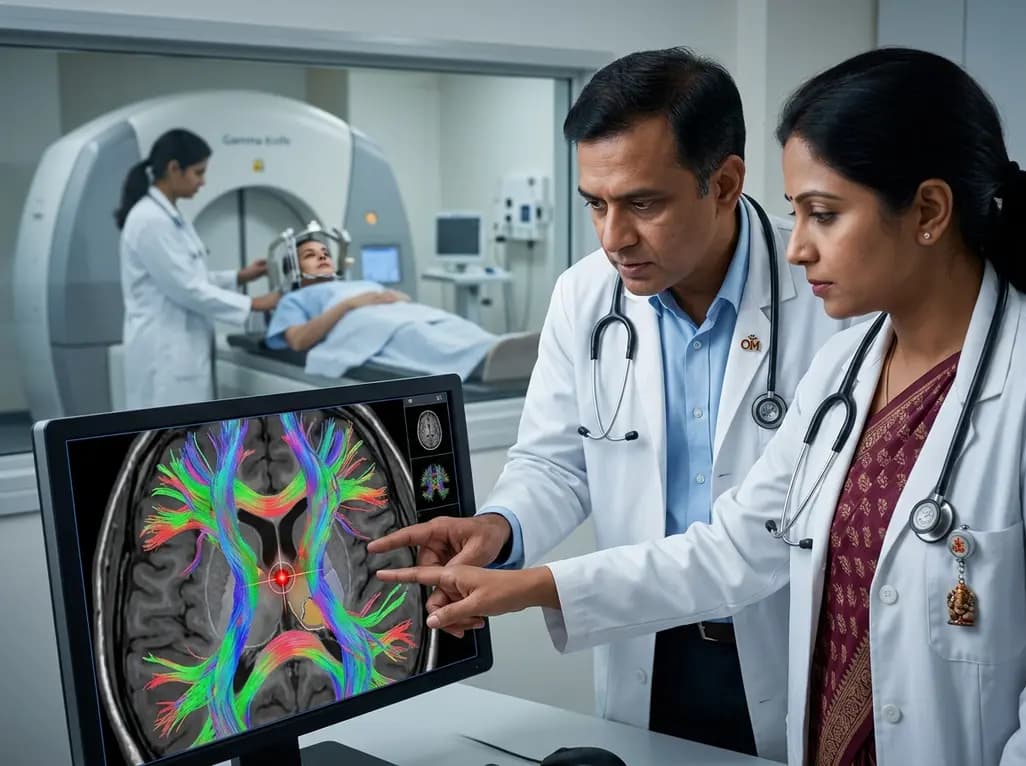
Functional neurosurgery has entered a transformative era driven by advanced neuroimaging techniques. Historically, stereotactic interventions relied heavily on indirect landmark coordinates to locate subcortical nuclei. However, anatomical variability frequently creates discrepancies between atlas coordinates and real brain structure. Consequently, clinicians treating essential tremor have sought direct visualization methods to improve surgical precision. Essential tremor causes significant disability in daily functional activities. When oral pharmacotherapy fails to provide adequate symptom relief, surgical options become necessary. Stereotactic radiosurgery offers a non-invasive alternative for patients unable to undergo open surgery or deep brain stimulation. Specifically, Gamma knife thalamotomy tremor protocols target the ventralis intermedius nucleus of the thalamus to disrupt abnormal tremor circuits. Recent advances incorporate high angular resolution diffusion imaging tractography to refine this target. By mapping crucial white matter tracts, functional neurosurgeons customize radiosurgical targets for individual patients. Therefore, integrating advanced tractography marks a major milestone, optimizing therapeutic tremor control while minimizing collateral radiation exposure to adjacent brain structures.
Accurate localization of the ventralis intermedius nucleus is challenging because subcortical gray matter boundaries are poorly defined on standard magnetic resonance sequences. To overcome this limitation, functional neurosurgeons utilize high angular resolution diffusion imaging tractography. This advanced technique allows detailed reconstruction of key white matter tracts surrounding the thalamus. Specifically, three critical pathways require precise mapping: the dento-rubro-thalamo-cortical tract, the cortico-spinal tract, and the medial lemniscus. Reconstructing the dento-rubro-thalamo-cortical tract is essential because this pathway carries tremor signals from the cerebellum to the motor cortex. Directing radiosurgical energy onto this pathway yields optimal tremor suppression. Simultaneously, neurosurgeons identify the cortico-spinal tract to prevent motor weakness. Additionally, mapping the medial lemniscus helps avoid sensory complications like paresthesias. By combining coordinates-based stereotaxy with individualized tractography, neurosurgeons construct a refined target known as the adjusted ventralis intermedius target. In observational studies, the Euclidean distance between indirect atlas targets and adjusted tractography targets measured approximately one millimeter, frequently shifting slightly cranial. This precise realignment helps clinicians tailor treatment plans effectively.
Delivering therapeutic radiation doses while protecting adjacent tissue represents a fundamental goal in functional radiosurgery. In modern stereotactic thalamotomy, dosimetric planning requires strict adherence to volume and dose constraints. Recent clinical data highlight specific parameters achieved with tractography guidance. For instance, the maximum radiation dose delivered to the dento-rubro-thalamo-cortical tract reached a median of 116 Gy. Additionally, the volume of this motor tract receiving twenty Gy or more was restricted to a median of 154 cubic millimeters. Meanwhile, the maximum dose delivered directly to the target nucleus reached a median of 126 Gy. The core therapeutic volume covered by the one hundred Gy isodose line measured a median of 25 cubic millimeters, corresponding to approximately 14.5 percent of total target volume. Consequently, radiosurgical energy is highly focused within the precise pathophysiological node. Minimizing radiation spread to the cortico-spinal tract and medial lemniscus dramatically reduces adverse events. Furthermore, precise dosimetry ensures consistent focal tissue necrosis necessary for therapeutic tremor reduction, demonstrating that advanced tractography allows clinicians to deliver high-dose radiation safely and effectively.
Essential tremor causes severe functional disability, impairing fundamental daily activities such as eating, writing, and drinking. For patients with medically refractory essential tremor, Gamma Knife thalamotomy offers a non-incision surgical alternative. This intervention is particularly advantageous for elderly individuals or patients with significant medical comorbidities facing high surgical risks from invasive procedures. Additionally, patients with contraindications to general anesthesia benefit immensely from non-invasive radiosurgery. Clinical evaluations demonstrate significant post-treatment reductions in postural and kinetic tremor severity. Furthermore, functional improvements in handwriting, drawing, and daily task performance significantly enhance patient quality of life. Because Gamma Knife radiosurgery generates therapeutic lesions gradually, clinical improvement typically manifests over several weeks to months. Consequently, patient counseling regarding expected timelines is vital prior to intervention. Careful patient selection combined with tractography-guided targeting maximizes clinical response rates while maintaining an excellent safety profile. Long-term observational studies confirm that radiosurgical thalamotomy provides durable tremor relief over extended follow-up periods, offering multidisciplinary care teams superior functional outcomes for challenging movement disorder cases.
Safety remains the primary consideration during radiosurgical interventions deep within thalamic regions. Historical radiosurgical techniques occasionally resulted in adverse radiation effects, including persistent motor weakness, ataxia, or sensory dysesthesias stemming from radiation beam overlap. However, modern high angular resolution diffusion imaging tractography drastically reduces these neurological risks. By accurately visualizing the cortico-spinal tract and medial lemniscus prior to treatment planning, neurosurgeons establish safe radiation fall-off gradients. Therefore, high radiation doses remain strictly confined within the target dento-rubro-thalamo-cortical pathway. Consequently, post-treatment edema and surrounding tissue reaction are significantly mitigated. Moreover, detailed dosimetric constraints allow clinicians to predict and prevent delayed radiation-induced complications. Regular neuroimaging follow-up after Gamma Knife thalamotomy confirms localized, well-circumscribed therapeutic focal lesions without unexpected expansion. In addition, routine neurological assessments verify sustained tremor suppression without emerging motor deficits. As a result, tractography-guided thalamotomy maintains a remarkably low complication rate, establishing advanced radiosurgery as a highly reliable therapeutic modality for refractory movement disorders.
The transition into the third era of functional neurosurgery highlights the crucial role of advanced imaging integration. Combining high-field magnetic resonance imaging, high angular resolution diffusion tractography, and automated stereotactic planning software transforms clinical workflows. Furthermore, artificial intelligence algorithms are rapidly emerging to assist neurosurgeons in automated tract segmentation. These technological innovations will further streamline target identification and refine dosimetric planning accuracy. In addition, ongoing research explores multi-center validation of tractography-guided radiosurgical algorithms across diverse clinical populations. As neuroimaging resolution continues to advance, direct visualization of microstructural thalamic architecture will become standard clinical practice. Consequently, future functional neurosurgery protocols will rely less on static anatomical atlases and more on personalized patient connectivity networks. Ultimately, these continuous advancements in image-guided radiosurgery promise to expand treatment access for patients with severe movement disorders worldwide. By combining non-invasive stereotactic radiosurgery with patient-specific white matter tractography, clinicians achieve unprecedented precision, efficacy, and safety, offering new hope to patients affected by debilitating tremor syndromes.
Gamma Knife thalamotomy is a non-invasive stereotactic radiosurgery procedure used to treat medically refractory essential tremor. It delivers precisely focused radiation beams to the ventralis intermedius nucleus of the thalamus. This targeted radiation interrupts abnormal neural signals causing tremor, restoring functional hand control and improving overall quality of life without open brain surgery.
High angular resolution diffusion imaging tractography directly visualizes crucial white matter tracts around the thalamus, including the dento-rubro-thalamo-cortical tract. Instead of relying solely on generic atlas coordinates, tractography allows neurosurgeons to customize the target to individual brain anatomy. This precise localization improves tremor control while protecting nearby motor and sensory pathways.
Tractography guidance precisely identifies adjacent critical structures like the cortico-spinal tract and medial lemniscus. By defining these anatomical boundaries, neurosurgeons prevent high radiation exposure to motor and sensory pathways. Consequently, this approach significantly reduces the risk of neurological complications, such as motor weakness, numbness, or gait ataxia after radiosurgery.
Disclaimer: This content is for informational and educational purposes only. It does not constitute medical advice, diagnosis, or treatment. Refer to the latest local and national guidelines for clinical practice.
References
1. Barzaghi LR et al. Gamma knife thalamotomy for essential tremor in the third era of functional neurosurgery. Neurosurg Rev. 2026 Jul 20. doi: 10.1007/s10143-026-04401-y. PMID: 42473004.
2. Niranjan A et al. Gamma knife thalamotomy provides durable long-term relief from essential tremor: a 30-year single institution experience. Neurol Sci. 2026 Jun 3. doi: 10.1007/s10072-026-09156-4. PMID: 42230990.
3. Jameel A et al. The evolution of ventral intermediate nucleus targeting in MRI-guided focused ultrasound thalamotomy for essential tremor: an international multi-center evaluation. Front Neurol. 2026 May 27;15:1345873.

Read summarized clinical updates, watch expert medical content, and earn CME certifications right from your smartphone.
Open your smartphone camera to scan and install.





A study evaluates high angular resolution diffusion imaging (HARDI) tractography to optimize Ventralis Intermedius (Vim) targeting in Gamma Knife stereotactic thalamotomy for essential tremor, enhancing targeting accuracy and safety.
2 months ago

Review how tailored exercise programs benefit frail older patients with heart failure. Explore pathophysiological mechanisms, individualized training prescriptions, and strategies to overcome adherence barriers in clinical practice.
Today

Leucine Rich Bio has introduced South Asia's first comprehensive vaginal microbiome test, BugSpeaks. By profiling microbial dysbiosis, pathogens, and antimicrobial resistance, this next-generation diagnostic platform provides clinicians with deeper insights into recurrent infections, fertility, and reproductive health.
Today

In high-risk pulmonary embolism complicated by severe anemia and active uterine bleeding, systemic thrombolysis is contraindicated. Large-bore aspiration thrombectomy provides rapid hemodynamic rescue without fibrinolysis, supported by inferior vena cava filter placement and multidisciplinary critical care.
Today

This comparative study evaluates posterior labral tears with and without glenohumeral instability, highlighting distinct demographic patterns, MRI underestimation in stable shoulders, and successful arthroscopic repair outcomes.
Today

A clinical study demonstrates that early intervention with tocilizumab, either as monotherapy or bridged with corticosteroids, achieves significant proptosis reduction and resolves active inflammation in treatment-naive thyroid eye disease.
Today
