.webp&w=384&q=75)

Loading, please wait...
Loading, please wait...

Managing acute ischemic stroke from underlying intracranial atherosclerotic disease presents substantial therapeutic dilemmas. Conventional thrombectomy frequently fails in these patients because repeated passes damage delicate endothelium and trigger acute re-occlusion. Consequently, neurointerventionalists increasingly explore alternative endovascular solutions. The innovative FRESH stenting technique offers a promising paradigm shift. By deploying a permanent stent without mechanical retrieval, operators rapidly re-establish microvascular perfusion. A newly published clinical investigation provides compelling mid-term evidence supporting this novel interventional approach.
Underlying intracranial atherosclerotic disease accounts for a large fraction of ischemic strokes, especially among Asian populations. In these complex cases, acute occlusion stems from in-situ plaque rupture and superimposed thrombus formation. Standard stent retrievers frequently disrupt the inflamed atheroma during withdrawal. Consequently, platelet activation triggers immediate re-thrombosis and vessel collapse. Repeated retriever passes aggravate mechanical endothelial trauma, leading to catastrophic subarachnoid or parenchymal hemorrhage.
In contrast, the FRESH technique intentionally leaves the self-expanding stent in place across the stenosis. Therefore, the device acts as an immediate mechanical scaffold that compresses the culprit plaque. The expanded stent stabilizes local laminar flow without shearing fragile endothelial surfaces. Furthermore, operators deliver concurrent antiplatelet therapy to arrest acute thrombogenesis. This deliberate deployment transforms an unstable emergent occlusion into a stable, reconstructed vessel channel. Thus, the technique drastically reduces puncture-to-recanalization intervals and avoids repeated mechanical trauma. Early clinical registries demonstrated the procedural feasibility of this strategy. However, neurointerventional teams required robust mid-term data to verify whether these acutely deployed stents maintained luminal patency over extended follow-up.
The recent study rigorously assessed serial digital subtraction angiography to evaluate luminal evolution over twelve months. Remarkably, all fifty enrolled patients achieved immediate successful reperfusion (mTICI 2b or 3). The median stented vessel diameter measured 0.7 mm immediately post-procedure. However, serial vascular imaging demonstrated progressive and statistically significant luminal expansion over time. By one week, the median luminal diameter doubled to 1.5 mm.
Additionally, this expansive remodeling continued through three months, reaching a peak median caliber of 1.61 mm. At the one-year landmark, the reconstructed vessel maintained a stable median diameter of 1.53 mm. Accordingly, residual stenosis dropped substantially from 73.1% immediately following stent release to 43.0% at one week. The stenosis narrowed further to 38.8% at three months before stabilizing at 45.9% at one year. Consequently, these angiographic findings confirm that radial outward forces from self-expanding stents safely remodel chronic atheroma. The initial vessel recoil gradually gives way to sustained luminal restoration. Therefore, neurointerventionalists can expect progressive biological adaptation rather than acute constrictive cicatrization within the treated vascular territory.
Technical success must translate directly into meaningful functional independence for stroke patients. In this cohort, clinical recovery aligned remarkably well with the robust angiographic recanalization. Specifically, eighty-eight percent of patients achieved favorable functional outcomes at three months, defined as a modified Rankin Scale score between zero and two. Furthermore, patients maintained this outstanding eighty-eight percent functional independence rate at twelve months of follow-up.
Moreover, the clinical trajectory showed minimal neurological deterioration throughout the extended observation window. Only two patients experienced stroke recurrence during follow-up, representing an impressively low rate of four percent. Consequently, permanent stenting effectively shielded the downstream cerebral penumbra against catastrophic hypoperfusion and secondary embolic showers. In comparison, historical mechanical thrombectomy cohorts without rescue stenting typically report significantly lower functional recovery rates. Those conventional cohorts also demonstrate much higher recurrent ischemic events due to residual stenotic flow disturbance. Thus, stabilizing the underlying diseased segment early in the intervention protects vulnerable brain tissue during critical recovery windows.
Safety considerations represent a vital priority whenever interventionalists place permanent intracranial metal in the acute stroke setting. Emergent stent deployment necessitates immediate antiplatelet therapy, which traditionally elevates intracranial bleeding hazards. Notably, this clinical study reported zero cases of symptomatic intracranial hemorrhage across the entire patient cohort. Careful peri-procedural management and precise pharmacological titration clearly mitigated hemorrhagic transformation risks.
However, endovascular teams must remain vigilant regarding delayed stent thrombosis and neointimal proliferation. In this study, four patients developed delayed re-occlusion during serial angiographic surveillance. Among these individuals, two required elective repeat stenting to secure adequate intracranial cerebral flow. Fortunately, none of the four re-occlusion patients suffered adverse functional outcomes or permanent clinical decline. Excellent collateral circulation and preserved penumbral territories likely shielded these patients from recurrent tissue infarction. Therefore, disciplined angiographic surveillance remains mandatory after acute intracranial stenting. Early detection of asymptomatic restenosis enables timely intervention before devastating neurological deficits occur.
These robust mid-term results provide actionable insights for interventionalists managing refractory large vessel occlusions. When fluoroscopy reveals underlying atheromatous narrowing or persistent re-occlusion after initial microcatheter passage, repeating aggressive thrombectomy passes proves counterproductive. Instead, adopting the FRESH approach offers an elegant, definitive solution. Clinicians can immediately arrest the cascade of acute vessel failure while restoring critical downstream cerebral perfusion.
Nevertheless, successful implementation demands comprehensive multidisciplinary coordination between interventional radiologists, neurologists, and intensive care physicians. Operators must select appropriately sized self-expanding neurovascular stents to avoid vessel rupture. Additionally, teams must formulate a structured post-procedure antiplatelet regimen, often utilizing intravenous glycoprotein IIb/IIIa inhibitors transitioned to dual oral agents. Clinicians must balance antiplatelet efficacy against hemorrhagic risks, especially when parenchymal ischemic cores are prominent. Furthermore, scheduled non-invasive vascular imaging or surveillance angiography ensures early identification of neointimal hyperplasia. Ultimately, this mid-term evidence solidifies primary stenting without retrieval as a viable, durable frontline strategy for carefully selected atherothrombotic strokes.
The FRESH technique deploys a permanent self-expanding stent directly across the stenotic plaque without mechanically retrieving the device. In contrast, standard thrombectomy repeatedly pulls captured thrombus through the vessel. This technique avoids severe endothelial disruption, minimizes vascular trauma, and immediately secures stable luminal flow in atherosclerotic occlusions.
Serial digital subtraction angiography shows marked, progressive luminal remodeling over twelve months. The median vessel diameter expands from 0.7 mm acutely to 1.53 mm at one year. Concurrently, residual stenosis decreases from 73% to approximately 46%, proving that radial stent forces foster durable biological adaptation without late luminal collapse.
Intracranial stent implantation requires immediate, aggressive antiplatelet therapy to prevent acute thrombosis. Clinicians typically initiate acute intravenous glycoprotein IIb/IIIa inhibitors or tirofiban, subsequently transitioning patients to dual oral antiplatelet therapy. Close neurological monitoring ensures therapeutic efficacy while minimizing hemorrhagic transformation risks across the salvageable cerebral territory.
Disclaimer: This content is for informational and educational purposes only. Refer to the latest local and national guidelines for clinical practice.
References

Read summarized clinical updates, watch expert medical content, and earn CME certifications right from your smartphone.
Open your smartphone camera to scan and install.





A retrospective study evaluating the FRESH stenting technique for ICAD-related acute large vessel occlusion demonstrated 100% recanalization, 88% favorable functional outcomes at 12 months, and sustained vessel remodeling without symptomatic intracranial hemorrhage.
Today

A North Texas pilot study reveals that combining virtual physician consultations with in-person house calls safely manages adult pneumonia. By utilizing CRB-65 severity scores, clinicians effectively triaged patients, providing home-based recovery while directing higher-risk individuals to emergency care.
Today

A quasi-experimental study demonstrates that culturally tailored educational interventions significantly boost HPV knowledge and vaccination intentions. These findings provide actionable strategies for healthcare providers in India to overcome vaccine hesitancy and advance cervical cancer prevention.
Today

A comprehensive meta-analysis evaluates the association between Body Mass Index and outcomes following abdominal aortic aneurysm repair. Discover how overweight and obesity correlate with lower mortality while underweight status confers heightened risk, challenging conventional preoperative risk stratification.
Today

The SOLARIO trial shows that a short course (≤7 days) of systemic antibiotic therapy is noninferior to long courses (≥4 weeks) in orthopedic infections treated with local antibiotic carriers, with significantly fewer adverse events.
Today
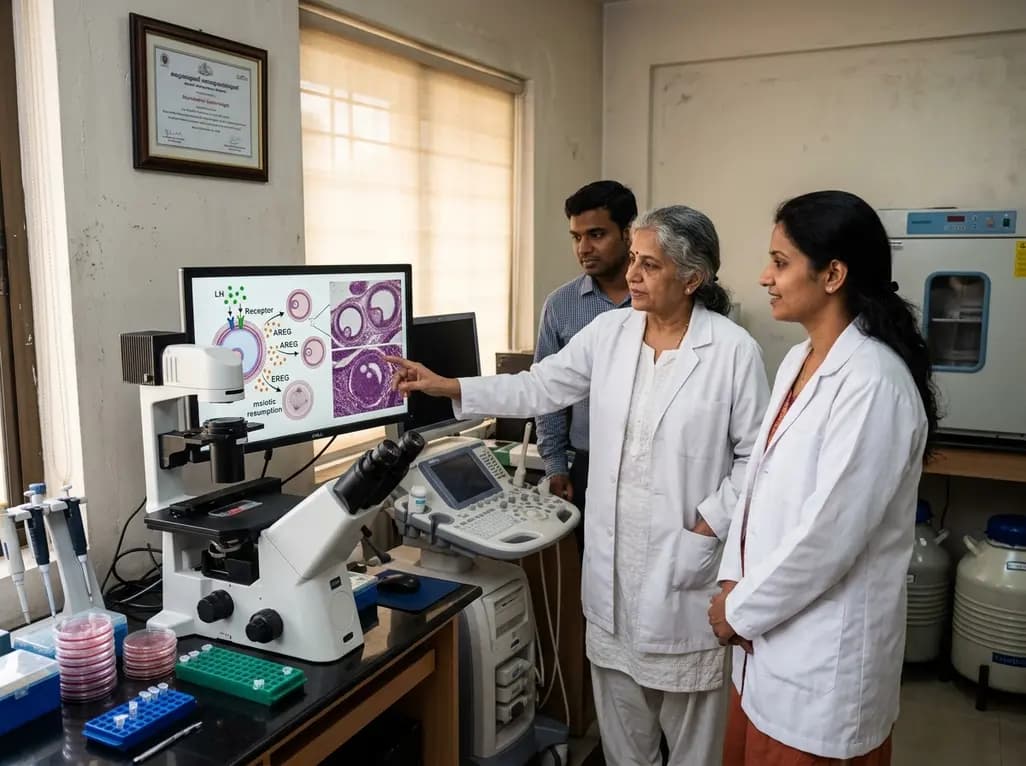
New research reveals that preovulatory follicles communicate via LH-induced paracrine signaling. Diffusible EGF ligands epiregulin and amphiregulin coordinate oocyte meiotic resumption across neighboring follicles, challenging traditional concepts of follicular autonomy.
Today
