.webp&w=384&q=75)

Loading, please wait...
Loading, please wait...

The Delhi High Court recently issued a critical directive to Fortis Healthcare Ltd (FHL) regarding its accountability for disappearing shares. Specifically, the court questioned FHL over the dissipation of shares previously held by its former promoters, Malvinder and Shivinder Singh. This long-standing legal battle, widely known as the Fortis liability case, continues to draw significant attention from healthcare professionals and corporate administrators across India.
The core dispute centers on 38.3 million shares of FHL. Originally, these shares formed the foundation of a massive international arbitration award. Japanese pharmaceutical giant Daiichi Sankyo has been pursuing this award for over a decade. Consequently, the legal claim has now swelled to a staggering Rs 5,200 crore. In the recent hearings, the court made it clear that Fortis Healthcare cannot shift its ownership responsibilities onto third parties. Justice Subramonium Prasad noted that FHL should have intervened to stop the sale of these shares when they were first liquidated.
Historically, the Singh brothers allegedly divested these shares in a series of transactions while the arbitration was active. Therefore, the court has taken a strict stance on asset preservation. Justice Prasad remarked that because these were FHL's shares, FHL remains ultimately responsible. This case has practically evolved into a complex three-way legal contest involving the Singh brothers, 16 banking institutions, and FHL. Furthermore, Daiichi Sankyo is pushing for a forensic audit to examine how these assets dwindled so significantly. In response, FHL's legal team intends to file a perjury application against Daiichi Sankyo, which will likely intensify the ongoing litigation.
Indeed, the judiciary is treating this case with immense gravity. The Delhi High Court has conducted 48 back-to-back hearings since December 2025. Legal experts suggest that this rapid schedule highlights the judiciary's commitment to enforcing international arbitral awards. Additionally, the outcome of this case could establish critical precedents for corporate governance and regulatory compliance within the Indian healthcare industry.
Q1: Why is the Delhi High Court holding Fortis Healthcare Ltd responsible?
The court stated that Fortis Healthcare Ltd should have prevented the sale of its promoter shares. Because FHL allowed these shares to slip away, it cannot now deflect the liability onto any third party.
Q2: What is the total value of the arbitral award involved in this dispute?
The original arbitration award obtained by Daiichi Sankyo against the Singh brothers has now grown to approximately Rs 5,200 crore over the last decade.
Q3: What legal actions are the parties taking next?
Daiichi Sankyo is seeking a forensic audit of Fortis Healthcare Ltd and the involved banks. Meanwhile, Fortis Healthcare's legal counsel plans to file a perjury application against Daiichi Sankyo.
Disclaimer: This content is for informational and educational purposes only. It does not constitute medical advice or replace professional judgment. Refer to the latest local and national guidelines for clinical practice.
References

Read summarized clinical updates, watch expert medical content, and earn CME certifications right from your smartphone.
Open your smartphone camera to scan and install.





Delhi HC rules Fortis Healthcare liable for dissipated promoter shares, impacting Daiichi Sankyo's Rs 5,200 cr arbitration award enforcement....
4 months ago
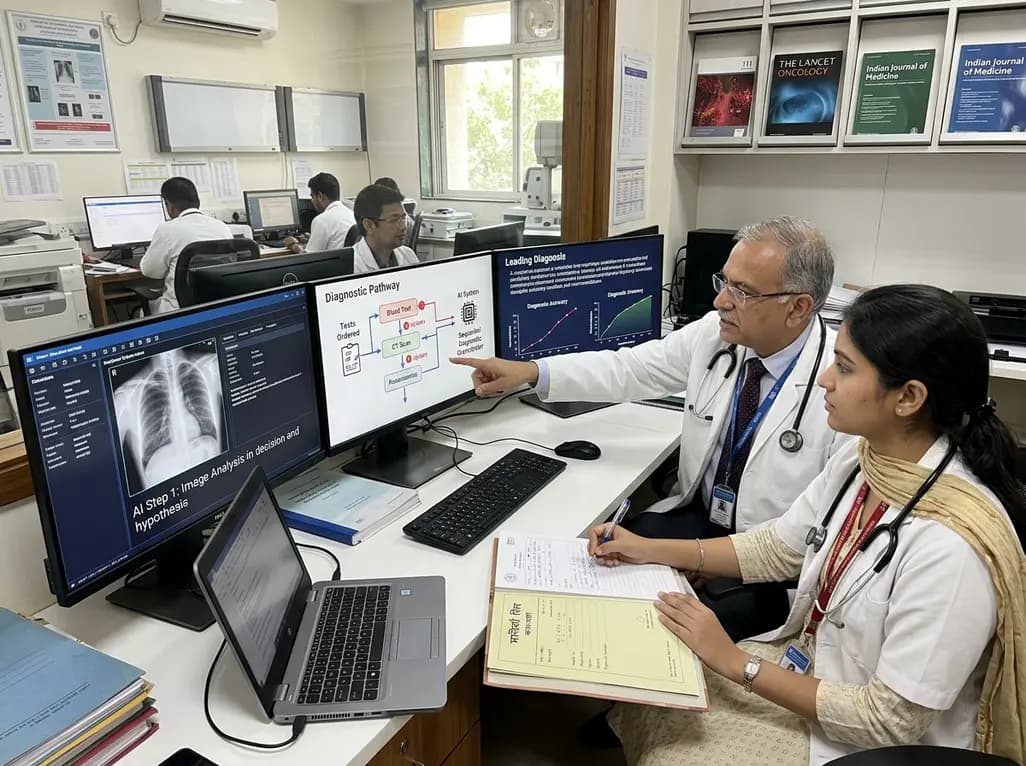
A breakthrough peer-reviewed study demonstrates that a sequential AI diagnosis system can mirror real-world clinical reasoning. By ordering stepwise tests and updating hypotheses dynamically, this multi-agent orchestrator achieved superior diagnostic accuracy while reducing investigative costs.
Today

A prenatal case highlights severe glutaric acidemia type II presenting as bilateral hyperechoic cystic kidneys at 18 weeks. Whole-exome sequencing revealed a novel homozygous ETFDH frameshift variant, demonstrating the power of rapid genetic testing in fetal renal anomalies.
Today

Review how tailored exercise programs benefit frail older patients with heart failure. Explore pathophysiological mechanisms, individualized training prescriptions, and strategies to overcome adherence barriers in clinical practice.
Yesterday

This comparative study evaluates posterior labral tears with and without glenohumeral instability, highlighting distinct demographic patterns, MRI underestimation in stable shoulders, and successful arthroscopic repair outcomes.
Yesterday

A clinical study demonstrates that early intervention with tocilizumab, either as monotherapy or bridged with corticosteroids, achieves significant proptosis reduction and resolves active inflammation in treatment-naive thyroid eye disease.
Yesterday
