.webp&w=384&q=75)

Loading, please wait...
Loading, please wait...
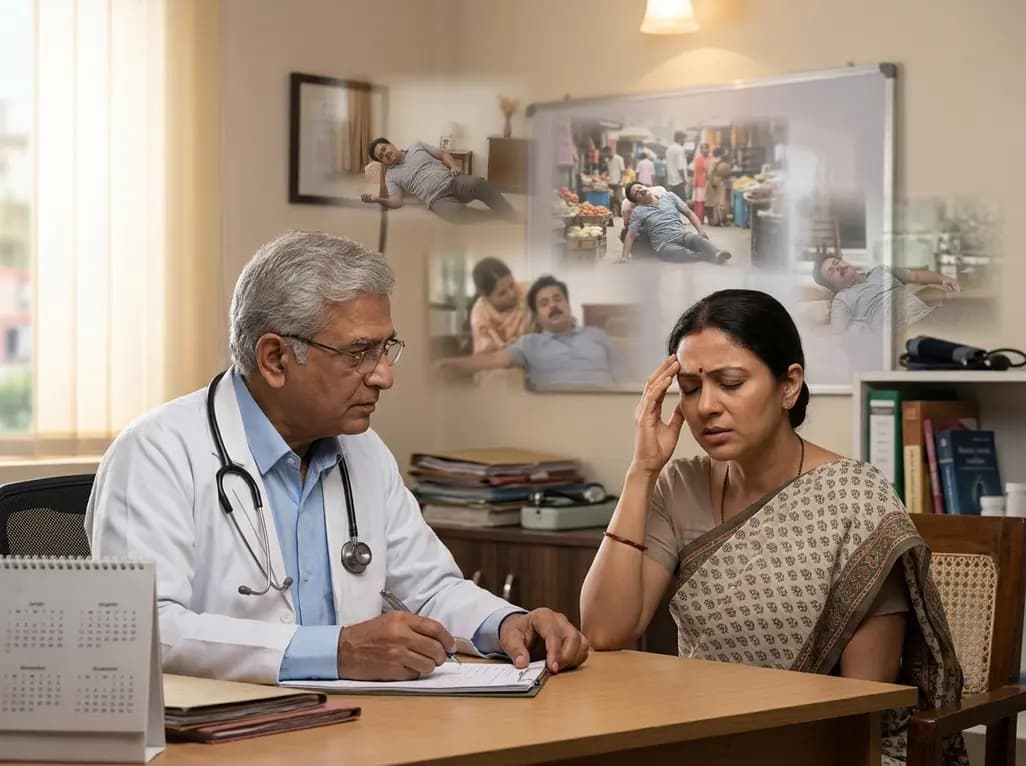
When assessing patients with transient loss of consciousness (TLOC), clinicians frequently depend on eyewitness seizure recall accuracy to differentiate between epilepsy and functional/dissociative seizures (FDS). In India, where access to high-end video-EEG monitoring might be limited in rural or primary care settings, the verbal account of a family member often serves as the primary diagnostic tool. However, FDS remains a frequently misdiagnosed condition. Because FDS episodes can mimic epileptic seizures, the semiological details provided by witnesses are vital for making an accurate referral. Unfortunately, memory is not a perfect recording. It is a reconstructive process that can be influenced by time, stress, and external suggestions. Consequently, relying solely on these accounts without understanding their limitations can lead to diagnostic errors and inappropriate management strategies. This is particularly relevant given that the delay between the event and the specialist assessment can often span several weeks. Understanding the trajectory of memory decay for these events is therefore crucial for every frontline physician and neurologist. By recognizing that witness recall is fallible, practitioners can better weigh the evidence presented during a clinical history.
A landmark experimental study recently conducted in the United Kingdom evaluated how well adults could recall the features of an FDS episode over time. The researchers found that immediately after viewing a seizure video, participants answered only 67% of semiology questions correctly. This initial level of accuracy is notably modest, even when the memory is fresh. Furthermore, the study demonstrated a significant decline in eyewitness seizure recall accuracy as time progressed. After a delay of two weeks, the accuracy dropped to 58.8%. By seven weeks—a timeframe that mirrors typical waiting list durations for specialist clinics—the accuracy fell even further. Specifically, there was an additional 5.4% decline compared to the two-week mark. These findings suggest that the longer the gap between a seizure and its medical evaluation, the less reliable the eyewitness account becomes. Moreover, the decay was not uniform across all features. Important diagnostic markers like asynchronous limb movements and ictal eye closure were particularly prone to being forgotten or misremembered. Consequently, clinicians must account for this 'forgetting curve' when evaluating historical data provided during follow-up appointments.
One might assume that a witness who feels highly confident in their description of an event is more likely to be accurate. However, this study revealed that confidence is a weak predictor of actual accuracy. Specifically, participants often felt certain about their observations even when they were incorrect about key semiological details. This phenomenon creates a significant challenge in routine clinical practice. When a witness provides a vivid and confident account, a doctor may be more inclined to trust that description without reservation. Nevertheless, the data indicates that subjective certainty does not equate to objective truth. Therefore, clinicians should remain cautious and maintain a high degree of skepticism, regardless of how convincing a witness appears. Additionally, this mismatch between confidence and reality highlights the necessity of using objective tools whenever possible. In the Indian context, where family members often take a leading role in the patient's care, the social pressure to provide a 'clear' account may further distort the witness's recall. Thus, the medical educator must emphasize that a confident witness is not necessarily a reliable one.
Diagnosis of FDS often relies on specific 'pathognomonic' signs that distinguish it from epilepsy. These features include long seizure duration, head movements, and ictal eye closure. Notably, the study found that these very features are highly susceptible to memory decay over time. As the interval between the event and the clinical interview grows, witnesses are less likely to accurately report these subtle but vital semiological markers. This decay is particularly problematic because these signs are often the only clues that point toward an FDS diagnosis in the absence of video evidence. Moreover, when these details are lost, the witness's narrative may default to a generic 'seizure' archetype, which often leads to a false diagnosis of epilepsy. Consequently, patients may be started on unnecessary anti-seizure medications that offer no benefit and cause potential harm. Therefore, it is imperative for clinicians to solicit descriptions as early as possible. Furthermore, recognizing that these critical signs fade quickly should encourage the medical community to prioritize faster referral pathways for first-time seizure presentations to minimize the diagnostic gap caused by memory loss.
The UK study also explored whether early intervention could mitigate memory loss. Researchers tested whether providing witnesses with structured, systematic questioning immediately after the event would improve their recall at two or seven weeks. Interestingly, the results showed that immediate systematic questioning did not significantly improve follow-up recall compared to simple free recall. Specifically, those who were asked detailed questions right away did not perform better later than those who simply described the event in their own words. This finding is somewhat counterintuitive, as one might expect that a structured interview would 'lock in' the details. However, it appears that the natural process of memory decay is robust and difficult to bypass through questioning techniques alone. This suggests that the current clinical reliance on 'better history-taking' may have its limits. While thorough questioning remains essential, it cannot fully compensate for the biological decline of memory over time. Thus, rather than solely focusing on improving witness interviews, healthcare systems should perhaps invest more in capturing objective evidence, such as encouraging bystanders to use smartphone technology to record events as they occur.
Given the limitations of human memory highlighted by this research, the medical community must adapt its diagnostic strategies. Since eyewitness seizure recall accuracy is inherently modest and declines predictably, objective documentation becomes the new gold standard. In the modern era, smartphone video recording offers a powerful solution to the pitfalls of witness testimony. Clinicians should proactively educate the public and patients' families on the importance of filming episodes when they are safe to do so. A short video clip can often provide more diagnostic clarity than a lengthy but delayed verbal interview. Additionally, reducing the waiting time for specialist assessments is a systemic necessity. If the 'forgetting curve' is most steep in the first few weeks, then every day of delay directly impacts the quality of the diagnostic information available. Therefore, integrating telemedicine for early review or creating 'rapid-access' seizure clinics could significantly enhance diagnostic accuracy. Ultimately, while witness accounts will always remain part of the clinical picture, they must be interpreted through the lens of memory fallibility. By combining cautious history-taking with objective video data, physicians can ensure a more accurate and timely diagnosis for patients suffering from TLOC.
The delay in specialist referral significantly diminishes the reliability of eyewitness accounts. Research indicates that accuracy for FDS semiology drops from 67% immediately to under 54% within seven weeks. This decline means that key diagnostic features, such as eye closure or asynchronous movements, are often lost by the time a neurologist sees the patient. Consequently, longer wait times directly increase the risk of misdiagnosis and inappropriate treatment for seizure disorders.
Witness confidence is a poor predictor because the psychological certainty of a witness does not correlate with their objective memory of semiological details. People can feel very confident about an incorrect memory, especially during high-stress events like witnessing a seizure. Clinicians who over-rely on a witness's certainty may be led toward a false diagnosis. Therefore, it is essential to treat confident verbal accounts with the same scrutiny as less certain ones.
Surprisingly, structured questioning immediately after an event does not seem to prevent the subsequent decay of memory. The study found that systematic questioning yielded no significant improvement in recall at two or seven weeks compared to free recall. This suggests that the biological process of forgetting is not easily corrected by interview techniques. Instead, capturing objective data through video recordings remains a much more effective strategy for preserving diagnostic accuracy.
Disclaimer: This content is for informational and educational purposes only. It is not intended as a substitute for professional medical advice, diagnosis, or treatment. Always seek the advice of your physician or other qualified health provider with any questions you may have regarding a medical condition. Refer to the latest local and national guidelines for clinical practice.
References
Noble AJ et al. Do witnesses of functional/dissociative seizures recall them accurately? A UK experimental study of semiology recall at clinically relevant time points with a pilot intervention. Epilepsia. 2026 Jul 10. doi: 10.1002/epi.70388. PMID: 42430193.
Moraes J, Cook M, Nurse E. The silent witness: The unseen gaps in eyewitness recognition of seizures. Epilepsia. 2025 Jun 10. doi: 10.1111/epi.18499. PMID: 40492933.
Ristic AJ, Draskovic M, Bukumiric Z, Sokic D. Reliability of the witness descriptions of epileptic seizures and psychogenic non-epileptic attacks: a comparative analysis. Neurol Res. 2015;37(7):560-562. doi: 10.1179/1743132815Y.0000000021.

Read summarized clinical updates, watch expert medical content, and earn CME certifications right from your smartphone.
Open your smartphone camera to scan and install.





Witness testimony is often the 'gold standard' for diagnosing seizures, but how reliable is it? A recent UK study shows that recall accuracy for functional/dissociative seizures is modest and declines significantly over seven weeks, with witness confidence providing little indication of actual truth.
3 months ago

As monsoon seasons elevate arboviral disease threats, Tamil Nadu has initiated an ICMR-monitored evaluation of the tetravalent dengue vaccine in Tenkasi district. Clinicians emphasize clinical monitoring, public prevention, and high-quality early pediatric care to reduce disease morbidity across endemic regions.
Today

A comparative cohort study evaluates vNOTES vs TLH hysterectomy for benign conditions, demonstrating shorter operative duration, faster return to daily activities, and equivalent female sexual function scores without increased dyspareunia.
Today

Review how tailored exercise programs benefit frail older patients with heart failure. Explore pathophysiological mechanisms, individualized training prescriptions, and strategies to overcome adherence barriers in clinical practice.
Today

This comparative study evaluates posterior labral tears with and without glenohumeral instability, highlighting distinct demographic patterns, MRI underestimation in stable shoulders, and successful arthroscopic repair outcomes.
Yesterday

A clinical study demonstrates that early intervention with tocilizumab, either as monotherapy or bridged with corticosteroids, achieves significant proptosis reduction and resolves active inflammation in treatment-naive thyroid eye disease.
Today
