.webp&w=384&q=75)

Loading, please wait...
Loading, please wait...
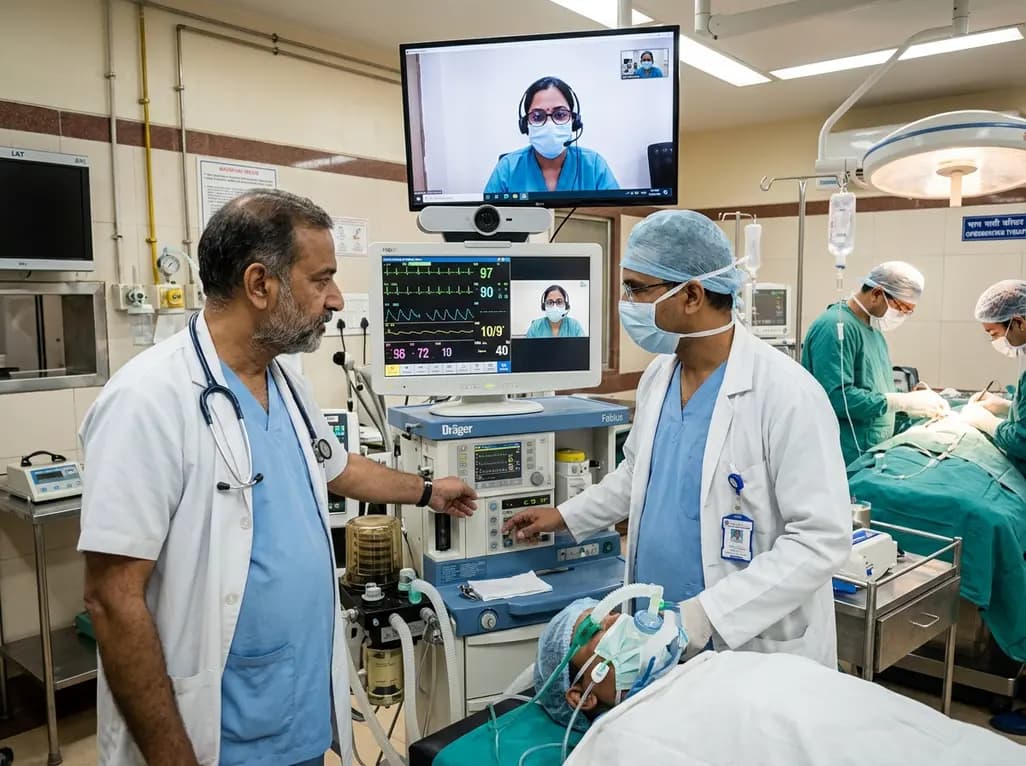
Operating rooms demand immediate decision-making and precise procedural execution during acute crisis events. In contemporary perioperative settings, telemedical supervision has emerged as a promising strategy to provide remote senior oversight when physical presence is constrained. Healthcare systems worldwide face severe shortages of specialist anesthesiologists, especially in community and rural surgical centers. Consequently, junior trainees or non-physician anesthetists frequently manage complex intraoperative emergencies without immediate bedside expert guidance. A recent randomized controlled simulation trial evaluated whether digital tele-supervision could provide equivalent clinical support compared to conventional on-site senior oversight during severe intraoperative crises.
Establishing effective remote support requires robust communication links and comprehensive data integration from disparate surgical equipment. The experimental system in this trial utilized an advanced tele-supervision infrastructure designed around the Institute of Electrical and Electronics Engineers 11073 Service-Oriented Device Connectivity standard. This standard facilitated seamless real-time interoperability between multi-parameter patient monitors, sophisticated anesthesia workstations, and electronic syringe infusion pumps. Therefore, the remote supervisor could observe high-resolution physiological streams, drug delivery parameters, and mechanical ventilator waveforms instantaneously.
In addition, the supervisor utilized a dedicated mobile workstation capable of overseeing multiple operating rooms simultaneously. The senior physician communicated bidirectionally with the resident using encrypted video feeds, live audio channels, and direct text interfaces. By presenting actionable physiological trends alongside live visual monitoring, the platform provided complete situational awareness. This integrated design eliminated the traditional communication bottleneck where on-site clinicians must manually verbalize dynamic vital signs over standard telephone lines. As a result, the remote consultant formulated timely, evidence-based recommendations without experiencing significant informational lag.
Investigators conducted the trial at Uniklinik RWTH Aachen in Germany, recruiting 16 anesthesiology residents in their first two years of postgraduate training. Researchers randomly allocated participants into two equal cohorts using block randomization. The intervention cohort managed an acute operating room crisis with guidance delivered exclusively through the telemedical system. Conversely, the control group relied on conventional telephone consultation, which subsequently transitioned into direct, on-site senior physician assistance when requested.
The simulated high-fidelity case centered on a 51-year-old male patient undergoing an emergency appendectomy. Exactly three minutes following intravenous cefuroxime administration, the patient developed severe grade III anaphylactic shock characterized by profound hypotension, bronchospasm, and cutaneous flushing. This sudden life-threatening scenario demanded rapid diagnostic confirmation, fluid resuscitation, epinephrine titration, and ventilator optimization according to established standard operating procedures. Researchers systematically evaluated protocol adherence, frequency of supervisor interactions, subjective task load, and clinician satisfaction across both cohorts.
The primary endpoint evaluated whether remote consultants could maintain the high standards of patient safety achieved by bedside consultants. Remarkably, participants in the tele-supervision cohort achieved a 91.6% mean completion rate of critical standard operating procedure measures. Meanwhile, residents in the conventional on-site supervision cohort achieved a 92.5% completion rate. Statistical analysis confirmed that this minor numerical difference was not statistically significant, demonstrating comparable clinical efficacy between the two operational modalities.
Furthermore, all resident anesthesiologists across both groups actively initiated contact with their designated senior physician during the crisis. On-site supervisors directly supported a mean of 6.44 procedural steps, whereas remote supervisors guided a mean of 5.00 procedural steps. Despite the lack of physical hands-on intervention, remote consultants successfully guided junior colleagues through rapid drug dilutions, secondary line placements, and advanced hemodynamic stabilization. These findings demonstrate that high-resolution data streams allow senior experts to deliver precise cognitive guidance that preserves protocol compliance during high-stakes operating room emergencies.
To quantify human factors and cognitive strain, investigators administered the validated NASA Task Load Index immediately after each simulated scenario. Interestingly, the two supervision models generated distinct cognitive profiles among the participating junior anesthesiologists. Trainees who used the tele-supervision workstation reported lower mental demand than those supported by conventional on-site methods. The uninterrupted, real-time data visibility likely relieved residents from the cognitive burden of repeatedly explaining monitor vitals and ventilator values to senior colleagues.
In contrast, residents in the tele-supervision group reported significantly higher temporal demand during the initial resuscitation phase. Navigating a novel telemedical user interface while managing an unstable patient introduced brief ergonomic friction. Post-scenario qualitative surveys revealed mixed subjective preferences regarding physical versus virtual support. Nevertheless, most participants confirmed that telemedical supervision represents an effective, reliable alternative when bedside senior consultants are unavailable. Improving user interface ergonomics and incorporating tele-supervision modules into residency training could rapidly mitigate these initial temporal demands.
The results of this study carry profound implications for perioperative care delivery across geographically diverse and resource-constrained regions. In countries with vast healthcare disparities, such as India, tertiary medical institutions concentrate specialist anesthesiologists in urban hubs, leaving secondary district hospitals understaffed. Standardized tele-supervision platforms allow a single experienced anesthesiologist to oversee multiple remote surgical suites, guiding junior doctors through complex inductions, airway challenges, or hemodynamic collapses.
Moreover, modern digital connectivity standards ensure that patient safety is not compromised when geographical barriers prevent immediate physical presence. Rather than functioning as an unguided solo practitioner, a remote junior doctor receives continuous, structured clinical oversight. While physical presence remains the traditional gold standard in surgical emergencies, tele-anesthesia networks offer a scalable solution to critical workforce shortages. Healthcare institutions should pursue prospective clinical trials in real operating theaters to optimize telemedical hardware, establish regulatory frameworks, and integrate digital supervision into national anesthesiology training curricula.
Telemedical supervision achieves protocol completion rates virtually identical to traditional on-site oversight. In high-fidelity simulation testing, junior residents receiving remote support completed 91.6% of essential clinical tasks, compared to 92.5% with physical bedside guidance. Real-time data feeds allow remote consultants to monitor physiological shifts accurately and provide precise, step-by-step guidance during critical emergencies.
Tele-supervision reduces overall mental demand for junior anesthesiologists because the remote supervisor directly visualizes live device data without requiring verbal explanations. However, junior doctors experience higher temporal demand initially as they adapt to communicating through digital interfaces during active crises. Targeted simulation training significantly reduces this temporal friction over time.
Yes, telemedical supervision provides a highly scalable model that maximizes expert workforce efficiency. A single senior anesthesiologist can remotely monitor several decentralized operating theaters simultaneously. This digital capability delivers crucial specialist guidance to rural hospitals, peripheral operating suites, and community health centers that lack immediate on-site anesthesia faculty.
Disclaimer: This content is for informational and educational purposes only and does not constitute formal medical advice, diagnosis, or treatment recommendations. Clinical decisions must always be tailored to individual patient circumstances by qualified healthcare professionals. Refer to the latest local and national guidelines for clinical practice.
References

Read summarized clinical updates, watch expert medical content, and earn CME certifications right from your smartphone.
Open your smartphone camera to scan and install.





A randomized controlled simulation study shows that telemedical supervision achieves comparable adherence to critical standard operating procedures as traditional on-site support in the operating room, offering a viable solution for anesthesiologist staffing shortages.
last month

Sarcopenia significantly impairs functional independence and amplifies fracture risks in patients with osteoarthritis and osteoporosis. Learn about modern diagnostic strategies, GLP-1 therapy considerations, and evidence-based non-pharmacological management across multidisciplinary clinical settings.
Today
A retrospective cohort study evaluated 1,000 low-risk singleton births to assess maternal and neonatal outcomes during office-hours versus off-hours. Off-hours deliveries were significantly associated with higher odds of intrapartum cesarean sections and episiotomies, highlighting critical obstetric staffing considerations.
Today
New clinical evidence demonstrates a shift away from strict exercise restrictions in genetic heart disease. While patients with channelopathies engage in more vigorous activity than those with cardiomyopathies, shared decision-making and individualized risk assessments ensure safe, beneficial exercise participation.
Today
Discover how to identify superimposed entrapment neuropathy in diabetic patients. This review details clinical evaluation, surgical decompression evidence, and a structured algorithm for primary care referrals to prevent ulcers and preserve limb function.
Today
Medical robotics is transitioning beyond operative suites into diagnostics, cardiology, and endocrinology. Explore how innovations in tele-robotics, AI integration, and nanomedicine are overcoming geographical barriers and transforming precision healthcare delivery across India's evolving disease landscape.
Today
