.webp&w=384&q=75)

Loading, please wait...
Loading, please wait...

The human endometrium is a complex and dynamic tissue. It plays a critical role in women's reproductive health. However, understanding benign endometrial disorders remains a significant challenge for clinicians. Traditional research often relies on animal models. Unfortunately, these models fail to replicate human-specific features like menstruation. Similarly, standard 2-dimensional cell cultures lack necessary structural complexity. Consequently, endometrial organoids research has emerged as a transformative tool. These 3rd-dimensional structures allow scientists to study the uterus in a controlled lab environment with high physiological relevance.
Endometrial epithelial organoids (EEOs) are self-organizing structures. Scientists derive them directly from patient biopsies. These models maintain the apical-basal polarity found in native tissue. Furthermore, they respond effectively to hormones like estrogen and progesterone. This responsiveness allows researchers to mimic the menstrual cycle accurately. Notably, EEOs retain the genetic signatures of the original patient. Therefore, they provide a personalized platform for investigating specific disease mechanisms and drug responses.
Clinical researchers use EEOs to model various benign conditions. For instance, they study endometriosis and adenomyosis using patient-derived cells. These models help identify why certain medical treatments fail. Additionally, EEOs assist in researching uterine fibroids and chronic endometritis. Scientists also investigate implantation failure and age-related changes in the womb. Because these organoids mimic tissue architecture, they reveal how diseases progress over time. Consequently, this research bridges the gap between basic laboratory science and clinical patient care.
While EEOs are revolutionary, they are not yet perfect. Currently, most models lack blood vessels and immune cells. Furthermore, they often exclude the stromal compartment of the uterus. However, new co-culture techniques are rapidly addressing these gaps. Researchers are now adding stromal cells to create more complex environments. As a result, the fidelity of these models continues to improve. This progress will eventually lead to better diagnostic tools and tailored therapies for women globally.
2D cultures are flat and often lose their natural functions quickly. In contrast, organoids are 3D and maintain a tissue-like architecture. They better replicate how cells interact and respond to hormones in the human body.
Yes, they can. Researchers use them to study implantation failure and endometrial receptivity. This knowledge helps clinicians develop personalized strategies for fertility treatments and improve success rates.
Disclaimer: This content is for informational and educational purposes only. It does not constitute medical advice. Refer to the latest local and national guidelines for clinical practice.
References
Dolmans MM et al. Endometrial organoids to model benign disorders affecting the endometrium. Hum Reprod. 2026 Mar 31. doi: undefined. PMID: 41915931.
Boretto M, et al. Patient-derived organoids from endometrial disease capture clinical heterogeneity and are amenable to drug screening. Nat Cell Biol. 2019;21(8):1041-1051.
Turco MY, et al. Long-term, hormone-responsive organoid cultures of human endometrium in a chemically defined medium. Nat Cell Biol. 2017;19(5):568-577.

Read summarized clinical updates, watch expert medical content, and earn CME certifications right from your smartphone.
Open your smartphone camera to scan and install.





Endometrial organoids (EEOs) are 3D models that mimic uterine tissue, offering new ways to study disorders like endometriosis and infertility....
6 months ago

A retrospective cohort study of 7,716 ICU patients from the MIMIC-IV database demonstrates that Gradient Boosting Decision Trees significantly outperform traditional SOFA scores in predicting in-hospital mortality among patients with sepsis and diabetes, with SHAP analysis providing clinical interpretability.
Today
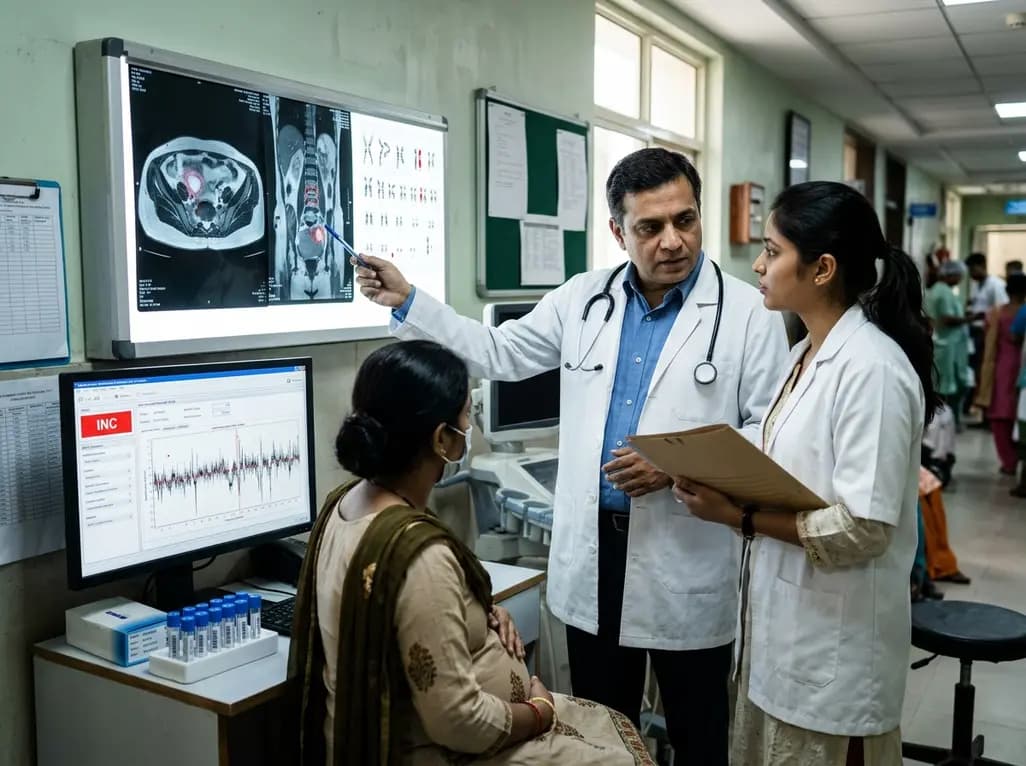
Occult maternal malignancy accounts for 3.82% of persistent unreportable NIPT results with genomic noise. Multiple chromosomal aberrations, notably on chromosome 18, warrant thorough oncological evaluation and whole-body MRI to ensure timely maternal diagnosis while preserving fetal care.
Today
This article reviews the forensic and clinical complexities of acute myocarditis arising on left ventricular hypertrophy in children, highlighting early diagnostic red flags and multidisciplinary postmortem autopsy protocols.
Today

This comparative study evaluates posterior labral tears with and without glenohumeral instability, highlighting distinct demographic patterns, MRI underestimation in stable shoulders, and successful arthroscopic repair outcomes.
Yesterday

A clinical study demonstrates that early intervention with tocilizumab, either as monotherapy or bridged with corticosteroids, achieves significant proptosis reduction and resolves active inflammation in treatment-naive thyroid eye disease.
Yesterday
