.webp&w=384&q=75)

Loading, please wait...
Loading, please wait...

Endocrine disruptor safety is a critical concern for modern medicine, particularly when evaluating long-term health outcomes across the life-course. A new study proposes an integrated workflow that bridges the \"Safe and Sustainable by Design\" (SSbD) framework with life-course exposome science. This approach aims to identify harmful exposures early in a chemical's lifecycle by using New Approach Methodologies (NAMs). Consequently, researchers can prioritize human-relevant evidence over traditional, broad animal testing.
The proposed decision workflow involves several key stages. First, problem formulation focuses on susceptible populations and windows of vulnerability. Second, scientists use Adverse Outcome Pathway (AOP)-guided selection to curate bioactivity evidence. Furthermore, physiologically based pharmacokinetic (PBPK) modeling translates in vitro findings into internal dose anchors. Finally, a transparent multi-criteria synthesis supports early design trade-offs for safer chemical production.
To demonstrate the framework, the researchers compared Bisphenol A (BPA) with alternatives like BPAP and isosorbide. While BPAP is structurally similar to BPA, the study used Estrogen Receptor (ER) bioactivity anchors to assess its risk. Interestingly, the internal margin for BPAP suggested it might still pose significant endocrine risks. In contrast, isosorbide, a bio-based monomer, showed weak or absent bioactivity. Therefore, these candidates can be advanced while more potent alternatives are deprioritized or redesigned.
This systematic approach helps clinicians and regulators move beyond \"regrettable substitutions.\" By mapping NAM outputs to human life-course windows, we can ensure that new chemicals are truly safer. This is especially vital for pediatric and obstetric health, where early-life exposures have permanent effects. Moreover, the workflow supports the \"3Rs\" principle by reducing the need for unnecessary in vivo studies.
The SSbD framework integrates safety and sustainability into the earliest design phases of a chemical. It uses advanced modeling and human-relevant data to prevent the creation of harmful substances before they reach the market.
Life-course exposome science studies every environmental exposure a person encounters from conception onwards. This is crucial for endocrinology because hormonal systems are highly sensitive during specific developmental windows, such as fetal growth and puberty.
Disclaimer: This content is for informational and educational purposes only. It does not constitute medical advice or a substitute for professional healthcare. Always consult with a qualified health professional for diagnosis and treatment. Refer to the latest local and national guidelines for clinical practice.
References
Sarigiannis D et al. Bridging the life-course exposome approach with a life-cycle perspective in safe and sustainable by design (SSbD) for chemical risk. Hum Genomics. 2026 May 07. doi: 10.1186/s40246-026-00976-1. PMID: 42098892.
National Institutes of Health. Concern about the Safety of Bisphenol A Substitutes. Diabetes & Metabolism Journal. 2019.
European Commission. Recommendation on a European assessment framework for 'safe and sustainable by design' chemicals and materials. 2022.

Read summarized clinical updates, watch expert medical content, and earn CME certifications right from your smartphone.
Open your smartphone camera to scan and install.





New framework links life-course exposome science with chemical design to identify safer alternatives to BPA using human-relevant evidence and PBPK modeling....
5 months ago

Recent epidemiological data reveals a dramatic surge in summer heat mortality driven by human-induced climate warming. This analysis explores the pathophysiological impacts on cardiac and renal systems, diagnostic dilemmas in death certification, and essential emergency cooling protocols for acute clinical care.
Today
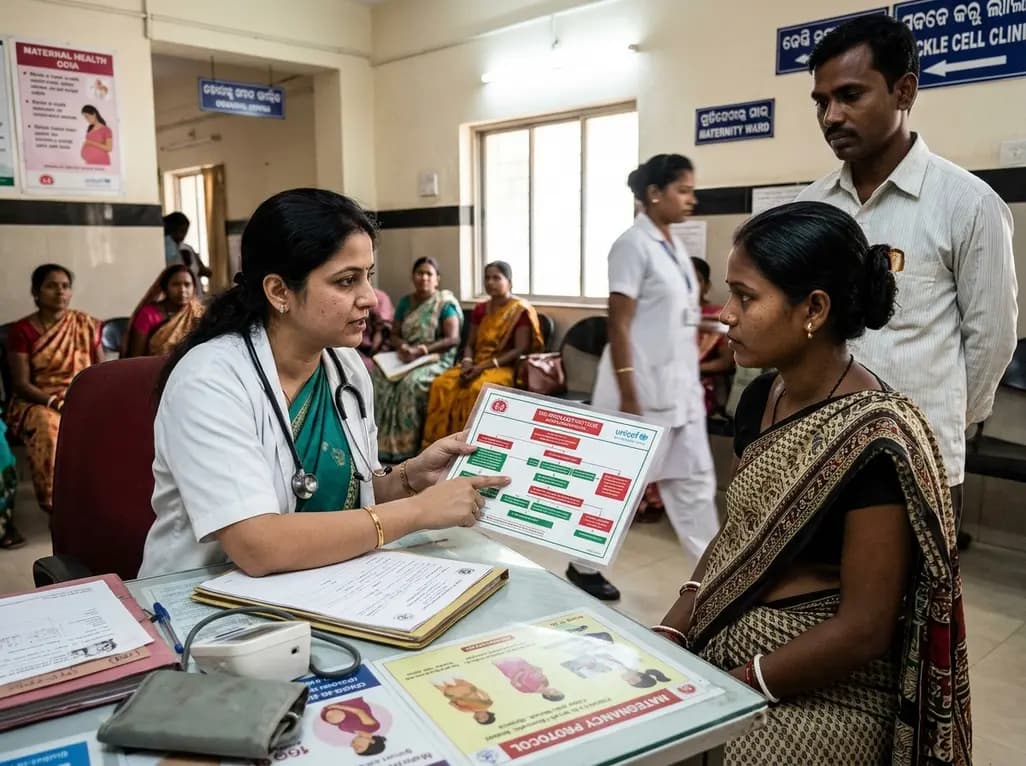
Odisha has established India's first state-level clinical protocol specifically tailored for pregnant women with sickle cell disease. Developed with NHM and UNICEF, the framework provides structured antenatal screening, crisis mitigation, standardized referral pathways, and specialized interdisciplinary care.
Today

India is advancing preventive healthcare by integrating genomics, artificial intelligence, and quantum technologies. With the SANGAM programme sequencing one million Indian genomes, clinicians can unlock personalized therapies, detect cardiometabolic risks early, and curb the burden of diabetes and heart disease.
Today

A randomized controlled trial demonstrates that an eight-week dual-task training intervention significantly improves static and dynamic postural control over standard balance exercises in individuals with chronic ankle instability, addressing critical neurocognitive deficits during athletic and daily activities.
Today

A retrospective cohort study of 7,716 ICU patients from the MIMIC-IV database demonstrates that Gradient Boosting Decision Trees significantly outperform traditional SOFA scores in predicting in-hospital mortality among patients with sepsis and diabetes, with SHAP analysis providing clinical interpretability.
Today
