.webp&w=384&q=75)

Loading, please wait...
Loading, please wait...

Management of unresectable limited-stage small cell lung cancer (LS-SCLC) in older populations requires careful deliberation. Because clinical trials often exclude older individuals, doctors lack robust evidence for elderly LS-SCLC treatment strategies. However, recent retrospective data provides much-needed clarity for this vulnerable group.
Researchers analyzed data from over 3,600 patients aged 75 and older using the SEER database. The study compared four approaches: chemotherapy, radiotherapy, combined chemoradiotherapy (C+R), and palliative care. Consequently, the findings revealed that active treatment significantly outperforms palliative care in terms of cancer-specific survival (CSS). Moreover, the median survival for the active treatment group was three times longer than that of the palliative group.
Specifically, combined chemoradiotherapy emerged as the most effective modality in this cohort. Furthermore, chemotherapy alone also showed substantial survival benefits compared to radiotherapy alone. These outcomes remained consistent regardless of the specific tumor or node stage, reinforcing the value of systemic therapy. Additionally, clinicians should note that the benefit of C+R was most pronounced in patients with higher nodal involvement.
Transitioning to more intensive regimens can be daunting for older patients. Nevertheless, the survival advantage suggests that age should not be the sole factor in treatment decisions. Clinicians must balance these benefits against potential toxicities like myelosuppression. Furthermore, incorporating comprehensive geriatric assessments can help tailor these treatments to individual tolerance levels.
Current research suggests that combined chemoradiotherapy provides the best survival outcomes for elderly patients with LS-SCLC. However, treatment plans must be personalized based on the patient's performance status and comorbidities.
No, chronological age should not be the primary exclusion factor. While intensive therapy carries risks, the survival benefits are significant across various T and N stages in the elderly population.
Disclaimer: This content is for informational and educational purposes only. It does not constitute medical advice, diagnosis, or treatment. Always seek the advice of a qualified healthcare provider with any questions regarding a medical condition. Refer to the latest local and national guidelines for clinical practice.
References
Zhou R et al. Therapeutic strategies for elderly patients with unresectable limited-stage small cell lung cancer. Clin Transl Oncol. 2026 Feb 28. doi: 10.1007/s12094-025-04178-4. PMID: 41762408.
National Comprehensive Cancer Network. NCCN Clinical Practice Guidelines in Oncology: Small Cell Lung Cancer. Version 1.2025.
Dingemans AMC et al. Small-cell lung cancer: ESMO Clinical Practice Guidelines for diagnosis, treatment and follow-up. Ann Oncol. 2021;32(7):839-853. Updated 2025.

Read summarized clinical updates, watch expert medical content, and earn CME certifications right from your smartphone.
Open your smartphone camera to scan and install.





A retrospective study using the SEER database highlights that combined chemoradiotherapy significantly improves survival in elderly patients with unresectab...
7 months ago
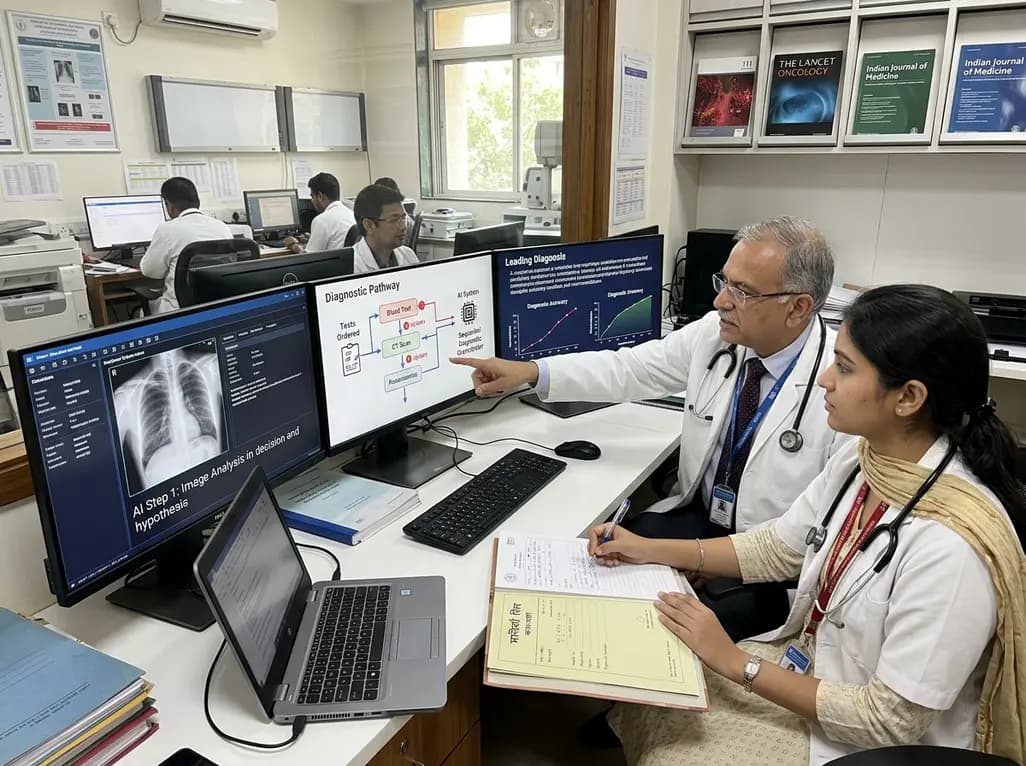
A breakthrough peer-reviewed study demonstrates that a sequential AI diagnosis system can mirror real-world clinical reasoning. By ordering stepwise tests and updating hypotheses dynamically, this multi-agent orchestrator achieved superior diagnostic accuracy while reducing investigative costs.
Today

A prenatal case highlights severe glutaric acidemia type II presenting as bilateral hyperechoic cystic kidneys at 18 weeks. Whole-exome sequencing revealed a novel homozygous ETFDH frameshift variant, demonstrating the power of rapid genetic testing in fetal renal anomalies.
Today

Review how tailored exercise programs benefit frail older patients with heart failure. Explore pathophysiological mechanisms, individualized training prescriptions, and strategies to overcome adherence barriers in clinical practice.
Yesterday

This comparative study evaluates posterior labral tears with and without glenohumeral instability, highlighting distinct demographic patterns, MRI underestimation in stable shoulders, and successful arthroscopic repair outcomes.
Yesterday

A clinical study demonstrates that early intervention with tocilizumab, either as monotherapy or bridged with corticosteroids, achieves significant proptosis reduction and resolves active inflammation in treatment-naive thyroid eye disease.
Yesterday
