.webp&w=384&q=75)

Loading, please wait...
Loading, please wait...

Driving in challenging environments significantly increases driver cognitive load. In India, foggy conditions contribute to more than 30,000 road accidents every year. Consequently, understanding how environmental factors impact visual attention is vital for developing better safety guidelines and tunnel designs. A recent study investigated how the combination of fog and nighttime affects fixation behavior during the critical 10-second approach to a tunnel portal.
The researchers monitored 30 licensed drivers on the Xinjin Expressway using advanced eye-tracking technology. They analyzed four specific scenarios: clear-day, foggy-day, clear-night, and foggy-night. By measuring fixation duration and frequency, the team quantified the mental effort required to navigate safely. The study specifically defined the tunnel approach zone as the 10-second travel distance preceding the entrance. This zone is critical because drivers must adapt to rapid changes in lighting and visibility while maintaining control.
The results revealed that driver cognitive load peaks under foggy-night conditions. Fixation duration increased to 689.82 ms in fog and darkness, compared to only 325.59 ms on clear days. Furthermore, fixation frequency dropped significantly, indicating that drivers struggle to process visual information efficiently. Horizontal gaze constricted as drivers focused more intensely on the narrow path ahead. Conversely, vertical fixation deviation increased. This suggests that drivers use compensatory vertical scanning to locate the tunnel entrance amidst poor visibility.
These findings highlight the extreme mental demand placed on drivers in adverse weather. Because fog and night conditions reduce horizontal scanning, drivers might miss peripheral hazards or obstacles. Therefore, highway engineers should consider installing enhanced lighting and reflective markings in tunnel approach zones. Such interventions can help manage driver cognitive load and reduce the risk of accidents during transitions from open roads to tunnels. Adopting these technical solutions could save lives on high-speed expressways across India.
In foggy conditions, drivers typically experience lateral gaze constriction. This means their horizontal field of vision narrows as they focus more intently on the immediate road ahead to maintain lane position, which increases mental fatigue.
Longer fixation durations indicate that the brain requires more time to process visual information. When visibility is poor, the driver must work harder to identify hazards, leading to a much higher cognitive demand.
Disclaimer: This content is for informational and educational purposes only. It is not intended as a substitute for professional medical advice, diagnosis, or treatment. Always seek the advice of your physician or other qualified health provider with any questions you may have regarding a medical condition. Refer to the latest local and national guidelines for clinical practice.
References
Liu B et al. Assessing cognitive load in drivers during tunnel approach under combined fog and nighttime conditions based on fixation behavior. Traffic Inj Prev. 2026 Apr 30. doi: 10.1080/15389588.2026.2650661. PMID: 42060340.
Ministry of Road Transport and Highways. Road Accidents in India 2022. Government of India, New Delhi. 2024.
Yan X et al. Research on the relationship between drivers' fixation behavior and road cognitive efficiency in curved tunnel environments. PubMed Central (PMC). 2025.
"
Read summarized clinical updates, watch expert medical content, and earn CME certifications right from your smartphone.
Open your smartphone camera to scan and install.





A study on the Xinjin Expressway explores how combined fog and night conditions impact driver cognitive load and visual attention patterns during tunnel app...
5 months ago
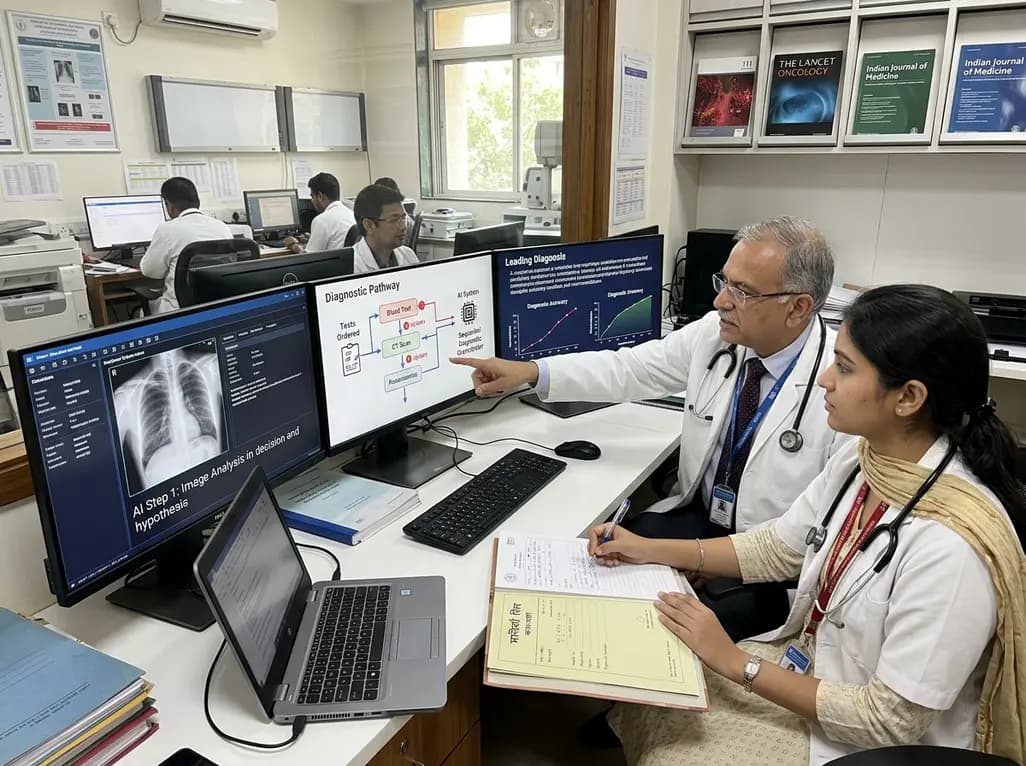
A breakthrough peer-reviewed study demonstrates that a sequential AI diagnosis system can mirror real-world clinical reasoning. By ordering stepwise tests and updating hypotheses dynamically, this multi-agent orchestrator achieved superior diagnostic accuracy while reducing investigative costs.
Today

A prenatal case highlights severe glutaric acidemia type II presenting as bilateral hyperechoic cystic kidneys at 18 weeks. Whole-exome sequencing revealed a novel homozygous ETFDH frameshift variant, demonstrating the power of rapid genetic testing in fetal renal anomalies.
Today

Review how tailored exercise programs benefit frail older patients with heart failure. Explore pathophysiological mechanisms, individualized training prescriptions, and strategies to overcome adherence barriers in clinical practice.
Yesterday

This comparative study evaluates posterior labral tears with and without glenohumeral instability, highlighting distinct demographic patterns, MRI underestimation in stable shoulders, and successful arthroscopic repair outcomes.
Yesterday

A clinical study demonstrates that early intervention with tocilizumab, either as monotherapy or bridged with corticosteroids, achieves significant proptosis reduction and resolves active inflammation in treatment-naive thyroid eye disease.
Yesterday
