.webp&w=384&q=75)

Loading, please wait...
Loading, please wait...

Scientists at the University of Delhi recently showcased an innovative urban carbon garden model to address India's worsening air quality. This nature-based solution uses a compact ecosystem to filter toxins directly from the atmosphere. Consequently, environmentalists view this project as a practical response to the country's environmental challenges. Experts believe these gardens can serve as a blueprint for metropolitan areas struggling with hazardous smog levels.
Air pollution remains a primary threat to public health in India today. For instance, the World Health Organization estimates that pollution claims over seven million lives globally each year. Specifically, India accounts for approximately 1.7 million of these annual deaths. In Delhi alone, toxic air caused nearly 15% of all deaths in 2023. Additionally, thirteen of the world's twenty most polluted cities are located within India. Therefore, the medical community urgently needs scalable interventions to reduce respiratory and cardiovascular diseases linked to poor air quality.
Professor Dinabandhu Sahoo developed this self-sustaining ecological unit over three years. Specifically, the model integrates over 50 plant species alongside algae, fungi, and bacteria. These microorganisms live on plant surfaces and actively break down toxic gases. For example, they convert methane and carbon monoxide into less harmful or useful compounds. Furthermore, the system functions as a natural filtration unit that enriches the soil while cleaning the air. Unlike traditional parks, this design focuses on year-round purification through complex biological interactions.
The most significant advantage of the urban carbon garden model is its high practicality. Large-scale green spaces are difficult to establish in land-starved cities like New Delhi. However, these gardens require only 2,000 square feet of space. Consequently, schools, residential complexes, and office campuses can easily adopt them. Over 1,000 visitors have already toured the site to explore replication. Moreover, experts at the recent national conference agreed that a network of these gardens could collectively improve urban health outcomes. By integrating nature into dense urban pockets, cities can build a resilient defense against toxicity.
Q1: How does an urban carbon garden differ from a standard park?
An urban carbon garden is specifically designed as a self-sustaining ecological unit. It uses a precise mix of plants and microbes to break down toxic gases like carbon monoxide, whereas standard parks primarily focus on aesthetics.
Q2: Can these gardens be built in small residential spaces?
Yes, the model is highly scalable and requires relatively little land. It can be adapted for use in small areas such as school grounds, office complexes, and housing societies.
Q3: Which specific pollutants do these gardens target?
The garden's microbes and plants work together to absorb and neutralize harmful pollutants, including methane, carbon monoxide, and various volatile organic compounds.
Disclaimer: This content is for informational and educational purposes only. It does not constitute medical advice or replace professional judgment. Refer to the latest local and national guidelines for clinical practice.
References

Read summarized clinical updates, watch expert medical content, and earn CME certifications right from your smartphone.
Open your smartphone camera to scan and install.





Delhi University's urban carbon garden model uses 50 plant species and microbes to filter pollutants, offering a scalable solution to India's air crisis....
6 months ago
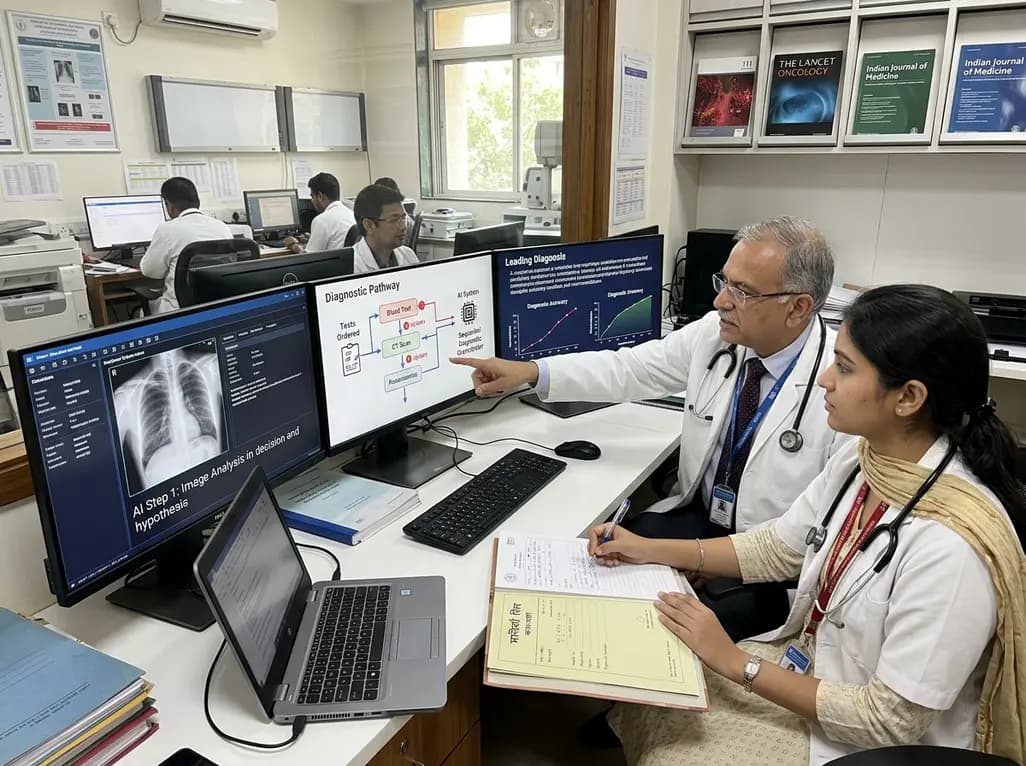
A breakthrough peer-reviewed study demonstrates that a sequential AI diagnosis system can mirror real-world clinical reasoning. By ordering stepwise tests and updating hypotheses dynamically, this multi-agent orchestrator achieved superior diagnostic accuracy while reducing investigative costs.
Today

A prenatal case highlights severe glutaric acidemia type II presenting as bilateral hyperechoic cystic kidneys at 18 weeks. Whole-exome sequencing revealed a novel homozygous ETFDH frameshift variant, demonstrating the power of rapid genetic testing in fetal renal anomalies.
Today

Review how tailored exercise programs benefit frail older patients with heart failure. Explore pathophysiological mechanisms, individualized training prescriptions, and strategies to overcome adherence barriers in clinical practice.
Yesterday

This comparative study evaluates posterior labral tears with and without glenohumeral instability, highlighting distinct demographic patterns, MRI underestimation in stable shoulders, and successful arthroscopic repair outcomes.
Yesterday

A clinical study demonstrates that early intervention with tocilizumab, either as monotherapy or bridged with corticosteroids, achieves significant proptosis reduction and resolves active inflammation in treatment-naive thyroid eye disease.
Yesterday
