.webp&w=384&q=75)

Loading, please wait...
Loading, please wait...
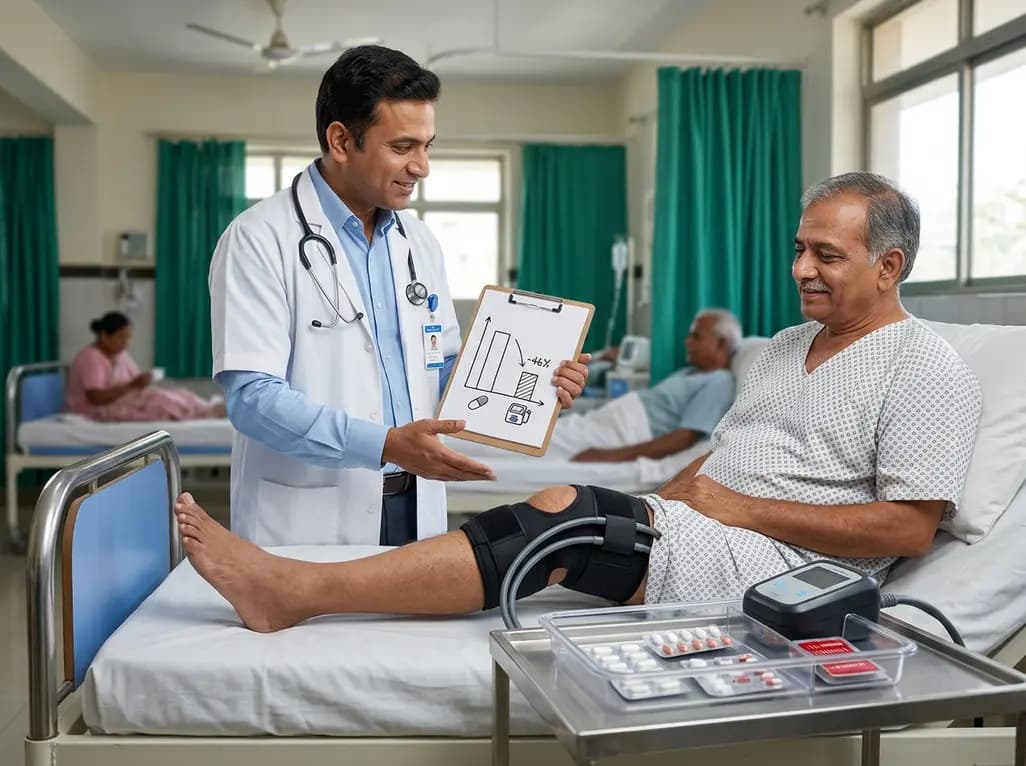
Cryo-compression therapy UKA management is increasingly important as orthopedic surgeons prioritize multimodal analgesia. While traditional cold therapy is a staple of post-operative care, adding compression for an extended six-week period remains less established. A recent secondary analysis of a randomized controlled trial investigated whether this prolonged intervention improves functional outcomes and reduces narcotic reliance.
Researchers measured pain at rest using the Numeric Rating Scale (NRS) as the primary endpoint. Notably, the study found no significant difference between the cryo-compression and standard care groups regarding resting pain. However, the intervention group experienced a remarkable 46% reduction in oxycodone consumption. This suggests that while pain intensity remains similar, the benefits of the therapy allow for lower medication dosages.
Secondary outcomes included functional scores and health-related quality of life. Furthermore, indicators such as the Oxford Knee Score and physical tests showed comparable results across both cohorts. Although the cryo-compression group reported better quality-of-life scores on the EQ5D-5L, these improvements did not meet the threshold for clinical significance. Consequently, the primary clinical advantage of this device lies in its opioid-sparing potential.
Research indicates that 6-week cryo-compression therapy does not lead to significant differences in pain at rest compared to standard care, although it significantly reduces opioid intake.
In the clinical trial, patients using cryo-compression therapy consumed 46% less oxycodone over the six-week post-operative period compared to those receiving standard care.
Disclaimer: This content is for informational and educational purposes only. It does not constitute medical advice and is not a substitute for professional clinical judgment. Refer to the latest local and national guidelines for clinical practice.
References
Biemans H et al. 6-week cryo-compression therapy and opioid use after unicompartmental knee arthroplasty with comparable pain scores: a secondary analysis of a randomized controlled trial. Acta Orthop. 2026 Jun 10. doi: 10.2340/17453674.2026.45963. PMID: 42267509.
Quesnot A et al. Compression + Cold Therapy Accelerates Recovery After Knee Replacement — New Clinical Evidence. BMC Musculoskelet Disord. 2024; 25(1): 182.
Song et al. Compressive cryotherapy versus cryotherapy alone in patients undergoing knee surgery: a meta-analysis. BMC Musculoskelet Disord. 2016; 17: 273.

Read summarized clinical updates, watch expert medical content, and earn CME certifications right from your smartphone.
Open your smartphone camera to scan and install.





A secondary analysis of an RCT shows that 6-week cryo-compression therapy after UKA reduces oxycodone consumption by 46% compared to standard care, despite comparable pain scores. While functional improvements were noted, they did not reach clinical significance, suggesting a primary benefit in opioid sparing.
4 months ago

A breakthrough peer-reviewed study demonstrates that a sequential AI diagnosis system can mirror real-world clinical reasoning. By ordering stepwise tests and updating hypotheses dynamically, this multi-agent orchestrator achieved superior diagnostic accuracy while reducing investigative costs.
Today

A prenatal case highlights severe glutaric acidemia type II presenting as bilateral hyperechoic cystic kidneys at 18 weeks. Whole-exome sequencing revealed a novel homozygous ETFDH frameshift variant, demonstrating the power of rapid genetic testing in fetal renal anomalies.
Today

Review how tailored exercise programs benefit frail older patients with heart failure. Explore pathophysiological mechanisms, individualized training prescriptions, and strategies to overcome adherence barriers in clinical practice.
Yesterday

This comparative study evaluates posterior labral tears with and without glenohumeral instability, highlighting distinct demographic patterns, MRI underestimation in stable shoulders, and successful arthroscopic repair outcomes.
Yesterday

A clinical study demonstrates that early intervention with tocilizumab, either as monotherapy or bridged with corticosteroids, achieves significant proptosis reduction and resolves active inflammation in treatment-naive thyroid eye disease.
Yesterday
