.webp&w=384&q=75)

Loading, please wait...
Loading, please wait...

The integration of continuous glucose monitoring systems into standard diabetes management has revolutionized glycemic control, treatment personalization, and acute complication prevention. Consequently, clinicians worldwide rely heavily on continuous glucose monitoring systems to make crucial therapeutic decisions, such as adjusting intensive insulin regimens. However, ensuring that these sophisticated digital health tools meet uniform performance, accuracy, and safety benchmarks remains a pressing challenge. In Europe, the transition to Medical Device Regulation (MDR) 2017/745 aimed to modernize the regulatory framework, replacing older directives with stringent evidence requirements. Despite these progressive intentions, structural bottlenecks and incomplete infrastructure continue to threaten device oversight, affecting clinical trust and post-market tracking globally.
The European Union enacted MDR 2017/745 to replace the outdated Medical Devices Directive (MDD 93/42/EEC), establishing rigorous standards for modern health technologies. Under this modernized framework, continuous glucose monitoring systems generally fall into Class IIb risk designations due to their critical role in guiding immediate pharmacotherapy. Therefore, manufacturers must compile robust technical documentation and furnish comprehensive clinical evaluation reports before receiving a Conformité Européenne (CE) mark. Moreover, the regulation mandates transparent verification of analytical accuracy, sensor longevity, and software algorithms under real-world operating conditions.
Nevertheless, the operational transition has proven exceptionally complex for stakeholders across the medical ecosystem. In addition, the increased stringency arrived alongside tight deadlines, creating significant compliance pressure for device manufacturers. Because continuous glucose monitoring systems integrate physical micro-sensors, wireless transmitters, and proprietary mobile applications, they require multifaceted testing. Consequently, regulatory bodies must evaluate both hardware durability and software algorithmic reliability simultaneously. While these heightened standards undoubtedly protect patients from sub-par technology, the administrative demands have exposed significant vulnerabilities within the European regulatory architecture.
To obtain CE certification under MDR 2017/745, manufacturers must undergo an exhaustive conformity assessment administered by independent Notified Bodies. However, national competent authorities have designated only a limited number of Notified Bodies authorized to conduct assessments under the new regulation. Consequently, a severe capacity deficit has emerged across the European continent, generating protracted delays for both novel product submissions and legacy device recertifications. Furthermore, specialized technical expertise regarding advanced biosensors and algorithmic trend-predicting software remains scarce among available auditors.
As a result, manufacturers face substantial inertia during technical dossier reviews, delaying the market entry of upgraded sensor technologies. Additionally, this administrative gridlock limits the depth of individualized assessments, as overburdened Notified Bodies struggle under heavy caseloads. Therefore, critical inquiries into sensor calibration mechanics, physiological lag-time corrections, and pediatric subgroup efficacy may experience abbreviated procedural scrutiny. Thus, the conformity assessment pipeline currently functions as an unintentional barrier to innovation rather than an efficient safety gateway. Clinicians and patients ultimately absorb the impact of these delays through deferred access to improved glycemic tracking technologies.
A central pillar of MDR 2017/745 was the creation of the European Databank on Medical Devices (EUDAMED), designed to harmonize pre-market registration and post-market intelligence. Specifically, EUDAMED intended to provide a unified portal housing clinical investigation summaries, safety certificates, and device identifiers. However, recurrent technical and administrative delays have severely hindered the complete rollout of this centralized digital databank. Consequently, Notified Bodies, clinical researchers, and national regulatory agencies lack centralized access to vital comparative evidence across different commercial sensor platforms.
Furthermore, without fully functional database modules, transparency regarding clinical study designs and reference methodologies remains compromised. In addition, healthcare professionals cannot readily access standardized Summary of Safety and Clinical Performance (SSCP) reports for specific sensor brands. Because public accessibility remains fragmented, clinicians must rely on industry-published white papers rather than standardized regulatory disclosures. Therefore, the absence of an operational data hub weakens systemic accountability, making cross-border pattern recognition of sensor failures difficult to coordinate efficiently across European healthcare jurisdictions.
Demonstrating clinical accuracy represents another major hurdle under MDR 2017/745, especially given the diverse physiological environments where sensors operate. Specifically, the regulation requires manufacturers to demonstrate equivalence or conduct prospective clinical investigations within representative patient populations. However, defining strict clinical performance metrics, such as Mean Absolute Relative Difference (MARD) thresholds across extreme glycemic excursions, remains non-standardized within regulatory texts. Consequently, variable reference comparator methods, such as YSI analyzers versus standard fingerstick meters, can skew reported accuracy outcomes.
Moreover, modern continuous glucose monitoring technologies frequently encounter physiological confounding factors in daily clinical use. For instance, rapid glycemic changes, local tissue inflammation, pressure-induced sensor attenuation during sleep, and pharmacological interference from common substances like acetaminophen can alter readings. Therefore, clinical evaluations must robustly test sensor resilience against these real-world confounders before market introduction. In the absence of standardized testing protocols across all Notified Bodies, discrepancies in device accuracy validation can persist. Consequently, clinicians must interpret promotional accuracy claims cautiously, acknowledging that regulatory clearance does not automatically guarantee identical performance across heterogeneous patient groups.
Post-market surveillance (PMS) serves as an essential regulatory safeguard, ensuring that sensor reliability remains intact after widespread public commercialization. Under MDR 2017/745, manufacturers must execute proactive Periodic Safety Update Reports (PSUR) and actively collect real-world clinical follow-up data. However, the delayed implementation of EUDAMED modules hampers the timely collection and aggregation of post-marketing adverse events. Consequently, signal detection for systemic manufacturing defects, transmitter communication dropouts, or unexpected biocompatibility reactions proceeds much slower than originally envisioned.
Importantly, these surveillance gaps carry tangible clinical implications for patients with type 1 or insulin-requiring type 2 diabetes. When continuous sensors produce erroneous glucose values or fail to trigger urgent hypoglycemia alarms, patients risk severe neuroglycopenia or inappropriate insulin overcorrection. Additionally, as automated insulin delivery (AID) closed-loop systems become standard of care, continuous glucose monitoring accuracy directly dictates automated basal and bolus insulin delivery. Therefore, any unobserved post-market drift in sensor calibration can induce severe metabolic destabilization. Robust traceability and proactive surveillance are indispensable mechanisms to prevent preventable adverse patient outcomes.
Addressing these structural deficiencies requires concerted collaboration among the European Commission, competent national authorities, Notified Bodies, and clinical societies. First, regulatory authorities must accelerate the full integration and mandatory adoption of all EUDAMED modules to restore transparency. Furthermore, standardizing clinical investigation methodologies and benchmarking protocols will ensure that all sensors meet rigorous analytical criteria before receiving certification. In addition, establishing specialized panels of independent endocrinology experts could support Notified Bodies during complex technical dossier evaluations, mitigating existing capacity constraints.
Meanwhile, global regulatory bodies and international clinical organizations should harmonize device reporting standards across international borders. Because medical device ecosystems are globally interconnected, European regulatory shortcomings directly influence clinical practices worldwide, including emerging markets in Asia and Latin America where CE marks guide local import approvals. Therefore, enhancing post-market registries, requiring public dissemination of adverse sensor events, and establishing clear traceability through Unique Device Identification (UDI) systems will restore comprehensive trust. Ultimately, rigorous and transparent regulatory oversight ensures that diabetes technologies empower patient safety while continuously fostering clinical innovation.
Under MDR 2017/745, continuous glucose monitors are classified as higher-risk Class IIb devices, requiring comprehensive technical documentation and verified clinical investigations. Consequently, manufacturers must provide prospective clinical evaluation data, demonstrate software reliability, and prove analytical accuracy rather than relying primarily on historical equivalence literature. This transition ensures that all marketed biosensors meet modern safety and efficacy benchmarks.
The delayed rollout of the centralized EUDAMED database severely limits transparent access to clinical performance data, certification certificates, and adverse incident reports. As a result, Notified Bodies and regulatory authorities struggle to track post-market safety signals systematically across different European borders, thereby hindering rapid identification of sensor drift or software failure patterns.
Real-world validation ensures sensors maintain precision during rapid glucose fluctuations, physical exercise, and pharmacological interference. Because erroneous readings can prompt incorrect insulin dosing or fail to detect life-threatening hypoglycemia, rigorous clinical evaluations under heterogeneous conditions are essential to guarantee reliable patient safety, particularly when integrated into automated insulin delivery systems.
Disclaimer: This content is for informational and educational purposes only and is not intended to substitute professional medical advice, diagnosis, or treatment. It does not establish a doctor-patient relationship nor endorse specific diagnostic tools or therapeutic measures. While every effort is made to maintain clinical accuracy, healthcare practices and device approvals change rapidly. Always seek the advice of a qualified physician or healthcare provider regarding medical conditions, interpretations of clinical trials, or device usage. Never disregard professional medical advice or delay seeking it because of something you have read here. Clinical cases and interpretations are illustrative and should not replace clinical judgment. Refer to the latest local and national guidelines for clinical practice.
References
1. Irace C et al. Continuous Glucose Monitoring Systems in Europe: Regulatory Landscape and Certification Process Challenges Under MDR 2017/745. Diabetes Obes Metab. 2026 Aug 13. doi: 10.1111/dom.71202. PMID: 42595726.
2. European Commission. Regulation (EU) 2017/745 of the European Parliament and of the Council on Medical Devices. Off J Eur Union. 2017;L117:1-175.
3. Heinemann L, Freckmann G. Quality of Continuous Glucose Monitoring Systems: How to Validate It? J Diabetes Sci Technol. 2020;14(5):909-916.

Read summarized clinical updates, watch expert medical content, and earn CME certifications right from your smartphone.
Open your smartphone camera to scan and install.





A comprehensive analysis of continuous glucose monitoring systems under European Medical Device Regulation 2017/745, examining conformity assessment challenges, Notified Body backlogs, EUDAMED rollout delays, and the critical need for transparent post-market surveillance.
last month

Epidemiologists and health leaders warn that active Ebola virus transmission in the Democratic Republic of Congo remains entrenched within communities. With fewer than ten percent of expected contacts monitored, public health officials urge rapid surveillance scale-up and reinforced healthcare precautions.
Today

A scoping review evaluates 116 studies on AI in women's reproductive health, finding that 83.6% carry high risk of bias. While ensemble models show promise, disparities and lack of validation hinder LMIC deployment.
Today
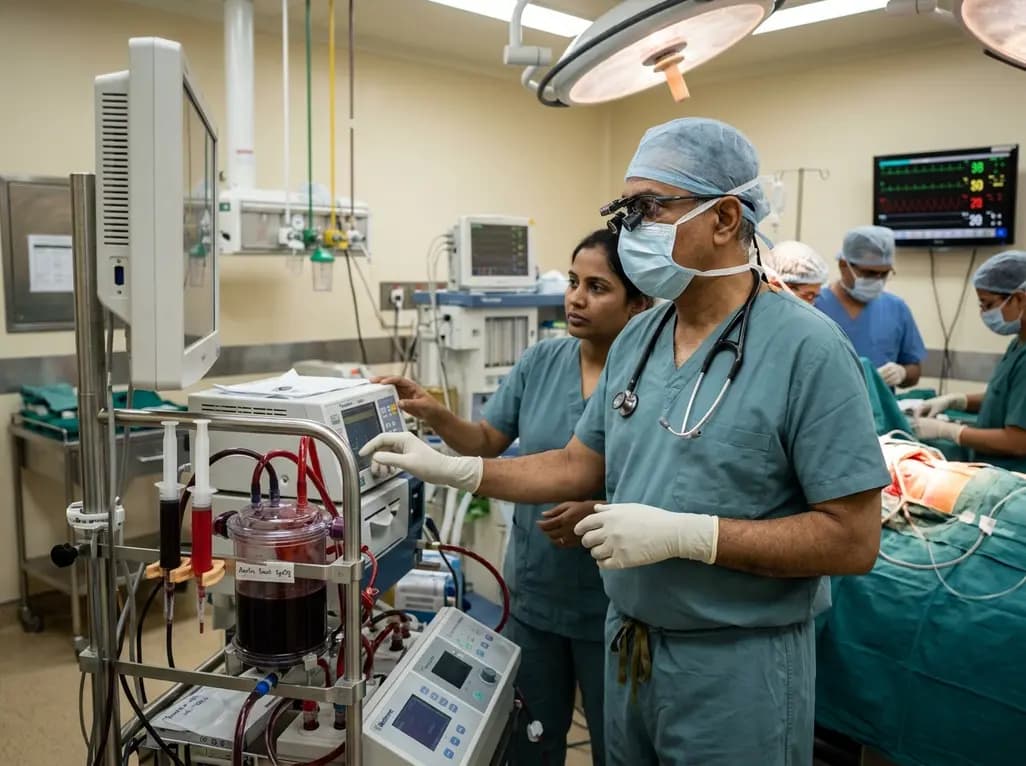
Differential oxygenation during peripheral TA-NRP can cause undetected coronary hypoxemia due to arch vessel clamping. A novel circuit with continuous aortic root monitoring detects desaturation early, facilitating left ventricular unloading and preventing allograft dysfunction and unnecessary heart discard.
Today

India faces significant opportunities to expand medical device exports to high-growth markets like Mexico, Brazil, and the UK. By addressing its trade deficit, advancing domestic component manufacturing, and aligning with global regulatory standards, the country aims to become an international healthcare hub.
Today

A post hoc analysis of the PARM-T2D study shows pemafibrate exerts baseline-dependent effects on LDL-C and particle size in type 2 diabetes and hypertriglyceridemia. It lowers triglycerides and remnants while favorably remodeling atherogenic LDL particles based on initial lipid control status.
Today
