

Loading, please wait...
Loading, please wait...

Healthcare administrators and clinicians worldwide constantly battle severe emergency department overcrowding, which compromises acute clinical workflows and patient safety. In addition, a substantial portion of emergency volume stems from non-urgent presentations that primary care could manage effectively. To address this persistent operational bottleneck, health systems actively explore decentralised ambulatory solutions. Specifically, a recent observational study from Italy evaluated the regional implementation of Community Urgent Care centres designed to redirect minor health complaints away from tertiary facilities. Consequently, these findings provide vital operational insights for emergency physicians and primary care doctors seeking sustainable decongestion frameworks.
Emergency departments frequently operate beyond their physical and human capacities due to inappropriate utilization by low-acuity patients. When individuals present with minor ailments, hospital resources become stretched thin, thereby increasing wait times for critically ill individuals. Furthermore, prolonged boarding times exacerbate provider burnout and raise the risk of medical errors. Urgent care centers offer a structured clinical alternative by providing timely evaluation for minor illnesses, uncomplicated lacerations, and mild infections. Moreover, these community units bridge the widening gap between overbooked general practitioners and hospital casualty wards. Therefore, diverting non-urgent presentations preserves tertiary emergency facilities for true life-threatening emergencies. Health authorities in the Emilia-Romagna region recognized this clinical imperative when they established community urgent care centres in 2023. As a result, administrators sought to determine whether decentralized outpatient centers could sustainably reduce daytime emergency attendances without jeopardizing clinical outcomes.
To quantify the actual impact of this initiative, researchers performed a rigorous retrospective observational study within the Forlì health district. Specifically, the authors compared daytime emergency access patterns between 08:00 and 20:00 across 184 matched days. They analyzed attendance data from the initial six months of center operation between June and December 2025, benchmarking them against identical dates in 2024. In addition, the research team stratified all hospital presentations according to validated triage priority scores and primary chief complaints. They employed the Wilcoxon signed-rank test and Pearson's chi-square test to evaluate paired volume shifts and proportional case-mix changes. Importantly, daytime hours represented the primary operational window when both the urgent care center and hospital services were functioning simultaneously. Consequently, this structured comparative framework isolated the specific diversion capacity of the community facility while minimizing seasonal confounders.
The investigation revealed striking reductions in non-urgent hospital volume during urgent care operational hours. Most notably, the lowest acuity attendances, classified as triage level 5 (TL5), plummeted by 48% from 2,489 visits down to 1,294 visits. Similarly, triage level 4 (TL4) visits experienced a statistically significant decline of 8%. These data confirm that community urgent care centers successfully intercepted patients who previously sought hospital care for routine clinical concerns. Furthermore, detailed categorical analysis demonstrated pronounced decreases in low-acuity respiratory illnesses and minor trauma presentations. Patients presenting with mild viral upper respiratory infections or superficial contusions increasingly utilized community facilities instead of queuing in tertiary waiting rooms. Accordingly, the community urgent care network relieved frontline triage nurses from sorting through overwhelming numbers of self-limiting conditions. Thus, the local intervention achieved one of the largest relative reductions reported across the entire regional healthcare network.
While non-urgent presentations declined significantly, the hospital emergency department experienced a concurrent shift toward higher clinical complexity. Specifically, higher-acuity attendances encompassing triage levels 1 through 3 increased by 18%, rising from 5,474 to 6,457 cases. Direct patient transfers from the community center accounted for only a modest portion of this upward surge. Consequently, underlying epidemiological dynamics and community healthcare-seeking behaviors contributed substantially to this case-mix transition. When lower-acuity patients move out of emergency waiting rooms, medical staff encounter a patient population with far greater clinical vulnerability. Therefore, remaining patients require more intensive nursing care, complex diagnostic imaging, and urgent multidisciplinary specialist consultations. However, treating a concentrated cohort of high-acuity patients demands sufficient inpatient bed capacity to prevent severe ward boarding. As a result, healthcare leaders must recognize that diverting minor cases changes departmental workload rather than simply diminishing total clinical effort.
The Forlì health district experience offers profound practical lessons for health system planners and clinical administrators. Primarily, establishing standalone clinics without strong clinical coordination rarely achieves long-term decongestion. In contrast, integrating urgent care facilities into established regional primary care networks ensures safe clinical governance and reliable triage pathways. Healthcare systems must also establish clear referral protocols so that primary clinicians can swiftly transfer deteriorating patients to tertiary resuscitations. Furthermore, robust public education campaigns must accompany facility launches so that citizens understand where to seek treatment for specific medical complaints. Without consistent public guidance, patients may default to tertiary emergency wards out of habit. Additionally, health authorities should implement shared electronic health records across primary, urgent, and emergency care settings. This technological cohesion prevents duplicate diagnostic testing, optimizes clinician time, and maintains unbroken continuity of patient care across diverse healthcare touchpoints.
In India, tertiary government hospitals and large private medical centers face relentless emergency department overcrowding. Casualty wards routinely treat minor cuts, uncomplicated febrile episodes, and mild gastroenteritis alongside acute coronary syndromes and severe polytrauma. Consequently, adapting community-oriented urgent care models offers immense promise for Indian urban and rural healthcare ecosystems. Government initiatives such as Ayushman Arogya Mandirs and urban health kiosks can serve as community urgent care hubs if adequately staffed. Moreover, general practitioners and family medicine specialists can run extended-hours walk-in services to manage non-emergent acute problems. By diverting minor ailments to community facilities, tertiary emergency departments can dedicate critical resuscitation bays and intensive resources to unstable patients. Similarly, standardizing triage protocols across Indian emergency units will ensure rapid identification and redirection of low-acuity cases. Therefore, investing in organized ambulatory urgent care represents an indispensable strategy for strengthening acute healthcare delivery nationwide.
Community urgent care centres provide immediate walk-in medical evaluation for minor illnesses, superficial injuries, and mild infections during peak operational hours. Consequently, these facilities absorb non-urgent patient volume that typically saturates hospital casualty wards. By offering accessible local medical care without requiring prior appointments, urgent care centers divert low-triage presentations away from hospital emergency departments, allowing emergency physicians to focus critical resources on resuscitating severely ill patients.
Higher-acuity presentations increased partly because community clinicians promptly identified and referred complex, deteriorating patients who required emergency hospital intervention. Furthermore, removing low-acuity volume unmasked a growing regional demand for advanced critical care among an aging population with multiple chronic comorbidities. Therefore, the hospital case-mix concentrated toward higher acuity, demonstrating that urgent care centers redefine patient complexity rather than solely reducing overall emergency department physician workload.
Indian healthcare networks can implement community-based urgent care models by strengthening Ayushman Arogya Mandirs and urban primary health centers with point-of-care diagnostics and extended operating hours. In addition, hospital administrators should adopt standardized pre-triage systems that safely direct stable, low-acuity patients to co-located outpatient walk-in clinics. Consequently, these coordinated triage strategies relieve severe casualty overcrowding, optimize specialist resource utilization, and significantly shorten treatment wait times for critical emergencies.
Disclaimer: This content is for informational and educational purposes only... Refer to the latest local and national guidelines for clinical practice.
References
Ceccarelli A et al. Impact of a community urgent care and primary care center (CAU) on emergency department visits: A before-after analysis in an Italian health district. Health Serv Manage Res. 2026 Nov 20. doi: 10.1177/09514848261510214. PMID: 43062423.
Morley C, Unwin M, Peterson GM, Stankovich J, Kinsman L. Emergency department crowding: A systematic review of causes, consequences and solutions. PLoS One. 2018;13(8):e0203316.
Sartini M, Carbone A, Demartini A, et al. Overcrowding in emergency department: causes, consequences, and solutions-a narrative review. Healthcare (Basel). 2022;10(9):1625.

Read summarized clinical updates, watch expert medical content, and earn CME certifications right from your smartphone.
Open your smartphone camera to scan and install.





A new study reveals that Italian Community Urgent Care centres (CAUs) cut low-acuity ED visits by up to 48%, significantly reshaping hospital case-mix. Explore the clinical, structural, and triage lessons this model offers for emergency medicine and primary healthcare delivery.
Today
A multicenter cohort study reveals that the 30-minute C-peptide response during OGTT independently predicts cystic fibrosis-related diabetes in patients with normal glucose tolerance, offering an early risk-stratification biomarker.
Today

The GESS-AEEM consensus establishes a clear clinical implementation framework for testosterone therapy in postmenopausal women with hypoactive sexual desire disorder, focusing on transdermal dosing, precise laboratory monitoring, and safety communication.
Today
A Bayesian component network meta-analysis of 130 RCTs reveals that self-monitoring and gamification provide the clearest positive effects in mHealth physical activity interventions, while social comparison may have adverse psychological trade-offs.
Today
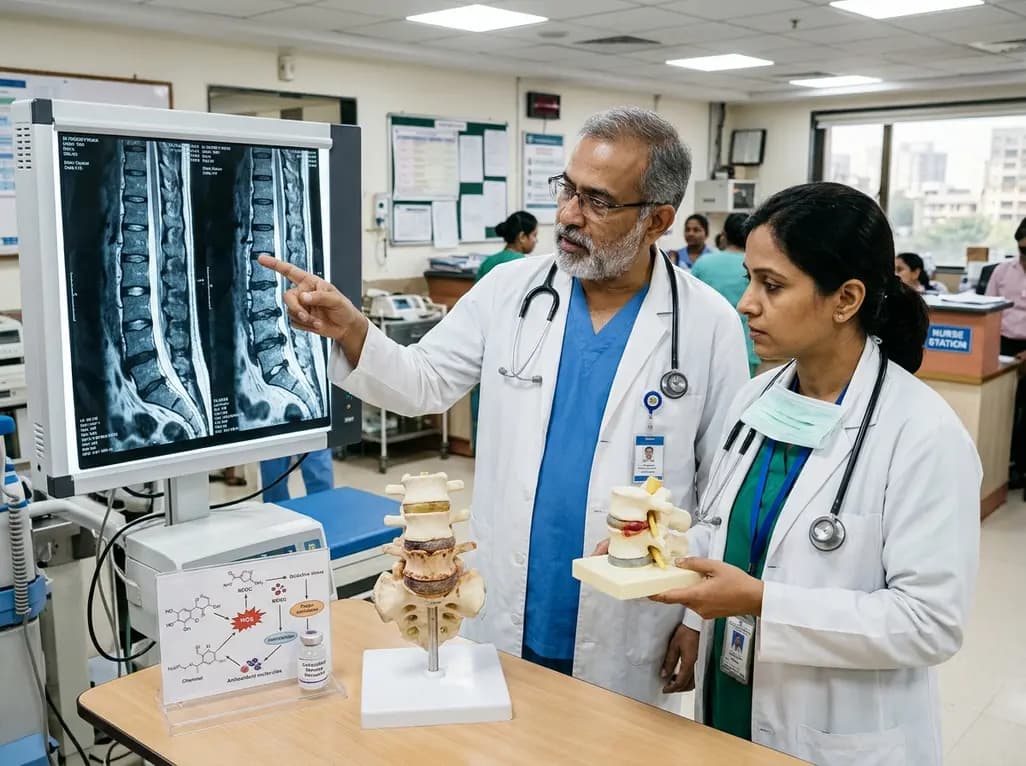
Intervertebral disc degeneration is a primary driver of chronic low back pain. Emerging evidence highlights reactive oxygen species and redox imbalance as central mechanisms. Targeted antioxidant strategies and biomaterial delivery systems offer promising disease-modifying therapies for spine health.
Today
As digital nutrition platforms and automated diet algorithms expand into chronic disease management, clinicians must prioritize verified biochemical outcomes over user engagement metrics. Learn how medical oversight, culturally tailored nutrition, and comprehensive testing safeguard long-term patient health.
Today
