.webp&w=384&q=75)

Loading, please wait...
Loading, please wait...

Community pharmacists often serve as the most accessible healthcare providers for the public. Despite this accessibility, the community pharmacist healthcare role remains subject to varying perceptions among consumers and medical practitioners. Therefore, a new scoping review protocol aims to identify studies exploring these perceptions across different demographics. This investigation is timely because negative portrayals can hinder the delivery of patient-centered care. Consequently, this review will synthesize current literature to provide a clearer picture of how different groups value the pharmacy profession.
Furthermore, the review methodology follows the strict JBI framework for scoping reviews. Researchers will search major databases such as PubMed, Embase, and Scopus. Specifically, they seek peer-reviewed articles published since 2015. In addition, the study focuses on the top five Commonwealth countries by GDP per capita. By excluding specialized settings like hospital pharmacies, the authors ensure a narrow focus on community practice. Moreover, two independent reviewers will extract data to maintain high analysis standards. Thus, this rigorous approach helps identify whether location or demographic factors influence how people perceive pharmacists.
In conclusion, collaboration between doctors and pharmacists significantly improves clinical outcomes. However, some professionals still view pharmacists primarily as business entrepreneurs rather than clinical partners. For this reason, the scoping review seeks to bridge that gap by highlighting existing evidence on professional capabilities. Ultimately, the findings may guide future policies to better integrate pharmacists into the broader healthcare team. Additionally, this integration is vital for optimizing medication management. Because of this, enhancing public health remains a primary goal of the study.
Perceptions influence how patients and other healthcare providers interact with pharmacists. If a doctor perceives a pharmacist only as a retailer, they are less likely to collaborate on complex clinical cases, which can delay optimal patient care.
Conflicting opinions regarding professional capabilities often act as a barrier. Additionally, viewing pharmacists solely as business entrepreneurs limits their potential to provide comprehensive, person-centered services and clinical advice.
Disclaimer: This content is for informational and educational purposes only. It does not constitute medical advice or establish a doctor-patient relationship. Professional perceptions and pharmacy regulations vary by region. Refer to the latest local and national guidelines for clinical practice.
References
Dimitrios L et al. The perceived role of community pharmacists in the healthcare continuum-a scoping review protocol. Int J Pharm Pract. 2026 Apr 02. doi: undefined. PMID: 41926165.
Agomo CO. The role of community pharmacists in public health: A scoping review of the literature. J Pharm Health Serv Res. 2012;3(1):25-33.
Eades CE, et al. Public and professional perceptions of a pharmacist-led management service: A systematic review. Res Social Adm Pharm. 2011;7(2):115-131.
"
Read summarized clinical updates, watch expert medical content, and earn CME certifications right from your smartphone.
Open your smartphone camera to scan and install.





A new scoping review protocol investigates how consumers and doctors perceive community pharmacists to improve healthcare collaboration and patient care....
6 months ago
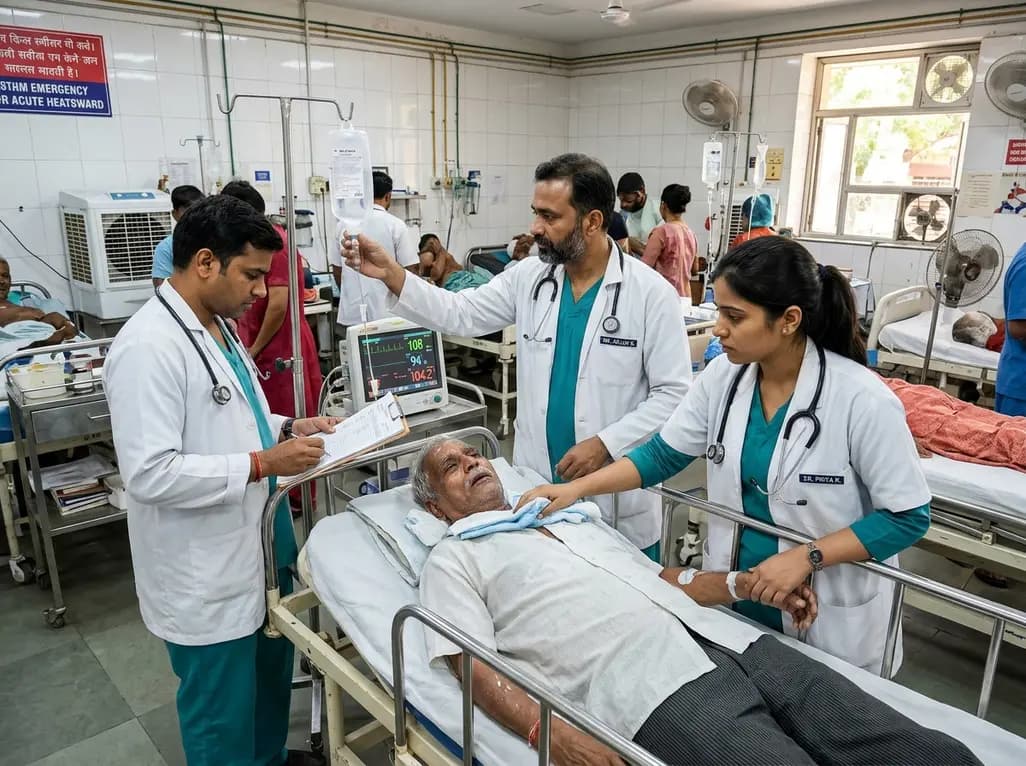
Recent epidemiological data reveals a dramatic surge in summer heat mortality driven by human-induced climate warming. This analysis explores the pathophysiological impacts on cardiac and renal systems, diagnostic dilemmas in death certification, and essential emergency cooling protocols for acute clinical care.
Today

Odisha has established India's first state-level clinical protocol specifically tailored for pregnant women with sickle cell disease. Developed with NHM and UNICEF, the framework provides structured antenatal screening, crisis mitigation, standardized referral pathways, and specialized interdisciplinary care.
Today

India is advancing preventive healthcare by integrating genomics, artificial intelligence, and quantum technologies. With the SANGAM programme sequencing one million Indian genomes, clinicians can unlock personalized therapies, detect cardiometabolic risks early, and curb the burden of diabetes and heart disease.
Today

A randomized controlled trial demonstrates that an eight-week dual-task training intervention significantly improves static and dynamic postural control over standard balance exercises in individuals with chronic ankle instability, addressing critical neurocognitive deficits during athletic and daily activities.
Today

A retrospective cohort study of 7,716 ICU patients from the MIMIC-IV database demonstrates that Gradient Boosting Decision Trees significantly outperform traditional SOFA scores in predicting in-hospital mortality among patients with sepsis and diabetes, with SHAP analysis providing clinical interpretability.
Today
