.webp&w=384&q=75)

Loading, please wait...
Loading, please wait...

Cobalt Ferrite Magnetic Nanoparticles represent a significant leap in the field of nanomedicine. These innovative particles act as both nanoheaters and nanothermometers within a single platform. This dual-functionality is crucial for improving thermal therapeutics, particularly in oncology. Specifically, the technology addresses the long-standing challenge of real-time temperature monitoring during localized heat treatments for cancer. By integrating these two functions, researchers have created a label-free system that could simplify clinical workflows and improve patient safety.
The research team established a quantitative relationship between temperature and the nanoparticles' dynamic magnetic response. This relationship relies heavily on Brownian relaxation, which is the physical rotation of the nanoparticle in a liquid medium. Furthermore, this mechanism depends on the thermal dependence of water viscosity. Consequently, clinicians can monitor internal temperature shifts by observing variations in magnetization cycles under alternating magnetic fields. This link between dynamics and diffusion enables highly precise, non-invasive temperature reading without the need for complex engineered readout schemes.
Interestingly, the same nanocrystal agent generates heat effectively when exposed to near-infrared (NIR) irradiation. Therefore, the system serves two vital purposes simultaneously. Moreover, the thermometric function remains stable even after surface functionalization or changes in the surrounding medium composition. This stability is vital for clinical translation, as it ensures the particles remain effective within the complex biological environments of the human body. Thus, these nanoparticles offer a robust, integrated platform for real-time thermal monitoring in advanced nanoscale heating applications.
They provide an intrinsic temperature readout without requiring additional chemical labels or specifically engineered materials. This makes them a simplified, more translational option for thermal therapies.
The system uses the relationship between magnetization dynamics and the viscosity of the surrounding fluid. As temperature changes, the fluid's viscosity shifts, altering the nanoparticles' rotation and their magnetic signal.
Yes, their magnetic properties make them potentially compatible with magnetic-based imaging and monitoring systems, which is a major focus of ongoing research in India and globally.
Disclaimer: This content is for informational and educational purposes only. It is not a substitute for professional medical advice, diagnosis, or treatment. Always seek the advice of your physician or other qualified health provider with any questions you may have regarding a medical condition. Refer to the latest local and national guidelines for clinical practice.
References
Venegas-Gomez A et al. Magnetic Nanoparticles as Label-Free Dual-Function Nanoheaters and Nanothermometers. Small. 2026 May 14. doi: 10.1002/smll.73780. PMID: 42132038.
Weaver JB et al. Temperature of the Magnetic Nanoparticle Microenvironment: Estimation from Relaxation Times. Communications in Biomedical Engineering. 2014;12:255-264.
Institute of Advanced Study in Science and Technology (IASST). Indian Researchers Develop Advanced Magnetic Nanoparticles to Enhance Cancer Therapy. Health Dialogues. 2025.

Read summarized clinical updates, watch expert medical content, and earn CME certifications right from your smartphone.
Open your smartphone camera to scan and install.





Cobalt ferrite magnetic nanoparticles now offer a label-free way to simultaneously generate heat and monitor temperature changes in thermal therapy....
5 months ago
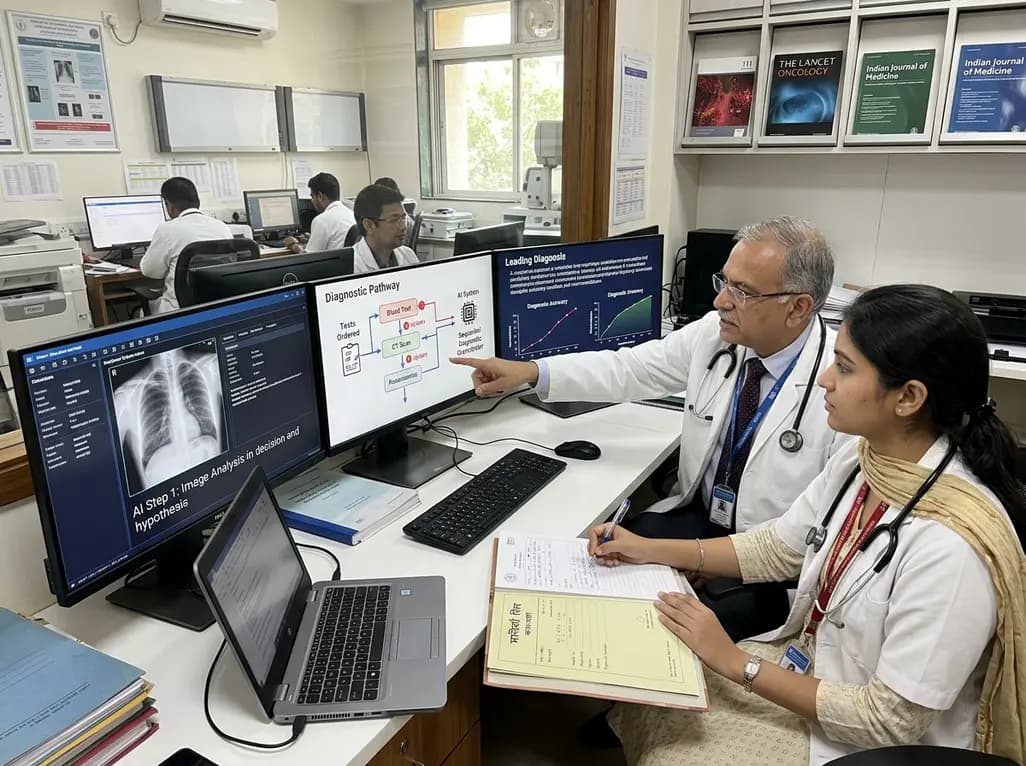
A breakthrough peer-reviewed study demonstrates that a sequential AI diagnosis system can mirror real-world clinical reasoning. By ordering stepwise tests and updating hypotheses dynamically, this multi-agent orchestrator achieved superior diagnostic accuracy while reducing investigative costs.
Today

A prenatal case highlights severe glutaric acidemia type II presenting as bilateral hyperechoic cystic kidneys at 18 weeks. Whole-exome sequencing revealed a novel homozygous ETFDH frameshift variant, demonstrating the power of rapid genetic testing in fetal renal anomalies.
Today

Review how tailored exercise programs benefit frail older patients with heart failure. Explore pathophysiological mechanisms, individualized training prescriptions, and strategies to overcome adherence barriers in clinical practice.
Yesterday

This comparative study evaluates posterior labral tears with and without glenohumeral instability, highlighting distinct demographic patterns, MRI underestimation in stable shoulders, and successful arthroscopic repair outcomes.
Yesterday

A clinical study demonstrates that early intervention with tocilizumab, either as monotherapy or bridged with corticosteroids, achieves significant proptosis reduction and resolves active inflammation in treatment-naive thyroid eye disease.
Yesterday
