.webp&w=384&q=75)

Loading, please wait...
Loading, please wait...
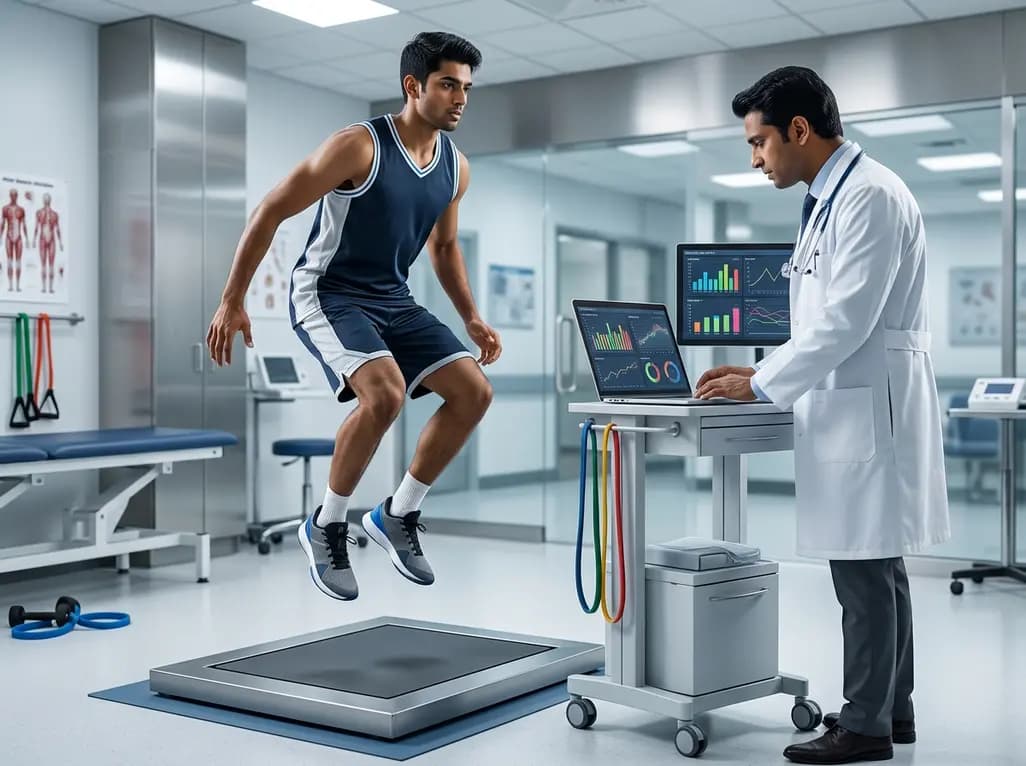
High-performance youth athletes face intense physical demands that often lead to overuse or acute injuries. Consequently, implementing **CMJ injury risk monitoring** has emerged as a vital strategy for sports medicine practitioners. This non-invasive assessment tracks neuromuscular fatigue by measuring vertical jump performance. A recent prospective study evaluated 49 youth volleyball and basketball players to determine if weekly jump variations could predict seasonal injuries.
The study monitored athletes over an entire season, recording injuries per 1000 athlete exposures (Ae). Researchers performed maximal jump tests 48 hours after every competition to ensure data consistency. Specifically, the results showed an overall injury rate of 1.61 per 1000 Ae. Ankle injuries were the most prevalent, accounting for 63.33% of the total cases reported. Moreover, female basketball players exhibited a significantly higher risk compared to other groups, with a rate of 2.54 per 1000 Ae.
Binary logistic regression analysis confirmed the predictive power of this tool. Furthermore, week-to-week reductions in jump performance were directly associated with a higher incidence of lower limb injuries. Therefore, a decline in jump height serves as a reliable red flag for impending physical breakdown. Because the test is easy to administer, it provides a practical solution for real-time workload management.
Integrating these metrics into routine training allow clinicians to tailor recovery protocols. For instance, if an athlete shows a significant performance drop, practitioners might recommend reduced intensity or additional physiotherapy. Additionally, this proactive approach helps maintain athlete availability throughout the competitive season. By addressing fatigue early, teams can mitigate the high risk of ankle and knee injuries often seen in jumping sports.
The monitoring identifies neuromuscular fatigue before it leads to a clinical injury. A decline in jump performance suggests that the athlete\'s lower limbs have not fully recovered from previous competitive stress, allowing for timely intervention.
Female basketball players were found to have the highest injury rate at 2.54 per 1000 athlete exposures. The ankle was the most frequently injured area across all participant groups.
Disclaimer: This content is for informational and educational purposes only. It does not constitute medical advice or a substitute for professional consultation. Refer to the latest local and national guidelines for clinical practice.
References
Sastre-Munar A et al. Countermovement Jump as Tool to Predict Injuries in High-Performance Youth Volleyball and Basketball Players: A One-Season Observational Prospective Study. Clin J Sport Med. 2026 Jun 03. doi: 10.1097/JSM.0000000000001475. PMID: 42235079.
Claudino JG et al. The Countermovement Jump to Monitor Neuromuscular Status: A Meta-Analysis. J Sci Med Sport. 2017;20(4):397-402.
Gathercole R et al. Alternative Methods of Monitoring Training Load and Fatigue in Professional Rugby Union. J Strength Cond Res. 2015;29(5):1253-1262.

Read summarized clinical updates, watch expert medical content, and earn CME certifications right from your smartphone.
Open your smartphone camera to scan and install.





A study shows that weekly countermovement jump (CMJ) monitoring effectively predicts lower limb injuries in high-performance youth volleyball and basketball...
4 months ago

Review how tailored exercise programs benefit frail older patients with heart failure. Explore pathophysiological mechanisms, individualized training prescriptions, and strategies to overcome adherence barriers in clinical practice.
Today

Recent clinical studies reveal maternal autoantibodies targeting IL-1RA as potential triggers for preterm labor, opening avenues for targeted cytokine therapies. Concurrently, new perioperative findings show inhaled cannabis increases propofol requirements during upper endoscopy compared to oral edible consumption.
Today

In high-risk pulmonary embolism complicated by severe anemia and active uterine bleeding, systemic thrombolysis is contraindicated. Large-bore aspiration thrombectomy provides rapid hemodynamic rescue without fibrinolysis, supported by inferior vena cava filter placement and multidisciplinary critical care.
Today

This comparative study evaluates posterior labral tears with and without glenohumeral instability, highlighting distinct demographic patterns, MRI underestimation in stable shoulders, and successful arthroscopic repair outcomes.
Today

A clinical study demonstrates that early intervention with tocilizumab, either as monotherapy or bridged with corticosteroids, achieves significant proptosis reduction and resolves active inflammation in treatment-naive thyroid eye disease.
Today
