.webp&w=384&q=75)

Loading, please wait...
Loading, please wait...

In the evolving landscape of diagnostic AI, the CLIP Graph Adaptor (CLIP-GA) introduces a significant leap for medical image analysis. Researchers developed this model to overcome the limitations of standard vision-language frameworks in identifying specific object boundaries. Consequently, this innovation offers a more precise method for weakly supervised semantic segmentation. By leveraging both textual and visual knowledge, the CLIP-GA model helps clinicians interpret complex scans with greater clarity.
The CLIP Graph Adaptor utilizes a unique dual-graph strategy to enhance image recognition. Specifically, it combines a textual subgraph and a visual subgraph to bridge the gap between image features and class descriptions. This fusion occurs through cross-modal graph attention, which ensures the model captures complete object regions accurately. In addition, the framework employs superpixel consistency to refine the labels used during training. Therefore, it reduces the noise often found in background areas of radiological images.
Furthermore, the inclusion of a graph reasoning attention module allows the system to build global contextual relationships. This capability is vital for medical applications where the relationship between different anatomical structures is crucial. Although standard models often struggle with interclass relationships, the CLIP-GA effectively manages these complexities. As a result, the tool demonstrates superior performance compared to previous state-of-the-art methods in benchmark tests.
The CLIP Graph Adaptor improves the accuracy of medical image segmentation. Specifically, it helps AI models distinguish between healthy tissue and pathological regions more effectively by using dual-graph structures.
Because the model uses a weakly supervised approach, it can learn from image-level labels instead of requiring expensive pixel-by-pixel manual annotations. This makes it easier to develop diagnostic tools for rare conditions.
Disclaimer: This content is for informational and educational purposes only. It does not constitute professional medical advice, diagnosis, or treatment. Always seek the advice of your physician or other qualified healthcare provider with any questions you may have regarding a medical condition. Refer to the latest local and national guidelines for clinical practice.
References
Zhang J et al. CLIP Graph Adaptor: A Dual-Graph Adapted Visual-Language Model for Weakly Supervised Semantic Segmentation. IEEE Trans Neural Netw Learn Syst. 2026 Apr 23. doi: 10.1109/TNNLS.2026.3683363. PMID: 42024937.
Radford A, et al. Learning Transferable Visual Models From Natural Language Supervision. International Conference on Machine Learning (ICML). 2021.
Zhang J et al. CLIP in medical imaging: A comprehensive survey. arXiv preprint arXiv:2312.07353. 2024.

Read summarized clinical updates, watch expert medical content, and earn CME certifications right from your smartphone.
Open your smartphone camera to scan and install.





The CLIP Graph Adaptor (CLIP-GA) utilizes dual-graph adaptive strategies to enhance semantic segmentation, offering improved accuracy for medical imaging AI...
5 months ago
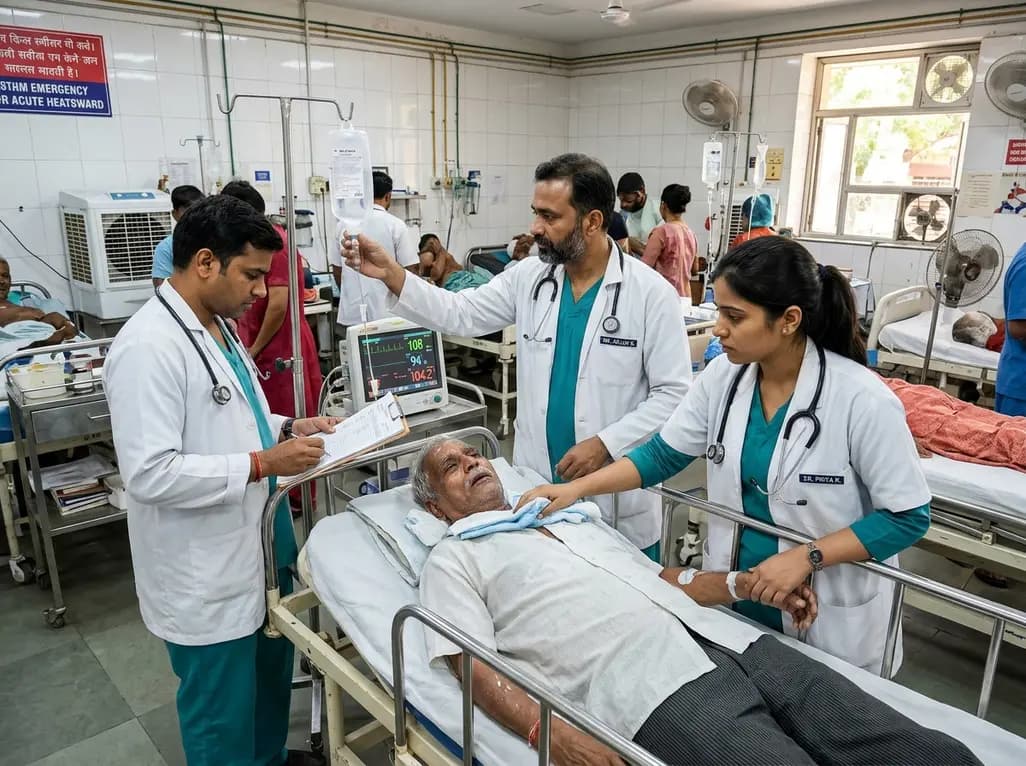
Recent epidemiological data reveals a dramatic surge in summer heat mortality driven by human-induced climate warming. This analysis explores the pathophysiological impacts on cardiac and renal systems, diagnostic dilemmas in death certification, and essential emergency cooling protocols for acute clinical care.
Today

Odisha has established India's first state-level clinical protocol specifically tailored for pregnant women with sickle cell disease. Developed with NHM and UNICEF, the framework provides structured antenatal screening, crisis mitigation, standardized referral pathways, and specialized interdisciplinary care.
Today

India is advancing preventive healthcare by integrating genomics, artificial intelligence, and quantum technologies. With the SANGAM programme sequencing one million Indian genomes, clinicians can unlock personalized therapies, detect cardiometabolic risks early, and curb the burden of diabetes and heart disease.
Today

A randomized controlled trial demonstrates that an eight-week dual-task training intervention significantly improves static and dynamic postural control over standard balance exercises in individuals with chronic ankle instability, addressing critical neurocognitive deficits during athletic and daily activities.
Today

A retrospective cohort study of 7,716 ICU patients from the MIMIC-IV database demonstrates that Gradient Boosting Decision Trees significantly outperform traditional SOFA scores in predicting in-hospital mortality among patients with sepsis and diabetes, with SHAP analysis providing clinical interpretability.
Today
