.webp&w=384&q=75)

Loading, please wait...
Loading, please wait...
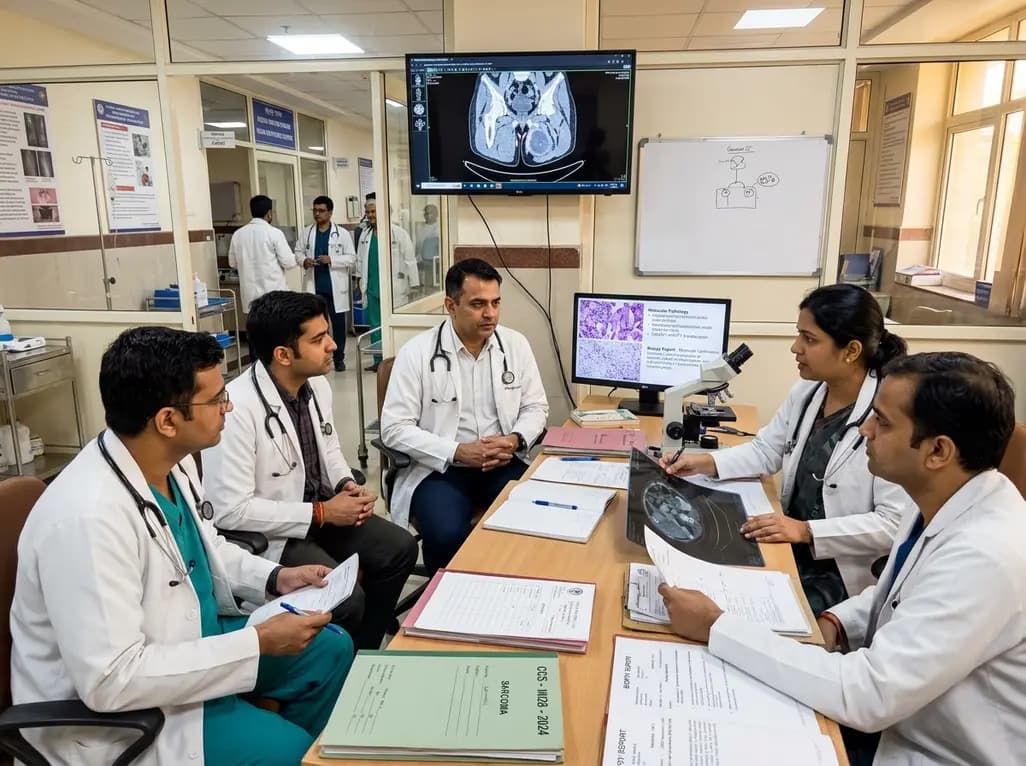
Clear cell sarcoma is an ultra-rare, aggressive soft tissue malignancy that primarily affects young adults aged 20 to 40 years. Clinicians frequently encounter this neoplasm in the deep soft tissues of the extremities, particularly involving tendons and aponeuroses. Because the lesion typically presents as a slow-growing, painless mass, initial clinical evaluation often misinterprets it as a benign soft tissue condition. Consequently, diagnostic delays frequently occur, allowing the primary tumor to enlarge substantially before definitive oncology referral. In athletic populations and active military personnel, high physical demands may mask symptoms, leading healthcare providers to suspect chronic tendonitis or post-traumatic hematoma. However, any deep soft tissue mass persisting beyond several weeks requires urgent cross-sectional magnetic resonance imaging and histological evaluation. A recent military case series demonstrated that thigh presentations often exceed five centimeters and exhibit advanced local invasion at diagnosis. Therefore, maintaining a high index of clinical suspicion and ensuring prompt referral to specialized sarcoma centers are paramount to improving patient outcomes.
Pathologists face considerable diagnostic hurdles when evaluating clear cell sarcoma due to its striking morphological overlap with malignant melanoma. Histopathologically, the tumor demonstrates nested fascicles of uniform epithelioid cells with clear cytoplasm and prominent nucleoli divided by fibrous septa. Furthermore, immunohistochemistry reveals strong positivity for melanocytic markers, including S100 protein, SOX10, and HMB-45. However, clear cell sarcoma possesses a distinct molecular driver absent in cutaneous melanoma. The definitive genetic hallmark is the t(12;22)(q13;q12) chromosomal translocation, which creates the chimeric EWSR1-ATF1 fusion oncogene. Less frequently, tumors exhibit an EWSR1-CREB1 translocation. In contrast, cutaneous melanoma lacks EWSR1 rearrangements and predominantly displays activating BRAF or NRAS mutations. Therefore, definitive diagnosis necessitates molecular confirmation using fluorescence in situ hybridization or reverse-transcriptase polymerase chain reaction. Additionally, novel immunohistochemical markers such as PRAME assist in difficult differential diagnoses. Rapid molecular verification prevents inappropriate treatment plans and guides timely multidisciplinary care.
Wide surgical resection with microscopically negative margins serves as the primary curative modality for localized clear cell sarcoma. Because local recurrence rates remain high after conservative excision, surgeons must achieve complete oncological clearance while preserving essential limb function. For large tumors in the thigh, extensive soft tissue dissection and periosteal stripping significantly alter skeletal biomechanics. Consequently, the affected bone experiences heightened cortical stress and an elevated risk of postoperative pathological fracture. To mitigate structural failure, orthopedic oncologists frequently perform prophylactic stabilization using intramedullary nails. Specifically, carbon fiber intramedullary nails provide rigid structural support while generating minimal artifact on surveillance magnetic resonance imaging and computed tomography scans. This radiolucent advantage significantly improves postoperative surveillance for recurrence and facilitates precise radiation planning. Nevertheless, extensive surgical margins combined with adjuvant radiation heighten the risk of wound dehiscence and vascular complications. Therefore, close multidisciplinary collaboration between orthopedic oncologists and reconstructive surgeons remains vital.
Unlike most adult soft tissue sarcomas that disseminate almost exclusively through hematogenous pathways, clear cell sarcoma shows a remarkable propensity for lymphatic spread. Regional lymph node metastases occur in up to one-third of patients at initial presentation or during disease follow-up. In the military cohort, two of three patients presented with nodal involvement at diagnosis, while the third developed nodal recurrence rapidly. Therefore, initial staging protocols must incorporate comprehensive regional lymph node evaluation alongside thoracic cross-sectional imaging. Sarcoma multidisciplinary teams increasingly utilize positron emission tomography and sentinel lymph node biopsy for accurate disease staging. When nodal involvement is identified, therapeutic lymphadenectomy provides regional disease control. Unfortunately, hematogenous dissemination to the lungs, bone, and spine remains common despite complete surgical clearance. Because distant metastatic disease carries a poor prognosis, systematic post-treatment surveillance remains essential to identify recurrence early and provide timely targeted interventions.
Systemic therapeutic options for advanced clear cell sarcoma remain severely limited, representing a major clinical challenge in soft tissue oncology. Standard anthracycline-based chemotherapy regimens demonstrate minimal efficacy, and single-agent immune checkpoint inhibitors offer modest objective response rates. Consequently, patients with metastatic disease experience poor overall survival, with median survival ranging between 12 and 21 months in advanced series. However, deeper insight into the EWSR1-ATF1 oncogenic pathway has revealed actionable biological targets. The fusion protein drives aberrant activation of the MET receptor tyrosine kinase and MITF transcriptional networks. As a result, multi-kinase inhibitors such as sunitinib and cabozantinib, alongside novel selective MET inhibitors, have demonstrated clinical benefit in ongoing trials. Furthermore, combinatorial epigenetic therapies targeting histone deacetylases show promising preclinical activity. Because therapeutic options remain constrained, medical oncologists must prioritize clinical trial enrollment for advanced cases while coordinating comprehensive supportive care to maintain quality of life.
Clear cell sarcoma shares histopathological features and melanocytic immunohistochemical markers with malignant melanoma, but it represents a genetically distinct soft tissue sarcoma. While cutaneous melanoma commonly harbors BRAF, NRAS, or KIT mutations, clear cell sarcoma is characterized by a pathognomonic EWSR1-ATF1 or EWSR1-CREB1 gene fusion. Clinically, clear cell sarcoma originates in deep connective tissues of extremities in young adults and demonstrates marked resistance to standard melanoma immunotherapy and chemotherapy protocols.
Unlike most adult soft tissue sarcomas that primarily spread via hematogenous pathways to the lungs, clear cell sarcoma possesses a high predilection for lymphatic dissemination. Regional lymph node metastases occur in up to one-third of patients at initial presentation or early follow-up. Consequently, baseline staging requires dedicated nodal ultrasound or PET-CT, and multidisciplinary sarcoma teams frequently utilize sentinel lymph node biopsy to detect occult metastases and guide therapeutic lymphadenectomy.
Resection of extensive soft tissue sarcomas adjacent to major long bones often requires aggressive periosteal stripping and surrounding muscle clearance, significantly weakening skeletal integrity. Prophylactic intramedullary fixation stabilizes the bone against pathological fracture under altered biomechanical loading. Utilizing radiolucent carbon fiber intramedullary nails provides robust structural support while minimizing imaging artifacts, which allows precise postoperative surveillance for local recurrence and facilitates targeted planning for adjuvant radiation therapy.
Disclaimer: This content is for informational and educational purposes only and does not constitute medical advice, diagnosis, or treatment. Healthcare professionals should rely on their clinical judgment and refer to the latest local and national guidelines for clinical practice.
References

Read summarized clinical updates, watch expert medical content, and earn CME certifications right from your smartphone.
Open your smartphone camera to scan and install.





Clear cell sarcoma is a rare, aggressive soft tissue malignancy primarily affecting young adults. A recent military case series underscores the high rate of regional nodal metastases, rapid disease progression, and the urgent need for early multidisciplinary referral and molecular verification.
4 weeks back

According to WHO data, average lifespan reached 73.3 years in 2023, recovering from pandemic lows. However, healthy life expectancy lags at 62.8 years due to surging noncommunicable conditions like cardiovascular disease and dementia, demanding proactive primary screening and sustained chronic care.
Today

A scoping review reveals how pregnancy affects phonation through laryngeal edema and reduced phonation time rather than major acoustic pitch alterations. Learn how to identify, evaluate, and manage vocal symptoms in expectant mothers.
Today

Medical robotics is transitioning beyond operative suites into diagnostics, cardiology, and endocrinology. Explore how innovations in tele-robotics, AI integration, and nanomedicine are overcoming geographical barriers and transforming precision healthcare delivery across India's evolving disease landscape.
Today
Researchers have engineered an artificial sensory-pain integrated receptor using a multi-threshold organic synaptic transistor. The system distinguishes benign touch from noxious stimuli, enabling safer, more responsive prosthetic limbs with built-in memory and simplified hardware architecture.
Today

A qualitative meta-synthesis highlights the complex interplay between gender dysphoria, minority stress, and eating disorders in transgender and gender-diverse individuals. Clinicians must recognize these distinct drivers to offer supportive, gender-affirming, and interdisciplinary eating disorder care.
Today
