.webp&w=384&q=75)

Loading, please wait...
Loading, please wait...

Anthropic recently announced the launch of its Claude Science AI research workbench. This platform represents a major milestone in modern medicine. This specialized tool helps clinical researchers streamline heavy computational workflows. Consequently, scientists can now analyze complex datasets and accelerate therapeutic breakthroughs. Indeed, by targeting academic research, the platform minimizes administrative burdens that bottleneck laboratory data management.
Modern biomedical research often demands immense computational power and tedious multi-step analysis. Fortunately, the new Claude Science AI workbench addresses these challenges by consolidating fragmented laboratory systems into a single, unified digital interface. Researchers can now conduct advanced analyses directly from their desktops while seamlessly managing high-performance computing clusters in the background. Furthermore, this tool allows investigators to query and cross-reference thousands of existing scientific papers instantaneously. Therefore, researchers can finalize literature reviews that previously consumed several months of rigorous manual searching in mere hours. Additionally, the system generates clean, publication-ready charts and complete manuscript drafts directly from raw laboratory inputs. This automated documentation allows laboratory teams to focus their intellect on active hypothesis testing rather than administrative tasks. Ultimately, this seamless automation bridges the historical gap between raw computational output and peer-reviewed publication. By providing pre-configured access to complex datasets, the workbench empowers academic institutions to produce high-quality biological studies with unprecedented speed. Consequently, researchers can focus on innovation rather than tedious data formatting.
The journey of bringing a novel therapeutic molecule to clinical trials is traditionally long, expensive, and fraught with failure. However, Anthropic is directly confronting this bottleneck by utilizing its new platform to run internal, pre-clinical drug discovery programs. Specifically, the company plans to focus its initial computational efforts on neglected tropical diseases that receive insufficient commercial attention. By harnessing advanced machine learning algorithms, the platform can predict drug-target interactions and model molecular behavior with high precision. Moreover, this system integrates seamlessly with the NVIDIA BioNeMo Agent Toolkit to leverage accelerated molecular modeling microservices. Consequently, researchers can quickly evaluate billions of chemical compounds without relying exclusively on slow, physical wet-lab assays. Subsequently, investigators identify promising therapeutic candidates in days rather than years, dramatically reducing initial research overhead. Thus, this computational acceleration promises to democratize drug design, making treatments for rare diseases far more economically viable for global health organizations. In the long run, this technological shift could revolutionize how public health institutions respond to emerging biological threats. Indeed, the ability to rapidly design molecules represents a vital safeguard.
To perform meaningful research, modern scientists require constant access to highly specialized biological repositories. Recognizing this critical need, Anthropic has pre-configured its research workbench with more than sixty massive scientific databases from day one. These resources include widely utilized platforms like BioMart, CellGuide, and Benchling, ensuring immediate access to genomic and proteomic data. Additionally, the workbench features native visualization tools designed to render highly technical molecular structures directly on the screen. For example, researchers can intuitively manipulate 3D protein structures, trace genome browser tracks, and analyze complex chemistry models without switching external applications. Furthermore, the integration with local compute sandboxes allows scientists to handle heavy datasets safely without exporting intellectual property. Consequently, this centralized architecture eliminates the operational friction of toggling between disparate tools. This unified experience is particularly beneficial for multidisciplinary teams collaborating on spatial transcriptomics or single-cell genomics projects. Ultimately, having all computational resources in a single interface leads to fewer manual errors. Therefore, institutions adopting this framework can expect significantly higher data throughput.
A persistent crisis in modern academic and clinical research is the widespread lack of experimental reproducibility. Fortunately, this platform tackles this fundamental issue head-on by generating fully auditable, step-by-step digital artifacts for every analysis. Specifically, the system automatically links every single visual plot, chart, or data table back to its underlying source code. Moreover, the system saves the precise laboratory environment, raw files, and conversational history that produced the output. Therefore, external peer reviewers can easily trace a study's computational journey from raw data to the final published figure. Additionally, this absolute transparency ensures that independent teams can replicate any findings months or even years later. Furthermore, this trace-back capability significantly mitigates the risk of scientific hallucinations and manual data tampering. By establishing a rigid, automated digital paper trail, the workbench fosters greater trust in computational biology. Consequently, regulatory bodies like the FDA can review clinical trial data submissions with greater confidence and speed. Ultimately, raising the standards of traceability is essential for translating laboratory discoveries into safe, real-world clinical applications.
As artificial intelligence technologies grow increasingly powerful, the potential risk of misuse in the life sciences becomes a major concern. To mitigate these risks, Anthropic has built its new system on models that have undergone extensive safety evaluations. Specifically, the workbench has successfully cleared the company’s strict "responsible scaling" policies designed to prevent biosecurity breaches. These evaluations ensure that malicious actors cannot exploit the AI to synthesize dangerous pathogens or design hazardous biological agents. Furthermore, the platform utilizes local execution and private sandboxes to keep sensitive patient information and proprietary drug designs completely secure. Consequently, clinical laboratories can conduct sensitive research without worrying about intellectual property theft or data leaks. Additionally, the system features built-in reviewer agents that actively monitor workflows to detect anomalous or high-risk biological queries. Therefore, this proactive approach to safety allows researchers to harness advanced AI without compromising ethical standards. Ultimately, balancing technological power with stringent biosecurity is vital for maintaining public trust in automated scientific systems. By establishing these safety baselines, the developer sets a responsible example.
Q1: What is the primary purpose of the new scientific research workbench?
The primary purpose of this platform is to streamline computational biology and medical research by unifying fragmented tools. It connects scientists to over sixty major databases and offers advanced local execution. Consequently, researchers can quickly analyze datasets, render complex 3D protein structures, and automate literature reviews. This significantly reduces the tedious administrative tasks often associated with complex modern laboratory data management.
Q2: How does the system ensure that generated research is reproducible?
The platform ensures reproducibility by linking every generated visual figure, chart, or dataset back to its exact code and environment. When researchers compile findings, the tool automatically packages the complete history, environment variables, and conversational queries used. Therefore, external peer reviewers or regulatory bodies can easily replicate and audit results. This open transparency effectively prevents digital data tampering and potential AI hallucinations.
Q3: What specific biosecurity and safety measures are integrated into the platform?
The platform incorporates rigorous biosecurity protocols to prevent the misuse of powerful AI models in synthesizing dangerous pathogens. Specifically, the system complies with strict responsible scaling policies and utilizes isolated local sandboxes to protect sensitive patient records. Furthermore, automated reviewer agents monitor queries to prevent the design of hazardous agents. These combined measures maintain the highest standards of general clinical safety.
Disclaimer: This content is for informational and educational purposes only. It does not constitute medical advice or replace professional judgment. Refer to the latest local and national guidelines for clinical practice.
References

Read summarized clinical updates, watch expert medical content, and earn CME certifications right from your smartphone.
Open your smartphone camera to scan and install.





Anthropic has launched Claude Science, a specialized AI research workbench designed for the healthcare and life sciences sectors. By integrating powerful computing tools, database connectors, and advanced visualization, this innovative platform accelerates pre-clinical drug discovery and clinical data workflows.
3 months ago
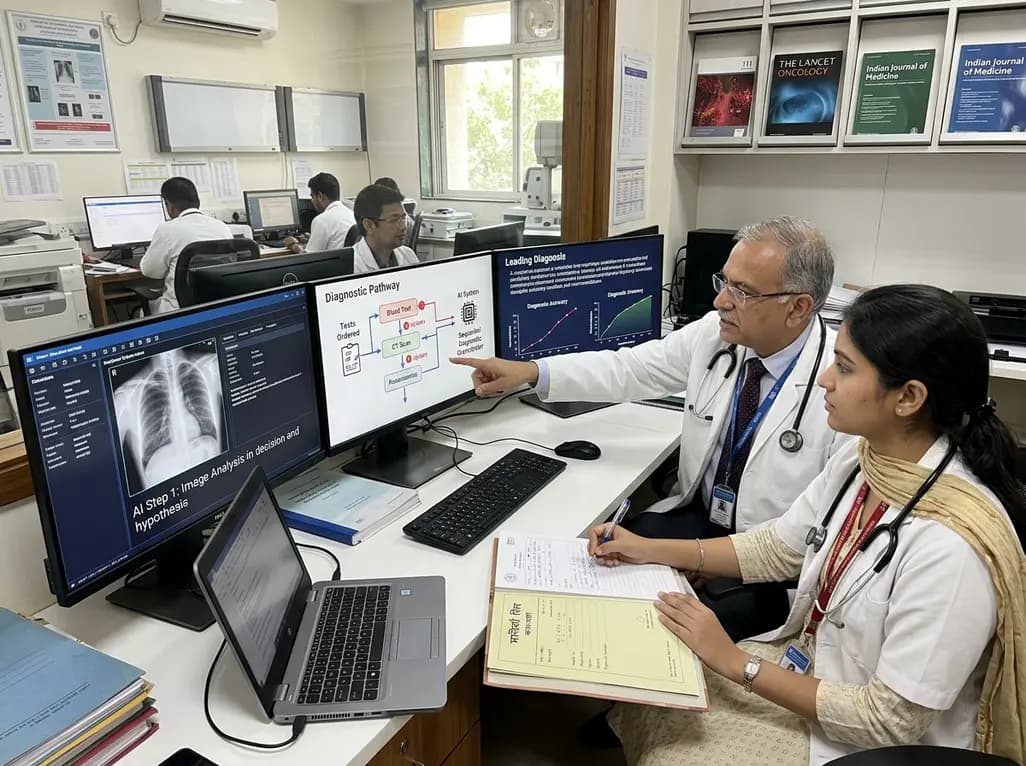
A breakthrough peer-reviewed study demonstrates that a sequential AI diagnosis system can mirror real-world clinical reasoning. By ordering stepwise tests and updating hypotheses dynamically, this multi-agent orchestrator achieved superior diagnostic accuracy while reducing investigative costs.
Today

A prenatal case highlights severe glutaric acidemia type II presenting as bilateral hyperechoic cystic kidneys at 18 weeks. Whole-exome sequencing revealed a novel homozygous ETFDH frameshift variant, demonstrating the power of rapid genetic testing in fetal renal anomalies.
Today

Review how tailored exercise programs benefit frail older patients with heart failure. Explore pathophysiological mechanisms, individualized training prescriptions, and strategies to overcome adherence barriers in clinical practice.
Yesterday

This comparative study evaluates posterior labral tears with and without glenohumeral instability, highlighting distinct demographic patterns, MRI underestimation in stable shoulders, and successful arthroscopic repair outcomes.
Yesterday

A clinical study demonstrates that early intervention with tocilizumab, either as monotherapy or bridged with corticosteroids, achieves significant proptosis reduction and resolves active inflammation in treatment-naive thyroid eye disease.
Yesterday
