.webp&w=384&q=75)

Loading, please wait...
Loading, please wait...
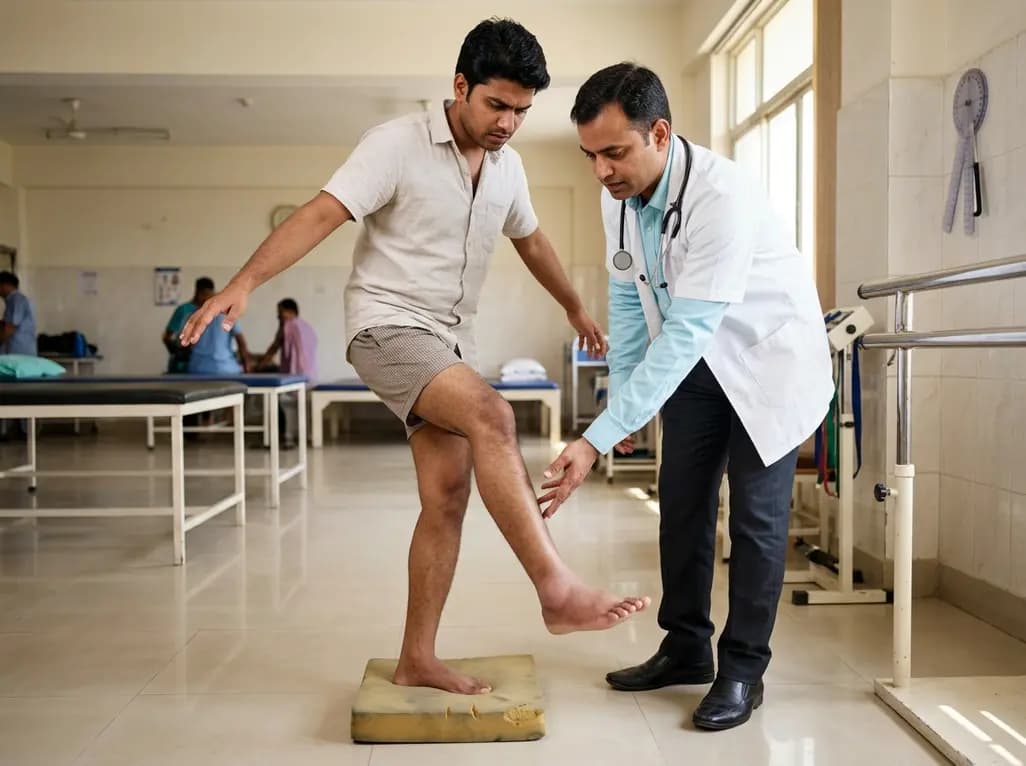
Clinicians often observe persistent edema in patients with recurrent ankle issues. Recent research highlights that Chronic Ankle Instability swelling significantly impairs both objective dynamic balance and subjective patient outcomes. This cross-sectional study evaluated sixty participants to understand how swelling influences postural control. The findings suggest that managing residual edema is a critical component of successful rehabilitation programs.
Researchers divided participants into three distinct groups: those with CAI and swelling, those with CAI without swelling, and healthy controls. The study team measured stability during single-leg stance and hop-to-stabilization tasks. Interestingly, the results showed that swelling primarily affects dynamic rather than static postural control. Specifically, the swelling group exhibited significantly higher scores on the Vertical Stability Index and Dynamic Postural Stability Index. Furthermore, this indicates a reduced ability to maintain equilibrium during complex movements compared to the nonswelling and control groups. Consequently, the presence of even minor swelling may disrupt the sensorimotor system.
Additionally, the presence of swelling correlates with lower scores on validated clinical assessment tools. Participants in the swelling group reported significantly worse outcomes on the Foot and Ankle Ability Measure (FAAM) for both daily living and sports activities. Moreover, their scores on the Cumberland Ankle Instability Tool were lower, reflecting a greater perceived sense of instability. These results imply that swelling acts as more than just a physical symptom. For instance, it serves as a clear marker for functional and perceived impairment. Therefore, clinicians should prioritize edema reduction to improve both stability and patient satisfaction.
Overall, this study underscores the necessity of a comprehensive approach to CAI management. Although static balance may remain relatively stable, dynamic movements are compromised by persistent swelling. Therefore, rehabilitation protocols should incorporate specific strategies to resolve edema. For example, therapists might use compression, elevation, or manual lymphatic drainage. This approach will likely enhance the recovery of motor control and improve the patient's overall quality of life. As a result, addressing swelling becomes an essential step in preventing future injury recurrence.
Swelling impairs dynamic postural control, making it harder for patients to stabilize their bodies after movement. This is reflected in higher Dynamic Postural Stability Index scores compared to those without swelling.
Yes. Patients with CAI and swelling report significantly lower scores on functional measures like the FAAM-ADL and FAAM-Sport subscales, indicating greater difficulty with daily activities and athletics.
The study found no significant differences in static postural control between the swelling and nonswelling groups. However, the deficits in dynamic stability suggest that movement-based tasks are more sensitive to the effects of swelling.
Disclaimer: This content is for informational and educational purposes only and does not constitute professional medical advice, diagnosis, or treatment. Always seek the advice of your physician or other qualified health provider with any questions you may have regarding a medical condition. Refer to the latest local and national guidelines for clinical practice.
References
Oh M et al. Effects of Swelling on Static and Dynamic Postural Control and Patient-Reported Outcomes in Individuals With Chronic Ankle Instability. Clin J Sport Med. 2026 Jun 03. doi: 10.1097/JSM.0000000000001482. PMID: 42235077.
McCriskin BL et al. Management and prevention of acute and chronic lateral ankle instability in athletic patient populations. World J Orthop. 2015;6(2):161-171.
Earl A et al. Effects of Ankle Swelling on Static Postural Control and Patient-Reported Outcomes in Individuals with Chronic Ankle Instability. International Journal of Exercise Science.
"
Read summarized clinical updates, watch expert medical content, and earn CME certifications right from your smartphone.
Open your smartphone camera to scan and install.





New research shows that swelling in chronic ankle instability significantly impairs dynamic balance and patient-reported outcomes, necessitating targeted ca...
4 months ago

A breakthrough study evaluated H5N1 transmission efficiency across mammalian isolates. Researchers discovered that human-derived D1.1 harboring the PB2 D701N mutation spread efficiently in ferrets, unlike strains carrying PB2 E627K. This finding highlights critical genetic markers for zoonotic surveillance.
Today

A comparative cohort study evaluates vNOTES vs TLH hysterectomy for benign conditions, demonstrating shorter operative duration, faster return to daily activities, and equivalent female sexual function scores without increased dyspareunia.
Today

Review how tailored exercise programs benefit frail older patients with heart failure. Explore pathophysiological mechanisms, individualized training prescriptions, and strategies to overcome adherence barriers in clinical practice.
Yesterday

This comparative study evaluates posterior labral tears with and without glenohumeral instability, highlighting distinct demographic patterns, MRI underestimation in stable shoulders, and successful arthroscopic repair outcomes.
Yesterday

A clinical study demonstrates that early intervention with tocilizumab, either as monotherapy or bridged with corticosteroids, achieves significant proptosis reduction and resolves active inflammation in treatment-naive thyroid eye disease.
Today
