.webp&w=384&q=75)

Loading, please wait...
Loading, please wait...

Understanding the molecular architecture of calcium phosphates is crucial for developing advanced dental and orthopedic implants. Recently, researchers applied Chlorine Calcium Phosphate NMR Analysis to investigate the interface between crystalline and glasslike moieties in calcium chlorapatite. This study highlights the sensitivity of Chlorine nuclear magnetic resonance (NMR) as a probe for characterizing complex biomaterials. By utilizing magic-angle spinning and static NMR, the team successfully analyzed lineshapes that distinguish highly crystalline structures from amorphous shells.
The study revealed a distinct core-shell relationship within the calcium chlorapatite particles. Transmission electron microscopy confirmed that the particles consist of a crystalline core and a glasslike shell. Notably, the ratio of these materials depends heavily on particle morphology. Smaller particles exhibit a higher proportion of glasslike species. Conversely, larger particles remain predominantly crystalline. Therefore, researchers can correlate phase composition directly with particle size at a molecular level.
While X-ray diffraction remains a standard tool, it often struggles with materials lacking long-range order. In contrast, quadrupolar NMR demonstrates remarkable robustness in characterizing coexisting phases. Specifically, it accurately identifies glasslike materials that lack traditional crystalline patterns. This capability makes it an essential complementary technique for evaluating materials used in clinical practice. Consequently, engineers can better predict how these materials will behave when integrated into biological systems.
Designing effective bone substitutes requires precise control over crystallinity and resorption rates. The presence of glasslike moieties often influences how effectively a material osseointegrates with host bone. Furthermore, understanding the shell-core composition helps manufacturers optimize injectable cements and implant coatings. Consequently, this refined analytical approach ensures higher quality standards for medical-grade calcium phosphates.
While X-ray diffraction identifies crystalline patterns, Chlorine NMR can detect amorphous or glasslike phases that lack long-range order, providing a more complete phase composition profile.
The core-shell structure influences the surface reactivity and bioactivity of the particles. A glasslike shell may resorb more quickly, potentially enhancing initial osseointegration compared to purely crystalline cores.
Yes, although this study focused on chlorapatite, the methodology provides a framework for analyzing other quadrupolar nuclei in various calcium-based biomaterials used in orthopedics and dentistry.
Disclaimer: This content is for informational and educational purposes only and does not constitute professional medical advice, diagnosis, or treatment. Always seek the advice of your physician or other qualified health provider with any questions you may have regarding a medical condition. Refer to the latest local and national guidelines for clinical practice.
References

Read summarized clinical updates, watch expert medical content, and earn CME certifications right from your smartphone.
Open your smartphone camera to scan and install.





Researchers utilize Chlorine NMR to analyze the core-shell structure of calcium phosphate particles, identifying crystalline and glasslike phases at molecul...
4 months ago
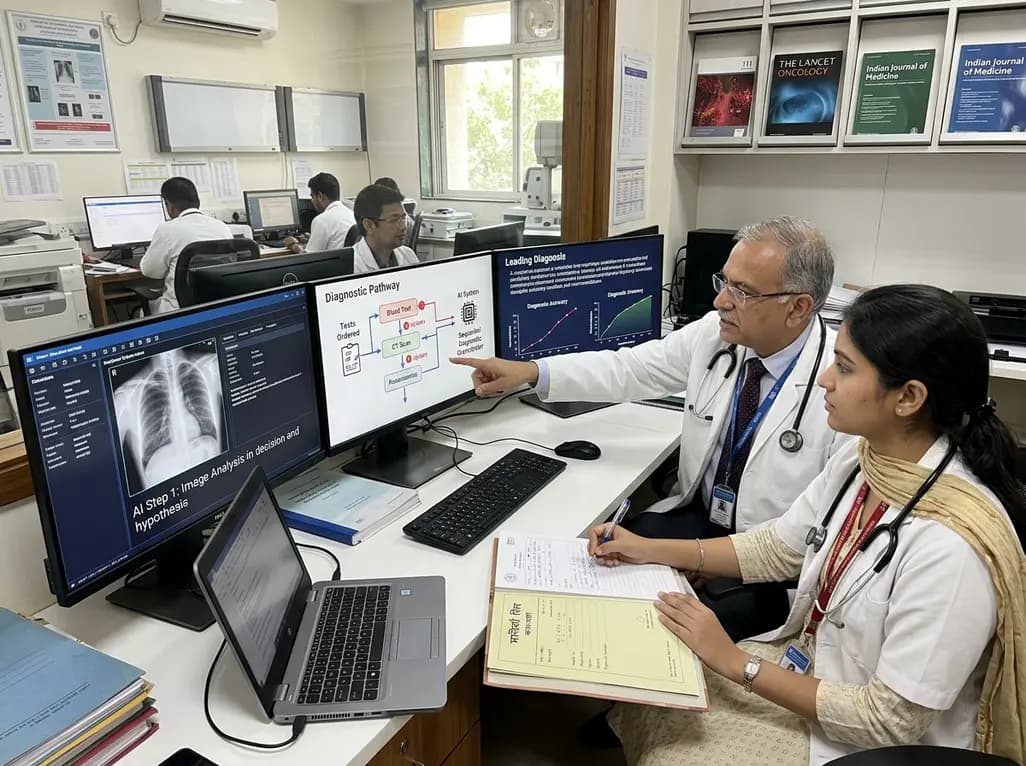
A breakthrough peer-reviewed study demonstrates that a sequential AI diagnosis system can mirror real-world clinical reasoning. By ordering stepwise tests and updating hypotheses dynamically, this multi-agent orchestrator achieved superior diagnostic accuracy while reducing investigative costs.
Today

A prenatal case highlights severe glutaric acidemia type II presenting as bilateral hyperechoic cystic kidneys at 18 weeks. Whole-exome sequencing revealed a novel homozygous ETFDH frameshift variant, demonstrating the power of rapid genetic testing in fetal renal anomalies.
Today

Review how tailored exercise programs benefit frail older patients with heart failure. Explore pathophysiological mechanisms, individualized training prescriptions, and strategies to overcome adherence barriers in clinical practice.
Yesterday

This comparative study evaluates posterior labral tears with and without glenohumeral instability, highlighting distinct demographic patterns, MRI underestimation in stable shoulders, and successful arthroscopic repair outcomes.
Yesterday

A clinical study demonstrates that early intervention with tocilizumab, either as monotherapy or bridged with corticosteroids, achieves significant proptosis reduction and resolves active inflammation in treatment-naive thyroid eye disease.
Yesterday
