.webp&w=384&q=75)

Loading, please wait...
Loading, please wait...

Child psychiatry competence among primary care providers remains a critical global issue as mental health cases among the youth continue to rise. A recent study in Sweden highlights that many general practitioners (GPs) and resident physicians feel ill-equipped to handle the mental health needs of younger patients. Consequently, this gap in training may hinder early intervention and effective management of pediatric psychiatric disorders. Because children and adolescents frequently present with complex symptoms, GPs often serve as the first point of contact for families seeking help.
In India, where over 434 million individuals are under the age of 18, the need for enhanced child psychiatry competence is particularly urgent. Specifically, the National Mental Health Survey (NMHS) indicates that nearly one in seven adolescents in India experiences a mental health disorder. However, most primary care doctors report limited education in child and adolescent psychiatry during their undergraduate years. Furthermore, the Swedish study found that physicians feel significantly less confident managing younger children (6-12 years) compared to adolescents. This lack of confidence is most evident when prescribing psychiatric medications or managing conditions like eating disorders and self-harm. As a result, many young patients do not receive timely or appropriate care at the primary level.
To address these challenges, several initiatives are focusing on upskilling medical professionals. For example, the National Medical Commission (NMC) in India has introduced a competency-based medical curriculum (CBME) to provide structured training for medical graduates. Similarly, institutions like NIMHANS offer the Primary Care Psychiatry Programme (PCPP) to empower GPs with essential skills. These programs aim to strengthen medical school curricula and residency programs to ensure doctors can identify and manage common mental health disorders. Therefore, continuing medical education (CME) is essential for practicing physicians to keep pace with the growing prevalence of mental ill-health in young populations.
Most GPs report limited clinical exposure and formal education in child-specific psychiatry during their medical school and residency years. This leads to lower confidence in diagnosing complex symptoms and prescribing psychiatric medications for younger age groups.
Physicians can participate in specialized diploma courses, such as those offered by NIMHANS, and engage in continuing medical education (CME) programs focused on child-specific diagnostic frameworks and pharmacological guidelines.
Disclaimer: This content is for informational and educational purposes only. It does not constitute medical advice or establish a doctor-patient relationship. Always seek the advice of a qualified healthcare provider for any questions regarding a medical condition. Refer to the latest local and national guidelines for clinical practice.
References
Söderström L et al. Caring for young minds: general practitioners' self-assessed competence in child and adolescent psychiatry. Scand J Prim Health Care. 2026 Dec undefined. doi: 10.1080/02813432.2026.2654175. PMID: 41984523.
Patra S. Competency-based child and adolescent psychiatry curriculum for Indian medical graduates: Need of the hour. Asian J Psychiatr. 2022 Jun;72:103150. doi: 10.1016/j.ajp.2022.103150.
National Institute of Mental Health & Neurosciences. Primary Care Psychiatry Program (PCPP). [Internet]. Bengaluru, India: NIMHANS; Available from: https://nimhans.co.in.
"
Read summarized clinical updates, watch expert medical content, and earn CME certifications right from your smartphone.
Open your smartphone camera to scan and install.





A Swedish study highlights significant gaps in child psychiatry competence among general practitioners, underscoring the need for better medical education....
6 months ago
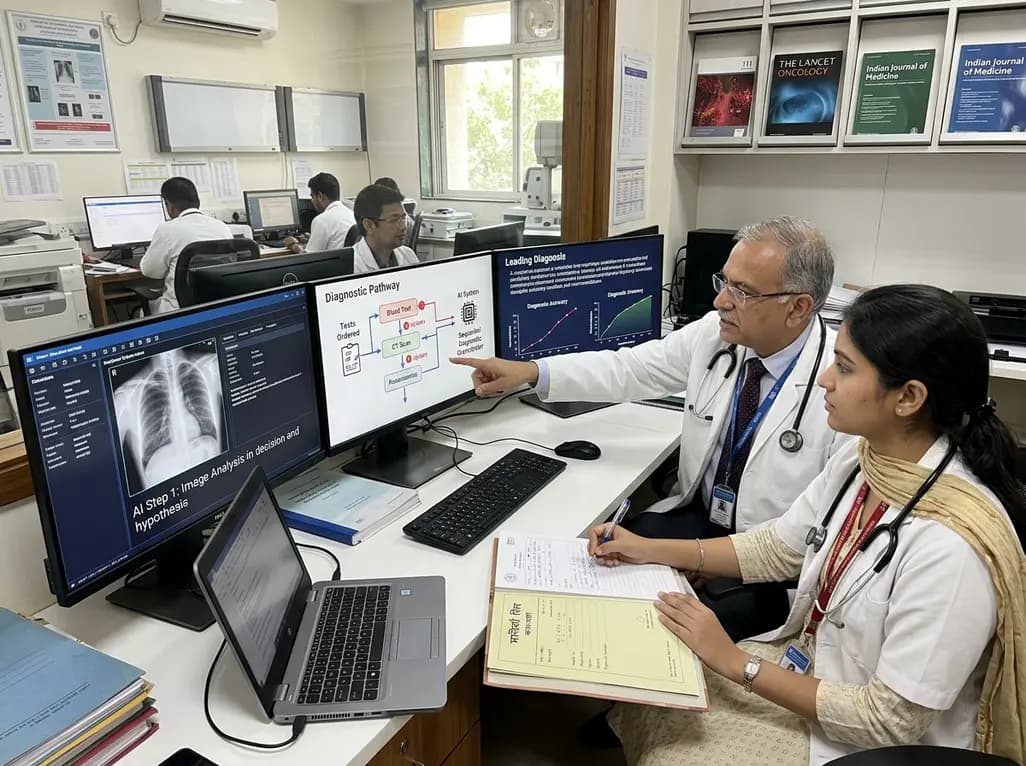
A breakthrough peer-reviewed study demonstrates that a sequential AI diagnosis system can mirror real-world clinical reasoning. By ordering stepwise tests and updating hypotheses dynamically, this multi-agent orchestrator achieved superior diagnostic accuracy while reducing investigative costs.
Today

A prenatal case highlights severe glutaric acidemia type II presenting as bilateral hyperechoic cystic kidneys at 18 weeks. Whole-exome sequencing revealed a novel homozygous ETFDH frameshift variant, demonstrating the power of rapid genetic testing in fetal renal anomalies.
Today

Review how tailored exercise programs benefit frail older patients with heart failure. Explore pathophysiological mechanisms, individualized training prescriptions, and strategies to overcome adherence barriers in clinical practice.
Yesterday

This comparative study evaluates posterior labral tears with and without glenohumeral instability, highlighting distinct demographic patterns, MRI underestimation in stable shoulders, and successful arthroscopic repair outcomes.
Yesterday

A clinical study demonstrates that early intervention with tocilizumab, either as monotherapy or bridged with corticosteroids, achieves significant proptosis reduction and resolves active inflammation in treatment-naive thyroid eye disease.
Yesterday
