.webp&w=384&q=75)

Loading, please wait...
Loading, please wait...
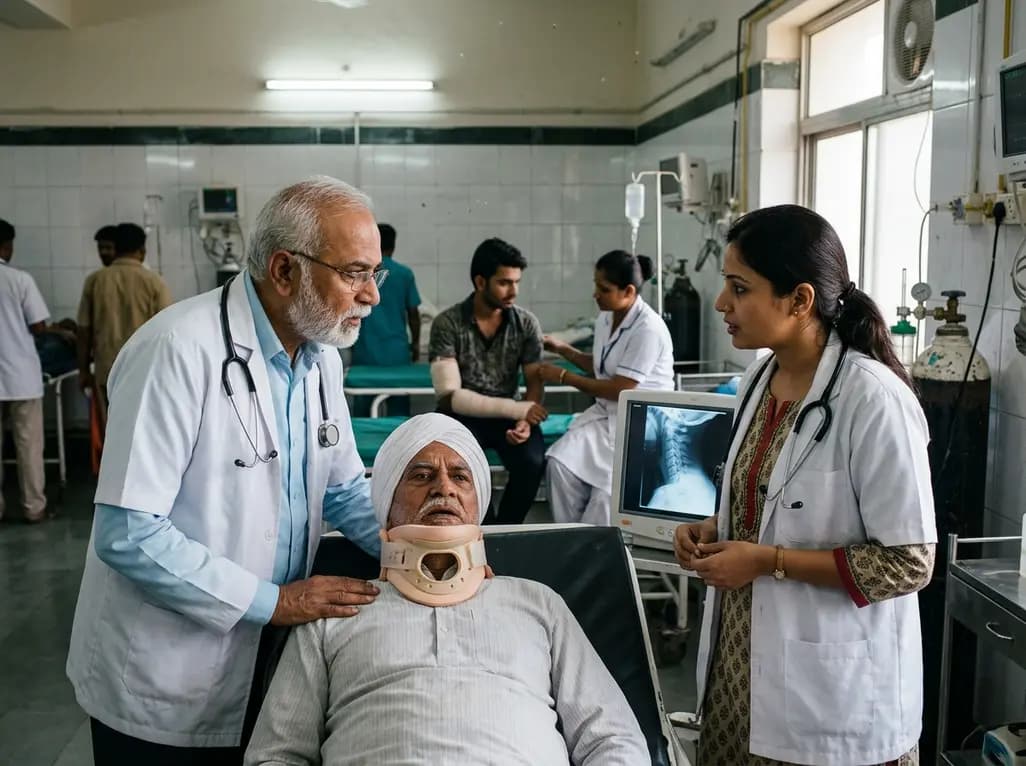
In the demanding environment of modern emergency departments, clinicians frequently encounter cervical spine injury falls. Historically, trauma protocols prioritized the height of a fall as the primary predictor of injury severity. However, recent bioengineering research challenges this conventional wisdom. Specifically, experts now emphasize the concept of imparted energy (IE). This vector combines velocity changes with the principal direction of force. Paradoxically, the vertical energy vector from a fall often fails to translate into the horizontal motion required to damage the cervical spine. Consequently, high-energy falls from significant heights do not always result in higher incidences of cervical fractures compared to ground-level incidents. Therefore, medical professionals must look beyond the fall distance when assessing trauma patients. Furthermore, understanding the nuances of how energy transfers during impact helps in predicting which patients require aggressive radiographic screening. Typically, the geriatric population remains at the highest risk regardless of the fall mechanism. Notably, this study hypothesizes that age-related physiological changes outweigh the external mechanics of the fall itself. Resultantly, physicians should maintain a high index of suspicion even for patients presenting after seemingly minor stumbles or slips on the same level.
Research consistently shows that patient age serves as a more reliable indicator for injury than fall distance. For instance, elderly patients often possess significantly lower bone mineral density. This physiological reality means that even a ground-level fall can generate enough force to cause a catastrophic fracture. Moreover, age-related degeneration within the spinal column reduces its natural flexibility. In contrast, younger individuals often possess resilient ligamentous structures that absorb energy more effectively. Resultantly, the imparted energy from a low-height fall may overwhelm a brittle spine but leave a youthful one unscathed. Additionally, comorbidities like osteoporosis and prior spinal stenosis exacerbate these risks. Therefore, the triage process should prioritize geriatric status over the stated height of the fall. Clinically, this shift in focus ensures that elderly patients receive appropriate imaging immediately upon arrival. Furthermore, statistical analysis confirms that the incidence of cervical spine injury (CSI) remains relatively constant across various fall heights in older adults. Consequently, a fall from two feet can be just as dangerous as a fall from ten feet for an eighty-year-old patient. Ultimately, age stands as the most critical variable in trauma risk stratification.
The patterns of injury observed in older populations differ markedly from those seen in younger cohorts. Specifically, geriatric patients frequently sustain fractures in the upper cervical spine, particularly at the C1 and C2 levels. Historically, these upper-level injuries relate to the stiffening of the subaxial spine due to spondylosis. When an elderly person falls, the mechanical stress often concentrates at the highly mobile atlantoaxial complex. Consequently, odontoid fractures represent a common finding in this demographic. Conversely, younger patients more often experience injuries in the lower cervical segments (C5-C7) where mobility is typically higher in a healthy spine. Furthermore, multilevel injuries occur more frequently in the elderly. Therefore, radiologists must meticulously examine the entire cervical series even if they identify a single fracture initially. Resultantly, computed tomography (CT) has become the gold standard for screening, as it provides superior visualization of complex bony architecture. Moreover, magnetic resonance imaging (MRI) remains essential for evaluating ligamentous integrity and spinal cord edema. Importantly, recognizing these specific patterns allows surgical teams to prepare for unique stabilizing procedures that address the specific vulnerabilities of an aging vertebral column.
Strategically, the management of suspected spinal trauma begins with effective triage protocols. Given that age is such a potent risk factor, clinicians should reconsider standard exclusion criteria for imaging. For example, some clinical decision rules like the NEXUS criteria may prove less reliable in the very elderly. Often, cognitive impairment or minor distractions can mask the classic symptom of midline tenderness. Therefore, many trauma centers now adopt a policy of screening all geriatric fall victims with a CT scan regardless of the height of the fall. This proactive approach aims to identify occult fractures that could lead to delayed neurological deterioration. Additionally, early immobilization remains vital during the initial assessment phase. However, clinicians must also manage the risks associated with prolonged collar use, such as pressure sores. Consequently, rapid diagnosis and early clearance of the cervical spine are paramount. Furthermore, the presence of head injuries frequently correlates with underlying cervical damage. Thus, if a patient requires a head CT after a fall, it is often prudent to include the cervical spine in the same session. Resultantly, this integrated imaging strategy saves time and ensures a comprehensive evaluation of the central nervous system.
In India, the management of fall-related injuries presents unique socio-economic and clinical challenges. Specifically, the rising geriatric population and the prevalence of multigenerational households mean that home-based falls are increasingly common. Frequently, these patients present with delayed diagnoses because minor falls are often dismissed by family members as inconsequential. Consequently, Indian surgeons often deal with fractures that have already begun to heal in malalignment. Furthermore, limited access to advanced imaging in rural areas can delay the identification of unstable injuries. Therefore, community health programs must educate families about the risks of cervical spine injury falls in the elderly. Additionally, the high cost of surgical stabilization and long-term rehabilitation remains a significant barrier for many families. Resultantly, conservative management with rigid collars is frequently utilized, even when surgery might be technically superior. Moreover, the lack of specialized geriatric trauma centers complicates the post-operative recovery phase. Typically, patients require intensive physiotherapy to regain mobility and prevent secondary complications like pneumonia. Ultimately, improving outcomes requires a holistic approach that integrates early detection, affordable surgical options, and robust rehabilitation networks across the country.
Ultimately, the best management strategy for spinal trauma is prevention. Since the incidence of injury remains high regardless of fall height, reducing the overall frequency of falls is critical. For instance, balance training and home safety modifications can significantly decrease the risk for vulnerable seniors. Moreover, managing medications that contribute to dizziness or orthostatic hypotension is a key intervention for primary care physicians. Additionally, ensuring adequate vitamin D and calcium intake helps maintain the bone density necessary to withstand minor impacts. From a clinical perspective, long-term outcomes for those who sustain a CSI vary based on the level of the injury and the patient’s baseline frailty. Typically, upper cervical fractures carry a higher risk of respiratory complications and mortality. Conversely, early surgical intervention and aggressive mobilization can improve the quality of life for many survivors. Furthermore, persistent neck pain and stiffness are common long-term complaints that require multidisciplinary pain management. Resultantly, clinicians must follow these patients closely even after the acute phase of injury. In conclusion, by shifting the focus from fall mechanics to patient physiology, the medical community can better identify, treat, and prevent these life-altering injuries.
Age is a superior predictor because physiological changes, such as decreased bone density and spinal stiffening, significantly lower the threshold for fracture. In older adults, even a ground-level fall can generate sufficient force to break brittle vertebrae. Conversely, younger individuals have flexible ligaments and stronger bones that absorb impact energy. Therefore, the patient's internal resilience is more critical than the external energy of the fall distance.
Elderly patients who experience low-energy falls typically sustain injuries in the upper cervical spine, particularly at C1 and C2. Odontoid fractures are especially prevalent due to the concentration of stress on the atlantoaxial joint. In contrast, high-energy trauma in younger patients usually impacts the lower subaxial spine. These patterns reflect age-related degenerative changes that shift the most vulnerable points of the vertebral column as the body ages.
Indian clinicians should maintain an extremely low threshold for imaging geriatric fall victims, even if the fall occurred at ground level. Given the high risk of occult fractures and the limitations of physical exams in the elderly, a non-contrast CT scan of the cervical spine is the preferred initial screening tool. This approach ensures that unstable injuries are not missed, preventing potential neurological catastrophes and improving long-term survival rates.
Disclaimer: This content is for informational and educational purposes only. It does not constitute medical advice or establish a doctor-patient relationship. Always seek the advice of a qualified healthcare provider regarding any medical condition or treatment. Refer to the latest local and national guidelines for clinical practice.
References
Eduardo S et al. It is Not How High, but How Old: The Incidence and Pattern of Cervical Spine Injury After a Fall. J Surg Res. 2026 Jul 10. doi: undefined. PMID: 42430831.
Kannus P, et al. Alarming rise in the number and incidence of fall-induced cervical spine injuries among older adults. J Gerontol A Biol Sci Med Sci. 2007 Feb;62(2):180-3.
Watanabe S, et al. Differences in clinical characteristics of cervical spine injuries in older adults by external causes: a multicenter study of 1512 cases. Sci Rep. 2022 Sep 23;12(1):15886.
"
Read summarized clinical updates, watch expert medical content, and earn CME certifications right from your smartphone.
Open your smartphone camera to scan and install.





A recent study highlights that patient age is a more significant predictor of cervical spine injury (CSI) than the height of a fall. Learn about the unique injury patterns in elderly patients and how imparted energy influences clinical outcomes in trauma management.
3 months ago

Discover the crucial role of glymphatic dysfunction in stroke, where perivascular clearance failure and neuroinflammation exacerbate cerebral edema and post-stroke brain injury.
Today

A prenatal case highlights severe glutaric acidemia type II presenting as bilateral hyperechoic cystic kidneys at 18 weeks. Whole-exome sequencing revealed a novel homozygous ETFDH frameshift variant, demonstrating the power of rapid genetic testing in fetal renal anomalies.
Today

Review how tailored exercise programs benefit frail older patients with heart failure. Explore pathophysiological mechanisms, individualized training prescriptions, and strategies to overcome adherence barriers in clinical practice.
Yesterday

This comparative study evaluates posterior labral tears with and without glenohumeral instability, highlighting distinct demographic patterns, MRI underestimation in stable shoulders, and successful arthroscopic repair outcomes.
Yesterday

A clinical study demonstrates that early intervention with tocilizumab, either as monotherapy or bridged with corticosteroids, achieves significant proptosis reduction and resolves active inflammation in treatment-naive thyroid eye disease.
Yesterday
