.webp&w=384&q=75)

Loading, please wait...
Loading, please wait...
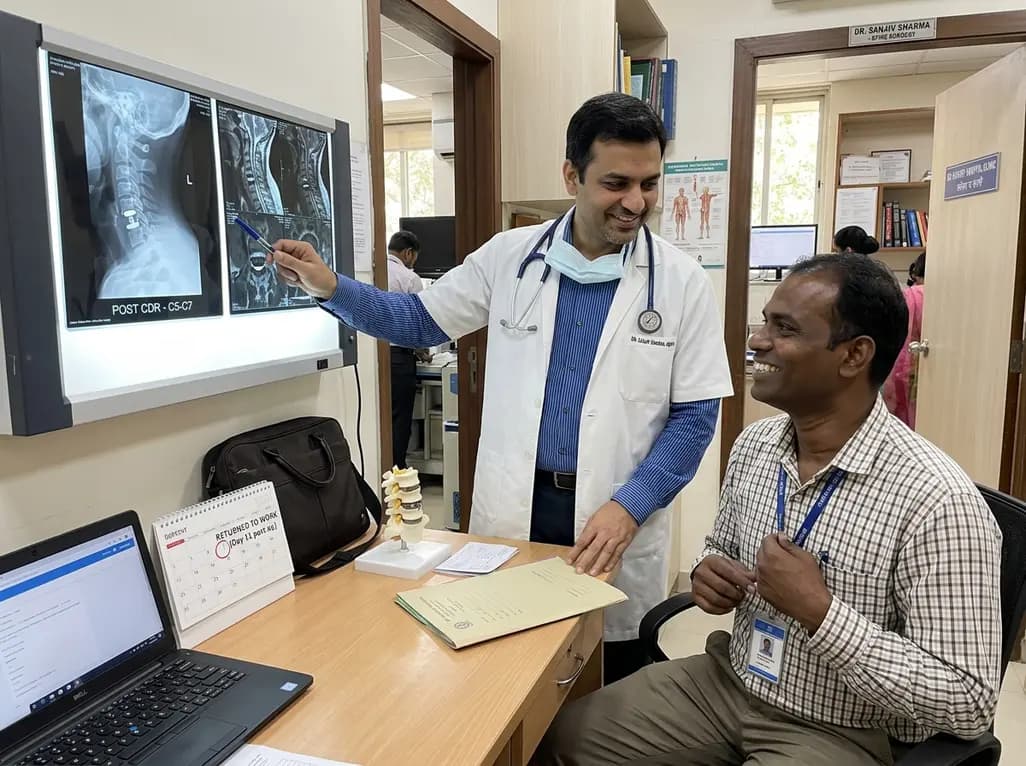
Degenerative cervical spine disease presents a substantial clinical challenge for working-aged adults. Therefore, choosing an effective surgical intervention directly influences physical rehabilitation and vocational productivity. Cervical disk replacement has emerged as an innovative alternative to traditional spinal fusion. While anterior cervical discectomy and fusion remains a reliable standard, motion-preserving techniques offer compelling physiological advantages. Consequently, evaluating how these procedures affect occupational recovery provides crucial guidance for clinicians and active patients.
Symptomatic cervical degenerative disease causes significant radicular pain, numbness, and neurological impairment in working-aged adults. Historically, spine surgeons relied on anterior cervical discectomy and fusion to decompress pinched neural structures and eliminate segmental instability. However, arthrodesis permanently alters spinal biomechanics and increases compensatory kinematic stresses across adjacent segments. In contrast, cervical disk replacement preserves physiological motion at the index operative level while effectively relieving neural compression. This motion preservation reduces mechanical stress shielding across neighboring disc spaces. Furthermore, fusion procedures mandate prolonged postoperative immobilization to achieve solid bony union. Patients frequently wear restrictive collars and follow strict activity limitations for several months to avoid pseudarthrosis. In contrast, artificial disc implants provide immediate mechanical stabilization without demanding biological bony healing. Therefore, rehabilitation specialists can initiate progressive range-of-motion exercises much sooner. Clinicians report that prompt mobilization prevents muscular deconditioning and minimizes persistent postoperative neck stiffness. In addition, patients experience fewer disruptions to daily functional activities. These distinct mechanical characteristics create an ideal physiological environment for individuals striving to resume professional duties without unnecessary delay.
To resolve persistent controversies regarding occupational outcomes, researchers performed a comprehensive systematic review and meta-analysis of randomized controlled trials. Specifically, investigators searched major medical databases, including PubMed, Medline, Cochrane, and Google Scholar, identifying prospective studies published from January 2000 through October 2024. The study strictly adhered to established PRISMA guidelines to guarantee analytical rigor and reproducibility. Ultimately, the authors identified sixteen high-quality randomized controlled trials comprising 5,657 working-aged participants. Within this study population, 3,007 patients underwent motion-preserving disc replacement, whereas 2,650 individuals received anterior cervical discectomy and fusion. The meta-analysis assessed 9,202 documented return-to-work data points across intervals extending from six weeks to beyond two years. In addition, researchers gathered relevant baseline demographic characteristics, such as patient age, operative levels, gender distribution, and body mass index. Statistical comparisons utilized odds ratios and weighted mean differences to evaluate employment timelines accurately across cohorts. Consequently, this high-quality Level I investigation offers robust evidence regarding postoperative occupational recovery, effectively minimizing the confounding variables commonly found in observational cohort analyses.
The pooled data revealed substantial occupational advantages for patients treated with motion-preserving arthroplasty during early recovery. Specifically, disc replacement recipients demonstrated significantly higher odds of returning to work at six weeks compared with fusion patients. Furthermore, this positive trend strengthened at three months, showing 58 percent higher odds of successful employment resumption. At one year postoperatively, disc arthroplasty maintained a statistically significant advantage in overall return-to-work rates. In addition, continuous outcome measures demonstrated that disc replacement shortened the time to work resumption by an average of 9.91 days. This nearly ten-day acceleration represents a clinically meaningful benefit for active employees and employers alike. However, long-term assessments revealed equivalent employment rates between both surgical groups. At two years and beyond, differences in work resumption lost statistical significance. Therefore, the occupational superiority of artificial disc replacement concentrates primarily within the first twelve postoperative months. During this pivotal initial window, avoiding extended convalescence allows active workers to regain occupational momentum, maintain job security, and avoid persistent income loss.
Several clinical mechanisms account for the accelerated workplace resumption observed after motion-preserving cervical spine surgery. Primarily, artificial disc arthroplasty eliminates the requirement for structural bone graft incorporation and subsequent osseous bridging. Consequently, patients avoid the functional restrictions and psychological anxiety associated with monitoring radiographic fusion progress. In addition, surgeons rarely prescribe rigid cervical collars following disk replacement, which encourages immediate postoperative head and neck mobility. Therefore, physical therapists can implement active cervical exercises within the initial postoperative weeks. Early mobilization prevents secondary myofascial pain syndromes and maintains supportive paracervical muscular strength. Furthermore, preserving natural kinematics prevents compensatory neck stiffness during common occupational tasks like computer usage and vehicle driving. In contrast, fusion patients often struggle with prolonged axial discomfort and restricted neck rotation. These lingering symptoms frequently delay medical clearance for full-duty work, particularly among individuals performing desk-based or light manual labor. As a result, disk replacement fosters a smoother and quicker transition from surgical intervention to normal professional responsibilities.
These occupational findings carry substantial implications for modern clinical practice, vocational planning, and healthcare resource allocation. Degenerative cervical disorders commonly affect adults during their peak productive earning years. In many instances, indirect costs stemming from lost wages and reduced workplace productivity surpass direct medical expenses. Therefore, expediting return to work by nearly ten days provides measurable financial relief to patients, employers, and compensation systems. Moreover, prompt vocational re-entry enhances psychological well-being and reduces the risk of long-term disability dependence. Nevertheless, clinicians must maintain rigorous patient selection criteria before recommending motion-preserving procedures. Disc arthroplasty requires intact facet joints, preserved bone mineral density, and localized single- or two-level pathology without marked instability. Consequently, surgeons must align procedural advantages with each patient's specific anatomical features and workplace requirements. While both surgical techniques yield excellent long-term clinical relief, disk replacement provides clear benefits for active professionals who prioritize rapid rehabilitation and prompt occupational resumption.
Meta-analytic evidence indicates that cervical disk replacement allows patients to return to work an average of 9.91 days earlier than fusion. Additionally, patients receiving disk replacement demonstrate significantly higher odds of workplace reintegration at six weeks, three months, and one year postoperatively, facilitating faster economic and functional recovery.
At two years and beyond, studies show no statistically significant difference in return-to-work rates between cervical disk replacement and fusion. Both surgical procedures deliver reliable long-term pain relief and neurological recovery, indicating that the occupational advantages of artificial disk replacement are most pronounced within the first postoperative year.
Cervical disk replacement preserves natural segmental biomechanics and eliminates the biological waiting period required for bony fusion. Consequently, patients avoid prolonged rigid cervical immobilization, experience reduced postoperative axial stiffness, and participate in early active rehabilitation. These physiological factors enable earlier physical recovery and rapid resumption of professional responsibilities.
Disclaimer: This content is for informational and educational purposes only and does not constitute medical advice, diagnosis, or treatment. Healthcare professionals should exercise their independent clinical judgment. Refer to the latest local and national guidelines for clinical practice.
References
Perez-Albela A et al. Return to Work After Anterior Cervical Disk Replacement Versus Fusion : A Systematic Review and Meta-analysis of Randomized Controlled Trials. Spine (Phila Pa 1976). 2025 Aug 15. doi: 10.1097/BRS.0000000000005319. PMID: 40066791.
Badhiwala JH, Platt A, Witiw CD, Traynelis VC. Cervical disc arthroplasty versus anterior cervical discectomy and fusion: a meta-analysis of rates of adjacent-level surgery to 7-year follow-up. Journal of Spine Surgery. 2020;6(1):217-232.
Zou S, Gao J, Xu B, Lu X, Han Y, Meng X. Mid- to Long-Term Outcomes of Cervical Disc Arthroplasty versus Anterior Cervical Discectomy and Fusion for Treatment of Symptomatic Cervical Disc Disease: A Systematic Review and Meta-Analysis of Eight Prospective Randomized Controlled Trials. PLoS One. 2016;11(2):e0149312.

Read summarized clinical updates, watch expert medical content, and earn CME certifications right from your smartphone.
Open your smartphone camera to scan and install.





A Level I meta-analysis reveals that cervical disk replacement significantly speeds return to work compared with fusion, shortening recovery time by an average of ten days within the first year.
last month

Explore why official drug package inserts fail to reflect modern evidence for clozapine prescribing. Learn how legal standards of care, case law, slow titration, and vital adverse event monitoring empower clinicians to prioritize evidence-based medical practice over outdated manufacturer labeling.
Today

Occult maternal malignancy accounts for 3.82% of persistent unreportable NIPT results with genomic noise. Multiple chromosomal aberrations, notably on chromosome 18, warrant thorough oncological evaluation and whole-body MRI to ensure timely maternal diagnosis while preserving fetal care.
Today

This article reviews the forensic and clinical complexities of acute myocarditis arising on left ventricular hypertrophy in children, highlighting early diagnostic red flags and multidisciplinary postmortem autopsy protocols.
Today
A randomized controlled trial demonstrates that an eight-week dual-task training intervention significantly improves static and dynamic postural control over standard balance exercises in individuals with chronic ankle instability, addressing critical neurocognitive deficits during athletic and daily activities.
Today

A retrospective cohort study of 7,716 ICU patients from the MIMIC-IV database demonstrates that Gradient Boosting Decision Trees significantly outperform traditional SOFA scores in predicting in-hospital mortality among patients with sepsis and diabetes, with SHAP analysis providing clinical interpretability.
Today
