.webp&w=384&q=75)

Loading, please wait...
Loading, please wait...
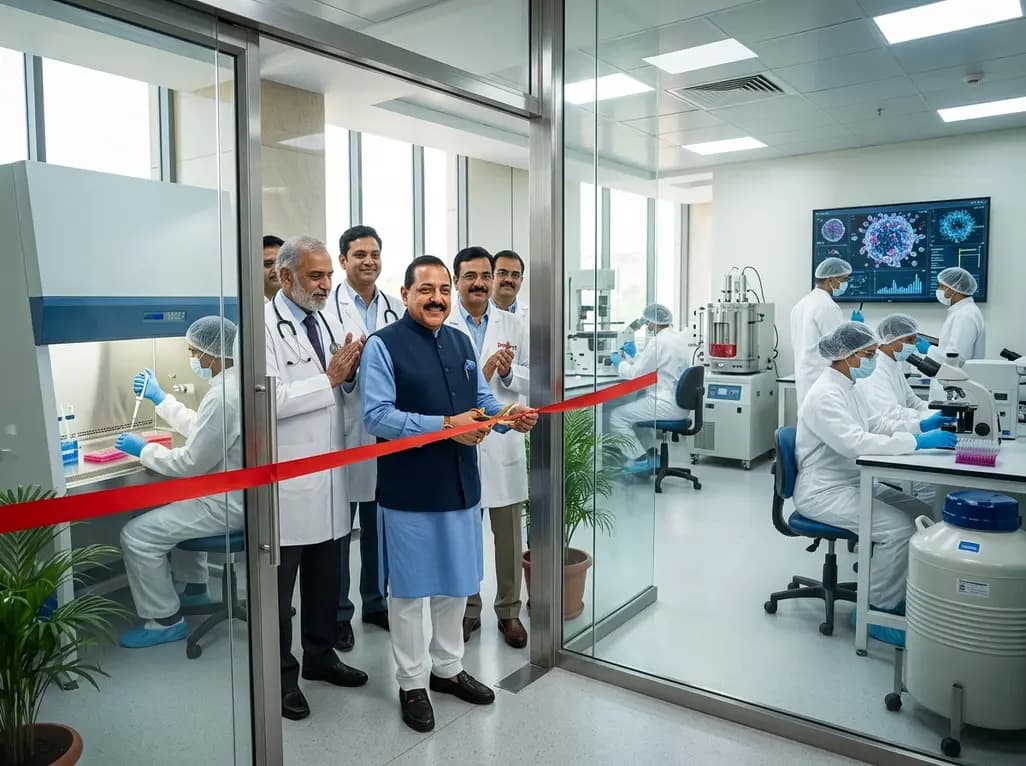
Union Minister Dr. Jitendra Singh recently inaugurated a cutting-edge cellular therapy facility at the Institute of Liver and Biliary Sciences. This advanced current Good Manufacturing Practice (cGMP) laboratory marks a significant milestone in India's medical research sector. Indeed, this establishment will strengthen translational research and cell-based therapeutic developments. The inauguration coincided with the third anniversary of the Liver and Metabolic Disease Network. This network operates with active support from the Department of Science and Technology. Consequently, it brings together prominent policymakers, scientists, and clinical researchers. Additionally, the event highlighted the urgent need for a cohesive national response to combat the metabolic health crisis. Leaders at the event emphasized that metabolic disorders no longer affect only the older population. Therefore, clinicians must adopt early preventive measures to protect the younger generation. This development paves the way for advanced clinical trials and personalized healthcare. Collaborators from across the country attended this prestigious meeting. They shared deep concerns about rising chronic illnesses. Thus, they recognized this facility as a crucial step forward.
The newly established cellular therapy facility at ILBS operates under strict regulatory guidelines. Specifically, the laboratory follows current Good Manufacturing Practice (cGMP) protocols to ensure patient safety. These standards guarantee high-quality cellular products for clinical use. Clinicians will utilize these advanced cell therapies to treat severe liver and metabolic diseases. Furthermore, the laboratory will act as a major hub for translational research in India. This means scientists can quickly move laboratory discoveries into clinical applications. Consequently, patients with end-stage organ failure might access innovative therapies sooner. However, maintaining such high-tech infrastructure requires continuous funding and expert management. The facility will also support research into stem cell therapies and regenerative medicine. In addition, it will train young scientists in cellular manufacturing techniques. This training is essential for building a robust scientific workforce. Through these initiatives, the institute aims to reduce India's reliance on imported therapeutic products. Thus, it fosters self-reliance in biotechnology. Moreover, clinical researchers can now design novel protocols. They will target specific genetic and acquired metabolic defects. As a result, the institution will lead in medical innovation.
During his address, Dr. Jitendra Singh raised critical concerns regarding the metabolic crisis in India. He explained that liver diseases and Type-2 diabetes represent interconnected aspects of a larger metabolic nexus. Indeed, conditions like fatty liver, hypertension, dyslipidemia, and insulin resistance directly trigger one another. The minister observed that these disorders are now affecting much younger populations than in previous decades. Consequently, pediatric obesity has emerged as a major national health challenge. This shift requires immediate public health interventions and policy changes. Additionally, India's unique genetic predisposition makes its citizens highly vulnerable to cardiovascular complications. Many individuals develop these severe metabolic conditions despite having a normal body mass index. However, early detection remains difficult due to a lack of affordable diagnostic tools. Therefore, the medical community must focus on early-life screening. By monitoring pediatric patients early, physicians can prevent irreversible metabolic damage. Ultimately, a healthy childhood forms the foundation for a healthier adult population. Furthermore, we must educate families about proper nutrition and sleep hygiene. These preventive habits will reduce the long-term burden on our healthcare infrastructure.
To tackle this growing epidemic, experts advocate for a unified and highly coordinated scientific strategy. Specifically, ILBS Director Shiv Kumar Sarin outlined a comprehensive action plan built upon five critical pillars. These pillars include understanding the problem, analyzing the population, shaping policies, training physicians, and developing therapeutic products. Moreover, Rajesh S Gokhale highlighted the vital role of collaborative and multidisciplinary research. The Department of Biotechnology continues to support initiatives that bridge the gap between distinct scientific fields. Additionally, former NITI Aayog member Vinod Paul stressed the necessity of long-term patient monitoring. This strategy ensures that high-risk individuals receive timely medical guidance. Consequently, seventeen major scientific groups from across India have committed to a collaborative research network. They will share biological samples, genetic data, and clinical insights. Thus, they will build a strong foundation for indigenous diagnostic tools. Through joint research efforts, India can design tailored medical solutions for its diverse population. Furthermore, this clinical network will establish standardized screening protocols. These protocols will enable doctors in remote areas to identify metabolic diseases early. As a result, public health outcomes will improve significantly.
During this milestone event, ILBS officially proposed the establishment of a National Centre for Liver and Metabolic Diseases. This proposed national center aims to integrate clinical care, education, and public health initiatives under one umbrella. Indeed, such a consolidated institution would accelerate drug discovery and clinical translation. Furthermore, it would provide specialized training for the next generation of metabolic specialists. The Union Minister expressed his strong support for this ambitious proposal. However, implementing this national framework requires careful planning and inter-ministerial coordination. Consequently, policymakers must work alongside leading medical institutions to secure funding. The center would focus heavily on creating affordable diagnostic biomarkers. Therefore, even rural clinics could access cutting-edge metabolic screening tests. By utilizing the existing Liver Biobank, researchers can identify distinct genetic risk factors. This facility will eventually establish India as a global leader in metabolic research. Thus, it will significantly reduce the nationwide burden of liver disorders. In addition, collaborative partnerships with international labs will enhance our scientific capabilities. This global network will bring new insights to local metabolic issues.
Q1: What is the primary purpose of the newly inaugurated cellular therapy facility?
The newly inaugurated cellular therapy facility at ILBS serves to strengthen advanced translational research and cell-based therapeutic developments. Specifically, this state-of-the-art cGMP laboratory will produce standardized cellular products under strict quality controls. Clinicians will utilize these advanced cellular therapies to treat patients suffering from end-stage liver disease and severe metabolic disorders. Consequently, this initiative bridges the gap between laboratory-based scientific discoveries and actual clinical applications.
Q2: How does fatty liver disease link to the broader metabolic syndrome?
Fatty liver disease forms a critical component of a larger metabolic nexus that includes hypertension, insulin resistance, and dyslipidemia. These conditions are closely interconnected, meaning that one disorder often predisposing patients to others. Therefore, a patient with fatty liver disease faces a higher risk of developing Type-2 diabetes and cardiovascular complications. Understanding this link helps physicians design comprehensive, multi-system treatment strategies.
Q3: Why did experts stress the importance of early-life screening for metabolic disorders?
Experts stressed early-life screening because metabolic disorders increasingly affect younger populations, including adolescents and children. Paediatric obesity is now recognized as a major precursor to adult diabetes and chronic liver diseases. Consequently, identifying metabolic risk factors early in life allows clinicians to implement effective lifestyle interventions. This proactive strategy prevents irreversible organ damage and ultimately reduces the long-term healthcare burden across the nation.
Disclaimer: This content is for informational and educational purposes only. It does not constitute medical advice or replace professional judgment. Refer to the latest local and national guidelines for clinical practice.
References

Read summarized clinical updates, watch expert medical content, and earn CME certifications right from your smartphone.
Open your smartphone camera to scan and install.





Union Minister Dr. Jitendra Singh inaugurated an advanced cGMP cellular therapy facility at the Institute of Liver and Biliary Sciences (ILBS), New Delhi. This landmark center will boost translational research, helping clinicians tackle India's growing metabolic disease crisis and paediatric obesity.
3 months ago

Novel diimide and hydrazone scaffolds, particularly compound #C4, synergistically reactivate latent HIV-1 when combined with JQ1 or PKC activators. Demonstrating donor-matched proviral transcription ex vivo and non-canonical signaling, these findings advance shock and kill strategies toward reservoir eradication.
Today

A comparative cohort study evaluates vNOTES vs TLH hysterectomy for benign conditions, demonstrating shorter operative duration, faster return to daily activities, and equivalent female sexual function scores without increased dyspareunia.
Today

Review how tailored exercise programs benefit frail older patients with heart failure. Explore pathophysiological mechanisms, individualized training prescriptions, and strategies to overcome adherence barriers in clinical practice.
Yesterday

This comparative study evaluates posterior labral tears with and without glenohumeral instability, highlighting distinct demographic patterns, MRI underestimation in stable shoulders, and successful arthroscopic repair outcomes.
Yesterday

A clinical study demonstrates that early intervention with tocilizumab, either as monotherapy or bridged with corticosteroids, achieves significant proptosis reduction and resolves active inflammation in treatment-naive thyroid eye disease.
Today
