.webp&w=384&q=75)

Loading, please wait...
Loading, please wait...
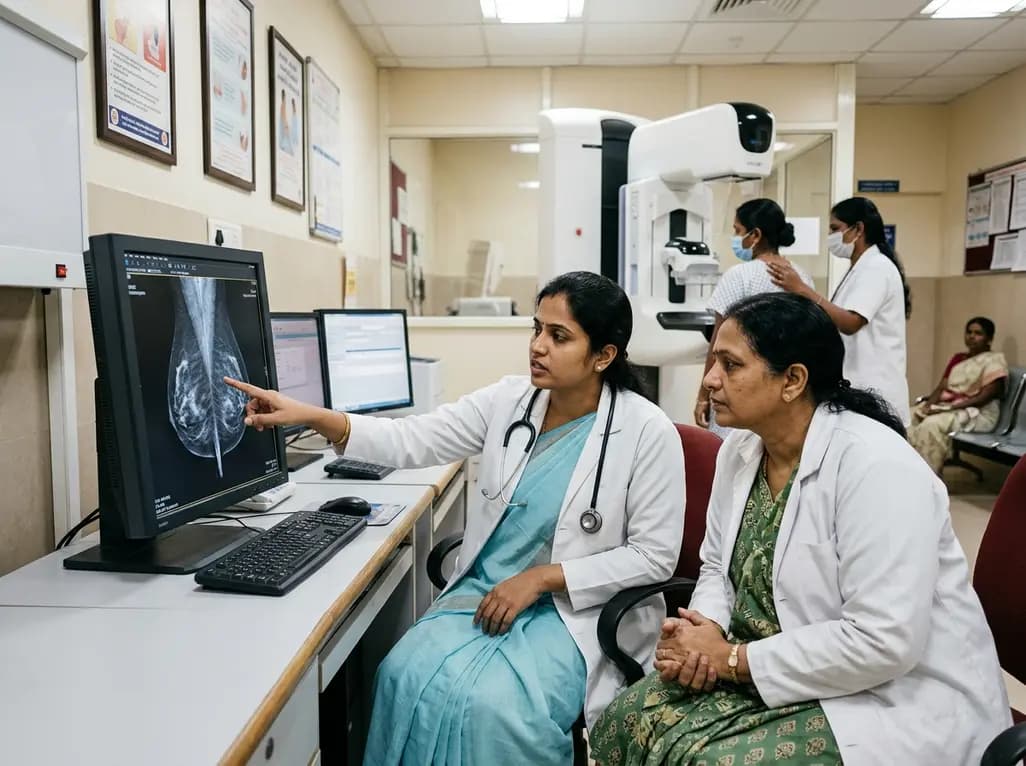
Breast cancer remains the foremost oncological challenge among Indian women today. Consequently, establishing effective breast cancer screening India frameworks has become an urgent public health priority. Recent epidemiological registries indicate that clinicians diagnose nearly 237,000 Indian women with mammary malignancies annually. Unfortunately, over 96,000 patients succumb to this illness every single year. The fundamental disparity between outcomes in India and Western nations stems directly from diagnostic timing rather than distinct tumour biology.
Epidemiological data reveal a profound contrast between breast cancer incidence and mortality in India compared to Western nations. According to GLOBOCAN estimates, India's breast cancer incidence is 31.2 per 100,000 women, compared to 95.2 in North America. Nevertheless, India's mortality rate reaches 12.7 per 100,000, which surpasses North America's rate of 12.2. In other words, a malignancy that strikes a third as many Indian women per capita ultimately claims more lives.
This devastating divergence reflects a chronic delay in clinical diagnosis. In the United States, screening catches 63 percent of malignancies while tumors remain localized to the breast. In sharp contrast, Indian registries show that most women present only after cancer reaches axillary lymph nodes. Consequently, five-year survival in India is 66.4 percent, compared to over 90 percent in the United States. Indian patients do not suffer from a more aggressive biological subtype on average. Instead, healthcare delivery systems fail to identify malignant tumors before physical signs become obvious. Shifting clinical detection from palpable masses to radiographic findings represents the only viable path to saving lives.
For decades, public health guidelines in India have prioritized clinical breast examination over population-level imaging. The national non-communicable disease framework provides physical examinations through frontline health workers at local Ayushman Arogya Mandirs. Government tallies cite over 100 million cumulative examinations conducted among adult women. However, independent surveys demonstrate a vast implementation gap. For instance, National Family Health Survey data revealed that under one percent of eligible women ever received an examination.
Furthermore, geographical disparities exacerbate this screening deficit across Indian states. While Tamil Nadu and Puducherry report modest uptake, states like Uttar Pradesh and Punjab record rates below 0.5 percent. Cost considerations and equipment shortages often justify this examination-only approach. Proponents frequently cite the landmark 20-year Mumbai trial involving over 151,000 women. However, that trial observed no significant overall reduction in breast cancer mortality. Although subset analysis indicated a 30 percent mortality reduction in women over 50, it produced zero benefit under 50. This represents a critical limitation because the median age of onset in India is 45 years. Physical examination therefore fails the exact demographic group facing peak vulnerability.
To overcome structural constraints, healthcare planners must establish an organized, technology-driven screening architecture. India should focus this initiative on all eligible women between 40 and 60 years of age. Rather than duplicating expensive Western models, India can leapfrog legacy hurdles using digital public infrastructure.
Specifically, health authorities can construct a central screening roster using Ayushman Bharat Health Accounts. District coordination teams can generate targeted invitations, schedule appointments, and arrange local transport for rural residents. Moreover, public-private partnerships can expand clinical capacity rapidly. By empaneling private diagnostic facilities under PM-JAY at standardized tariff rates, public and private machines can serve one synchronized roster. Mobile digital mammography units can travel through remote rural blocks to provide equitable geographic reach.
Additionally, clinical guidelines should establish clear screening intervals. The United States Preventive Services Task Force recommends screening mammograms every two years from age 40. Clinical trials reveal that interval cancers jump from 12.5 percent under annual screening to 42.5 percent at three-year gaps. Therefore, establishing a two-year screening cycle balances clinical safety against logistical constraints.
A massive nationwide imaging programme encounters a major bottleneck: the acute scarcity of qualified radiologists. India currently operates approximately 3,000 mammography machines, and fewer than ten percent feature full-field digital capabilities. Radiologists cannot manually interpret tens of millions of screening studies annually without severe diagnostic fatigue.
Fortunately, artificial intelligence offers an evidence-based solution to this human resource crisis. In Sweden's landmark MASAI randomized trial of over 100,000 women, artificial intelligence reduced radiologists' reading workloads by 44 percent. At the same time, the automated system detected more malignant lesions than standard double reading. In this workflow, automated software acts as an intelligent triage engine. The algorithm rapidly clears normal examinations and flags abnormal cases for prompt expert evaluation.
Tele-radiology networks can securely transmit images from mobile vans in rural taluks to tertiary diagnostic hubs within hours. Radiologists maintain full clinical oversight by reviewing and signing every flagged report. Before national implementation, researchers must validate these algorithmic tools against indigenous datasets across diverse breast densities. Furthermore, clinicians should recommend supplemental ultrasound imaging for women under 45 with dense breast tissue.
Screening without guaranteed, rapid therapeutic intervention creates ethical failure and clinical frustration. Therefore, national cancer control policy must adhere strictly to World Health Organization performance benchmarks. These standards require diagnosing 60 percent of breast cancers at stage I or II. They also mandate completing definitive diagnosis within 60 days of detection and ensuring 80 percent complete therapy.
Meeting these criteria demands a responsive hub-and-spoke clinical network. Community health centers must swiftly refer suspicious radiographic findings to district hospital hubs. At these district centers, interventional radiologists should utilize image-guided core-needle or vacuum-assisted biopsies. This approach must entirely replace blind surgical excision. Furthermore, pathology departments must consistently test for estrogen receptor, progesterone receptor, HER2 overexpression, and Ki-67 proliferation markers.
Recent quality audits indicate that barely one-third of assessed Indian laboratories utilized validated HER2 testing protocols. Consequently, state health authorities must enforce strict laboratory accreditation. Additionally, multidisciplinary virtual tumor boards linked through the National Cancer Grid can design personalized treatment strategies. Patients can conveniently receive adjuvant chemotherapy regimens at district daycare cancer centers. This decentralization prevents families from traveling to crowded metropolitan apex hospitals. Finally, dedicated patient navigators must guide each woman through her therapeutic journey, minimizing financial toxicity.
Q1: Why is clinical breast examination alone insufficient for Indian women?
Clinical breast examination often fails to detect non-palpable microcalcifications and early-stage architectural distortions. Furthermore, evidence shows that physical examination does not significantly reduce breast cancer mortality in women under 50 years. Because the median age of breast cancer onset in India is 45 years, relying solely on physical exams misses early lesions. Consequently, patients present with advanced, node-positive disease that carries poor survival outcomes.
Q2: At what age should Indian women begin routine mammography screening?
Health specialists recommend that Indian women begin routine biennial mammograms at age 40. Indian patients tend to develop breast cancer approximately one decade earlier than Western women. Therefore, initiating screening at 40 years captures asymptomatic early lesions. For women under 45 who possess dense breast tissue, clinicians recommend supplemental breast ultrasound alongside mammography. This multimodal strategy enhances diagnostic sensitivity and reduces interval cancers.
Q3: How does artificial intelligence assist in population-scale mammography screening?
Artificial intelligence functions as an automated triage tool that evaluates screening mammograms rapidly. It safely filters normal scans and flags suspicious microcalcifications or soft tissue asymmetries for radiologist review. Clinical evidence demonstrates that AI integration reduces specialist workload by roughly 44 percent while increasing cancer detection rates. Consequently, this computational assistance allows limited radiology resources to interpret millions of scans efficiently without sacrificing diagnostic precision.
Disclaimer: This content is for informational and educational purposes only. It does not constitute medical advice or replace professional judgment. Refer to the latest local and national guidelines for clinical practice.
References

Read summarized clinical updates, watch expert medical content, and earn CME certifications right from your smartphone.
Open your smartphone camera to scan and install.





India faces an escalating breast cancer burden marked by late diagnosis and elevated mortality. Shifting from reliance on physical exams to an organized, AI-assisted mammography screening protocol can detect malignancies early, bridge urban-rural disparities, and improve patient survival outcomes across the nation.
Today

A multicenter study validates dry chemical colorimetry on the VITROS 350 system for plasma ammonia detection, proving excellent precision, linearity, and cross-platform concordance.
Today
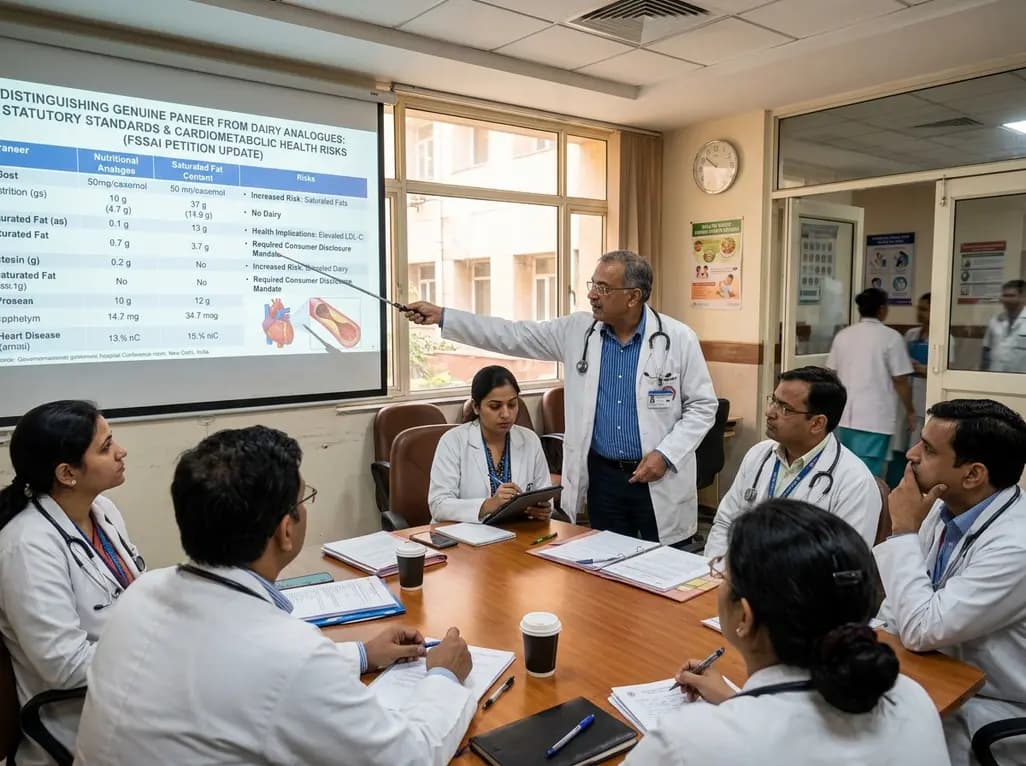
The Delhi High Court has directed the FSSAI and Centre to address petitions regarding dairy analogue products sold as genuine paneer. Learn about the statutory standards, nutritional differences, cardiometabolic health risks, and required consumer disclosure mandates in eateries across India.
Today

The state government is deploying helicopter emergency medical services across the Mumbai-Pune Expressway, Samruddhi Mahamarg, and Mumbai-Goa Highway. This initiative establishes unified standard operating procedures to enable rapid triage, advanced prehospital resuscitation, and seamless trauma care transfers.
Today
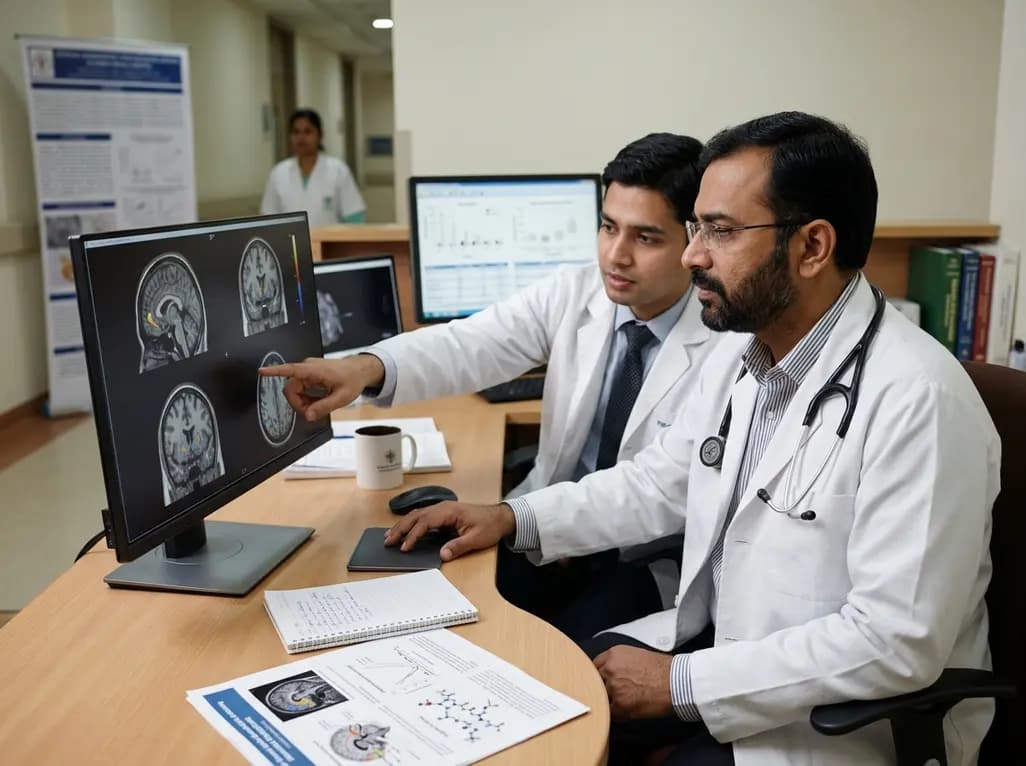
A systematic review of 66 preclinical studies reveals that GLP-1 mono-agonists modulate central reward processing. These findings demonstrate significant reductions in palatable food intake, substance self-administration, and compulsive behaviors, offering novel neurobiological targets for neuropsychiatry.
Today
