.webp&w=384&q=75)

Loading, please wait...
Loading, please wait...
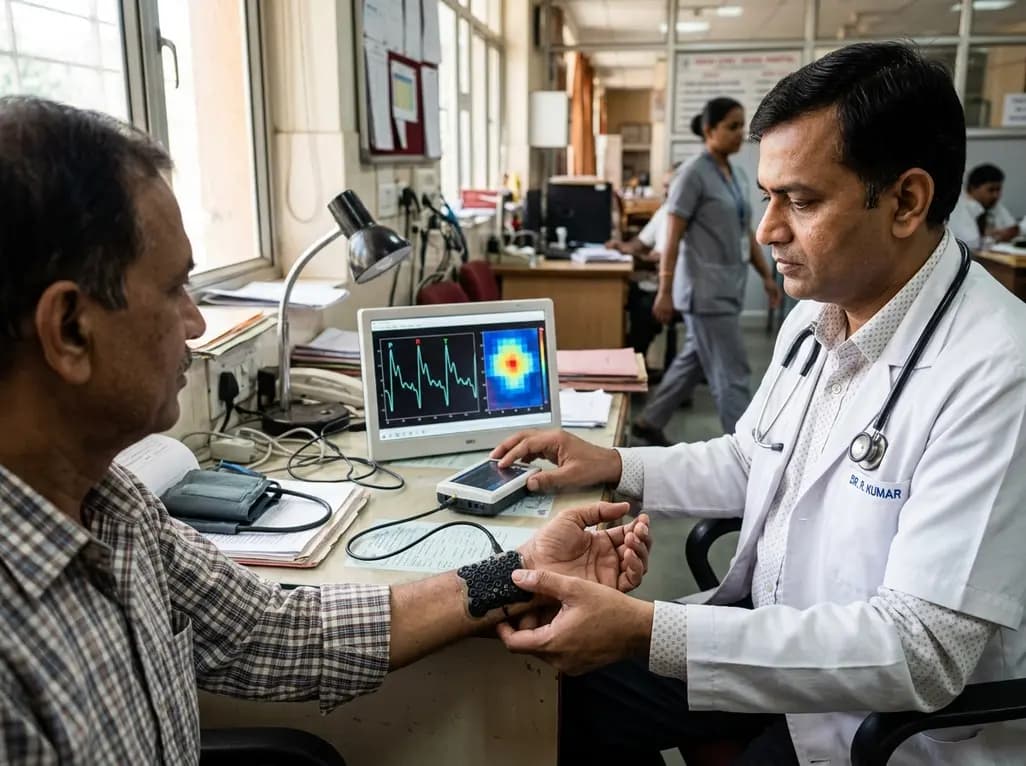
Wearable physiological monitoring continues to transform digital healthcare, preventive cardiology, and noninvasive diagnostics. Recently, bioengineers engineered an innovative flexible tactile sensor that dramatically advances noninvasive hemodynamic tracking. Conventional capacitive pressure devices often struggle to achieve high sensitivity alongside an expansive operational range because standard dielectric materials saturate prematurely. Consequently, clinical teams encounter significant challenges when recording both subtle arterial vibrations and higher pressure body dynamics with a single device. By mimicking the unique architecture of octopus suckers, this novel platform overcomes structural limitations, thereby providing reliable continuous biophysical signal acquisition.
To resolve traditional sensing trade-offs, researchers developed a bioinspired tactile architecture patterned after cephalopod suckers. Specifically, the engineering team utilized a scalable template-transfer fabrication method that replicates delicate surface microstructures with exceptional fidelity. The resulting capacitive sensor integrates a hierarchical concave microstructure within its elastomeric dielectric layer. As a result, this specialized geometry accommodates substantial mechanical compliance under delicate contact while maintaining durable mechanical integrity during high-pressure loads.
Finite element simulations reveal precisely how the microstructural elements engage during continuous external compression. Initially, the peripheral rim contacts the opposing surface under low tactile pressures, thereby conferring high initial sensitivity. Subsequently, the central protrusion engages as the applied compressive load increases further. Consequently, this sequential engagement redistributes contact stress across the sensing matrix and substantially delays structural saturation. Therefore, the device operates smoothly without experiencing signal plateauing or mechanical fatigue across rigorous physiological cycles. Ultimately, this structural biomimicry bridges the gap between delicate micro-vibration sensing and heavy mechanical load monitoring.
The primary breakthrough of this engineering framework lies in its exceptional segmented linearity across broad pressure regimes. Typically, capacitive pressure sensors experience rapid declines in responsiveness once applied loads surpass nominal physiological baselines. However, this biomimetic device exhibits three distinct linear operating zones with remarkable quantitative performance. In the ultra-low pressure range of zero to five kilopascals, the device demonstrates an extraordinary sensitivity of 8.78 kPa⁻¹ with 99.34% linearity.
Additionally, across the intermediate pressure interval spanning five to 230 kilopascals, the platform maintains a robust sensitivity of 1.84 kPa⁻¹ and 97.83% linearity. Furthermore, under heavy loads between 230 and 500 kilopascals, the sensor preserves an effective sensitivity of 0.91 kPa⁻¹ alongside 98.98% linearity. Consequently, this wide operational capacity ensures that clinician teams can capture delicate micro-pressures without sacrificing high-pressure durability. In contrast to conventional piezocapacitive devices that compress irreversibly, this sensor recovers instantly following mechanical unloading. Ultimately, this tiered response profile guarantees precise data acquisition across varied anatomical interfaces and dynamic physical motions.
In modern cardiology and vascular medicine, arterial pulse morphology provides crucial diagnostic insight into systemic arterial stiffness and cardiovascular risk. Traditional applanation tonometry requires cumbersome handheld transducers and depends heavily on operator technique. In contrast, this flexible tactile sensor array conforms intimately to complex skin contours over the radial and carotid arteries. Consequently, the sensor array records subtle arterial wall deflections without producing vascular occlusion or patient discomfort.
Moreover, the device enables high-fidelity spatiotemporal reconstruction of radial pulse wave contours. Specifically, the array captures the primary percussion wave, the tidal wave, and the dicrotic notch with high signal fidelity. Clinicians can subsequently calculate radial augmentation indices, evaluate reflection timing, and monitor pulse wave velocity continuously. Furthermore, the multi-point spatial array maps localized lateral pulse propagation patterns that single-point tonometers miss entirely. Therefore, continuous tactile pulse mapping provides actionable prognostic indicators for arterial compliance, early vascular aging, and long-term hypertensive end-organ damage.
Beyond cardiovascular hemodynamics, the sensor supports multimodal biophysical data collection across varied clinical disciplines. For instance, the high sensitivity in the sub-five kilopascal range captures minute epidermal vibrations associated with vocal cord phonation and swallowing mechanics. Consequently, speech pathologists and otolaryngologists can assess neurological dysphagia or vocal fatigue objectively during rehabilitation therapy.
Similarly, the wide detection window permits concurrent recording of forceful musculoskeletal actions and joint articulation. Specifically, sports medicine physicians and rehabilitation specialists can monitor plantar pressure distribution during dynamic gait cycles without structural sensor degradation. Furthermore, intensive care units can utilize the sensor matrix for unobtrusive respiratory waveform tracking and micro-motion surveillance in fragile neonatal or geriatric patients. Additionally, the rapid mechanical recovery ensures reliable continuous tracking even during intense physical tremors or sudden postural adjustments. Thus, the flexible platform serves as an adaptable diagnostic instrument across multidisciplinary clinical domains.
The seamless transition from laboratory fabrication to scalable medical manufacturing represents an essential clinical requirement. Fortunately, the template-transfer fabrication method allows cost-effective, reproducible mass production of sensor arrays with uniform performance. Additionally, the thin, biocompatible polymer construction facilitates long-term epidermal adhesion without inducing allergic dermatitis or tactile interference during everyday patient activities.
Nevertheless, successful clinical translation requires rigorous validation across large human cohorts in certified hospital environments. Furthermore, regulatory bodies will demand standardized validation against catheter-based invasive arterial reference standards before diagnostic implementation. Future engineering workflows must also combine these microstructured arrays with flexible wireless transmitters and onboard machine-learning microcontrollers. Consequently, automated algorithmic interpretation can alert clinicians to acute hemodynamic deterioration in real time. Ultimately, integrating these smart sensor patches into remote monitoring networks will advance personalized preventive cardiology across diverse healthcare environments.
The flexible tactile sensor uses a bioinspired hierarchical concave microstructure derived from octopus suckers. Under low compressive force, only the outer peripheral rim contacts the opposing electrode, creating high initial sensitivity. As mechanical pressure rises, the inner central protrusion sequentially engages to disperse localized mechanical stress. Consequently, this graduated structural deformation delays capacitive saturation, providing dependable linear sensitivity across wide ranges up to 500 kilopascals.
The sensor conforms seamlessly to epidermal surfaces, eliminating motion artifacts and user-dependent positioning errors common in rigid tonometry probes. Furthermore, its rapid response time and high signal-to-noise ratio permit precise reconstruction of percussion, tidal, and dicrotic peaks. Consequently, physicians can evaluate central arterial stiffness, systemic vascular compliance, and pulse wave velocity noninvasively during continuous outpatient monitoring without causing patient discomfort.
Yes, the sensor provides versatile multimodal detection across diverse physiological amplitudes and mechanical forces. Because the platform detects subtle pressures below five kilopascals, it easily measures epidermal phonation, micro-vibrations, and swallowing dynamics. Simultaneously, the durable structure withstands loads up to 500 kilopascals. Therefore, clinicians can record forceful musculoskeletal movement, plantar gait mechanics, and respiratory excursion using a single unified sensing technology.
Disclaimer: This content is for informational and educational purposes only... Refer to the latest local and national guidelines for clinical practice.
References

Read summarized clinical updates, watch expert medical content, and earn CME certifications right from your smartphone.
Open your smartphone camera to scan and install.





A bioinspired flexible tactile sensor mimicking octopus suckers enables high sensitivity and wide-range pressure monitoring. This innovation facilitates noninvasive spatiotemporal pulse mapping and biophysical signal acquisition, opening new avenues for continuous cardiovascular assessment in clinical practice.
last month
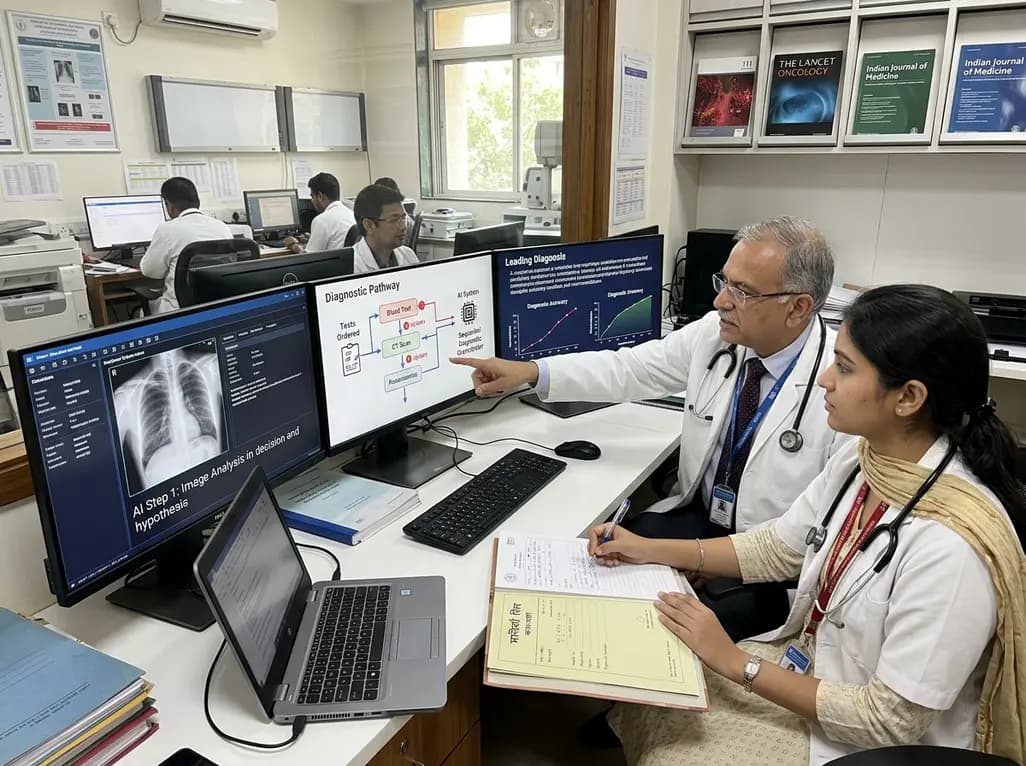
A breakthrough peer-reviewed study demonstrates that a sequential AI diagnosis system can mirror real-world clinical reasoning. By ordering stepwise tests and updating hypotheses dynamically, this multi-agent orchestrator achieved superior diagnostic accuracy while reducing investigative costs.
Today

A prenatal case highlights severe glutaric acidemia type II presenting as bilateral hyperechoic cystic kidneys at 18 weeks. Whole-exome sequencing revealed a novel homozygous ETFDH frameshift variant, demonstrating the power of rapid genetic testing in fetal renal anomalies.
Today

Review how tailored exercise programs benefit frail older patients with heart failure. Explore pathophysiological mechanisms, individualized training prescriptions, and strategies to overcome adherence barriers in clinical practice.
Yesterday

This comparative study evaluates posterior labral tears with and without glenohumeral instability, highlighting distinct demographic patterns, MRI underestimation in stable shoulders, and successful arthroscopic repair outcomes.
Yesterday

A clinical study demonstrates that early intervention with tocilizumab, either as monotherapy or bridged with corticosteroids, achieves significant proptosis reduction and resolves active inflammation in treatment-naive thyroid eye disease.
Yesterday
