.webp&w=384&q=75)

Loading, please wait...
Loading, please wait...

Bilingualism represents the norm rather than an exception in diverse clinical landscapes like India. Consequently, pediatric healthcare providers routinely encounter children who speak multiple tongues across domestic and school settings. Clinicians often face significant hurdles when evaluating bilingual youngsters for suspected speech and developmental delays. Specifically, distinguishing typical bilingual acquisition from developmental language disorder presents an enduring diagnostic challenge for pediatric teams. Many practitioners worry whether a child's low language performance reflects limited linguistic input or an intrinsic neurodevelopmental impairment. When families raise concerns regarding delayed milestones, clinicians must interpret language exposure accurately without making erroneous clinical assumptions.
Recent pediatric research provides valuable clarity regarding how practitioners can quantify dual-language exposure effectively. Historically, clinicians have debated whether tracking cumulative hours or calculating relative percentages yields superior diagnostic precision during evaluations. A major investigation led by Yang and colleagues analyzed 1,397 bilingual preschool children, including seventy-three individuals diagnosed with developmental language disorder. The researchers examined whether exposure measurement methodology significantly alters our clinical understanding of linguistic performance. Ultimately, their findings offer reassuring insights for pediatricians, neurologists, and speech pathologists managing complex multilingual cases.
Accurate exposure quantification forms the foundation of any comprehensive bilingual developmental assessment. Traditionally, clinicians assess home language environments using two distinct frameworks: total absolute hours or relative percentage share. In the multicenter study, caregivers documented hour-by-hour language input and conversational output across representative weekdays and weekends. Subsequently, researchers examined associations between these quantified metrics and standardized linguistic performance across both spoken languages. This rigorous tracking allowed investigators to compare the clinical utility of each measurement strategy directly.
The statistical analyses demonstrated that percentage exposure and total exposure hours correlated strongly and significantly for both languages. Furthermore, both measures exhibited moderate, statistically significant correlations with standardized bilingual language scores. Importantly, the observed differences in effect sizes between the two measurement tools remained virtually negligible across analyses. Consequently, clinicians do not need to execute tedious mathematical conversions during time-constrained clinical encounters. Healthcare practitioners can confidently choose either metric when recording linguistic input during developmental history taking. Therefore, documenting proportional exposure offers reliable predictive validity comparable to calculating exhaustive hourly schedules.
While language exposure strongly correlates with linguistic skill in typically developing children, atypical patterns emerge in disordered cohorts. Notably, the study identified significant group differences between typically developing children and peers with developmental language disorder. In typically developing multilingual preschoolers, increased linguistic exposure predictably yielded enhanced expressive and receptive performance in both languages. Their neural systems readily capitalize on environmental verbal input to build vocabulary and grammatical complexity.
In sharp contrast, children diagnosed with developmental language disorder exhibited significantly weaker correlations between exposure metrics and functional performance. This critical divergence reveals that environmental exposure limitations do not explain the primary mechanisms of developmental language disorder. Instead, intrinsic cognitive and neurodevelopmental processing deficits fundamentally constrain their language acquisition trajectories. Consequently, providing additional hours of exposure alone cannot fully overcome these core linguistic processing deficits without structured therapy. Clinicians must recognize that developmental language disorder affects all languages an individual acquires. Therefore, whenever a bilingual child displays persistent deficits across both languages, clinicians must suspect a true neurodevelopmental condition rather than insufficient environmental exposure.
In India, multilingual households constitute the everyday reality across urban and rural demographics alike. Parents frequently express apprehension that early exposure to regional and national languages might trigger speech delay. Consequently, misguided recommendations advising parents to restrict communication to a single language still persist in community healthcare. Pediatricians must actively dismantle these misconceptions using robust empirical evidence.
The scientific literature firmly demonstrates that multilingual environments do not generate neurodevelopmental disorders or speech delay. Reduced exposure to a specific tongue simply explains domain-specific lexical differences, whereas intrinsic pathology disrupts communication globally. Furthermore, Indian pediatricians can streamline developmental evaluations by gathering estimated exposure percentages rather than demanding exhausting hourly logs. Busy outpatient clinics benefit substantially from this practical clinical flexibility. However, if a bilingual toddler demonstrates deficits across both maternal and community languages, clinicians should initiate comprehensive developmental investigations immediately. Prompt developmental screening guarantees that children requiring specialized speech-language interventions receive support without needless observational delays.
Implementing structured assessment protocols allows healthcare teams to differentiate language differences from true language disorders efficiently. First, clinicians should obtain a detailed language history during routine developmental consultations. Practitioners can document simple percentage breakdowns, such as seventy percent regional language and thirty percent English, to capture environmental input. Because both exposure metrics demonstrate comparable predictive value, clinicians can use whichever metric fits their workflow best.
Second, clinicians must evaluate receptive and expressive capabilities in every language the child understands. True developmental language disorder consistently compromises language acquisition across all linguistic environments, rather than sparing the primary domestic tongue. Third, pediatricians must avoid evaluating multilingual children against monolingual standardized norms. Instead, clinicians should evaluate total conceptual vocabulary and pragmatic communication skills across both languages collaboratively. Finally, practitioners should promptly refer children with persistent grammatical deficits, poor comprehension, or speech regression for formal speech-language assessment. Early therapeutic intervention fosters academic success, psychosocial development, and communicative confidence in vulnerable children.
No, bilingual language exposure does not cause developmental language disorder. Scientific research consistently shows that bilingual children achieve foundational language milestones at the same chronological age as monolingual peers. While bilingualism alters how vocabulary distributes across different languages, underlying neurodevelopmental factors drive language disorders. Consequently, clinicians should never advise bilingual families to drop one language, because dual-language environments do not induce or worsen genuine language disorders.
Clinicians can confidently choose either total exposure hours or relative percentage exposure during clinical evaluations. Recent research demonstrates that both measurement approaches yield comparable correlations and effect sizes when assessing bilingual language proficiency. Therefore, healthcare providers may select whichever method fits their clinical workflow best. Estimating percentage distribution often saves valuable time during brief pediatric consultations, whereas detailed hour logs provide useful structure for comprehensive neurodevelopmental evaluations.
Clinicians differentiate language differences from disorders by thoroughly evaluating performance across all spoken languages. A multilingual child displaying normal language learning differences struggles only in their less-exposed tongue while demonstrating age-appropriate skills in their primary language. In contrast, developmental language disorder impairs linguistic processing across every language the child encounters. Furthermore, children with true disorders exhibit persistent receptive difficulties, limited sentence complexity, and poor narrative abilities across all environments.
Disclaimer: This content is for informational and educational purposes only and should not be considered as medical advice. Always consult a qualified healthcare provider for diagnosis, treatment, or specific medical queries. Refer to the latest local and national guidelines for clinical practice.
References
Yang C et al. Two Measures, Same Outcome: Comparable Associations Between Exposure Measurements and Language Performance in Bilinguals With and Without Developmental Language Disorder. Am J Speech Lang Pathol. 2026 Oct 09. doi: 10.1044/2026_AJSLP-25-00371. PMID: 42853230.
Bishop DVM, Snowling MJ, Thompson PA, Greenhalgh T, CATALISE consortium. Phase 2 of CATALISE: a multinational and multidisciplinary Delphi consensus study of problems with language development: Terminology. J Child Psychol Psychiatry. 2017;58(10):1068-1080.
Paradis J, Genesee F, Crago MB. Dual Language Development and Disorders: A Handbook on Bilingualism and Second Language Learning. 3rd ed. Brookes Publishing; 2021.

Read summarized clinical updates, watch expert medical content, and earn CME certifications right from your smartphone.
Open your smartphone camera to scan and install.





A large study demonstrates that total hours and percentage of language exposure yield comparable clinical outcomes in bilingual children. Furthermore, children with developmental language disorder exhibit weaker exposure-performance correlations, underscoring intrinsic neurodevelopmental factors.
Today
India's antidepressant market crossed Rs 2,842 crore in 2026 even as unit sales declined. Clinicians analyze the shift toward newer drugs, widespread clonazepam combination use, social media-driven self-diagnosis, and persistent treatment gaps to assess genuine therapeutic recovery across diverse patient groups.
Today
Integrating adult genetic services into reproductive and pregnancy care substantially alters clinical management. A study reveals that diagnostic genetic evaluations directly inform maternal, fetal, and neonatal care in nearly 57% of tested patients, highlighting the value of preconception and antenatal genomics.
Today
A real-world emergency department evaluation demonstrates that the Abbott i-STAT Alinity point-of-care high-sensitivity troponin I assay achieves excellent analytical precision and safely rules out myocardial infarction without false negatives, offering rapid bedside results to decongest acute care pathways.
Today
A recent scoping review highlights the efficacy, usability, and patient satisfaction of virtual reality pain management for chronic musculoskeletal pain, emphasizing psychotherapy-based VR protocols.
Today
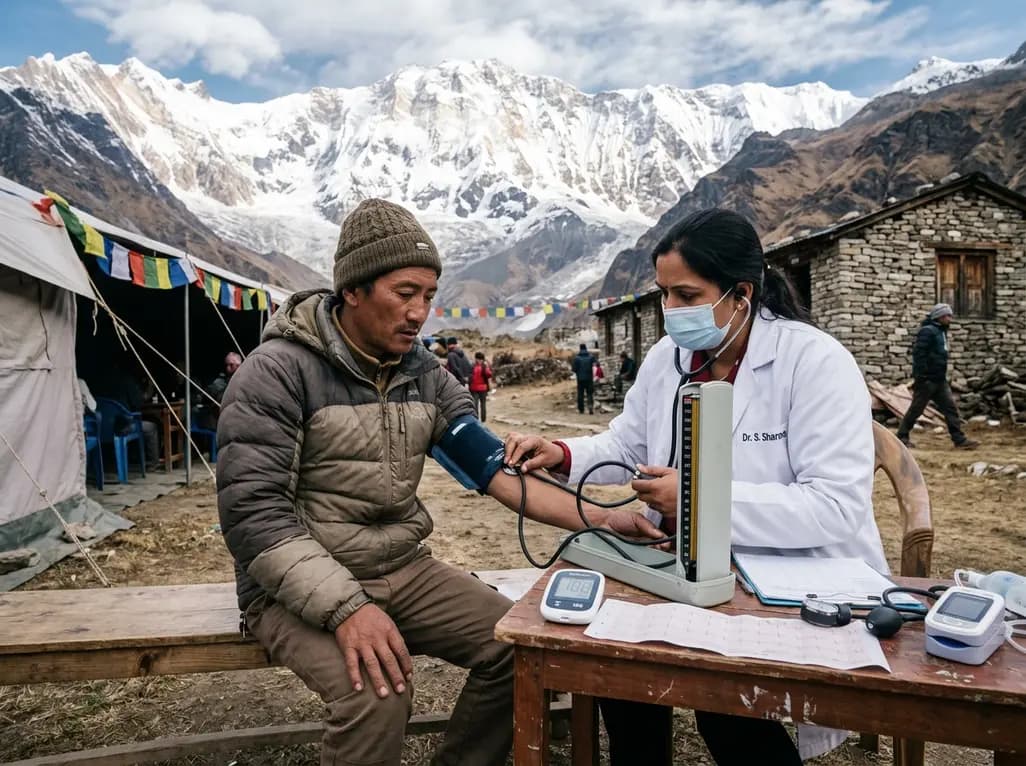
A cross-sectional study in Nepal evaluates cardiovascular risk factors among adults working above 4,000 meters. The findings reveal unexpected rates of diabetes, hypertension, and mountain sickness, underscoring the urgent need for targeted cardiometabolic screening in high-altitude occupational cohorts.
Today
