.webp&w=384&q=75)

Loading, please wait...
Loading, please wait...

Union Health Minister JP Nadda addressed the plenary session of the 79th World Health Assembly (WHA) in Geneva. Consequently, he reiterated India's commitment to equitable, inclusive, and people-centric healthcare. Specifically, he highlighted how the Ayushman Bharat Digital Mission is driving a massive technological transformation across the country.
The Minister emphasized India's whole-of-government approach to achieving Universal Health Coverage (UHC). Furthermore, India has established over 1,85,000 Ayushman Arogya Mandirs. These centers deliver comprehensive primary healthcare closer to local communities. This infrastructure significantly reduces the clinical burden on secondary and tertiary referral hospitals. Additionally, Nadda highlighted the PM-JAY scheme, which currently secures health coverage for nearly 600 million vulnerable citizens.
Technology plays a pivotal role in strengthening India's national digital health ecosystem. Under the Ayushman Bharat Digital Mission, India has successfully generated over 880 million unique digital health IDs. Consequently, these digital records enable a seamless continuum of care and ensure longitudinal patient tracking. Clinicians can securely access vital medical histories, which dramatically improves treatment accuracy. Moreover, the Minister announced the strategy for ethical, human-centric Artificial Intelligence (AI) implementation in healthcare.
Nadda also reaffirmed India's status as the Pharmacy of the World. For instance, during the COVID-19 pandemic, India supplied nearly 300 million vaccine doses to approximately 100 countries. Therefore, India remains a vital leader in manufacturing affordable generic medicines and vaccines globally. Ultimately, the Minister urged global health leaders to translate shared policies into direct public health impact.
Q1: What is the main objective of the Ayushman Bharat Digital Mission?
The Ayushman Bharat Digital Mission aims to build a robust digital health infrastructure in India by establishing unique digital health IDs. Consequently, these IDs facilitate seamless coordination and longitudinal health tracking across clinics and hospitals.
Q2: How many Ayushman Arogya Mandirs have been set up in India?
India has successfully established over 1,85,000 Ayushman Arogya Mandirs across the country. Specifically, these centers deliver comprehensive, accessible primary healthcare services directly to local communities.
Q3: Who benefits from the PM-JAY public health assurance scheme?
The PM-JAY scheme provides robust financial protection to nearly 600 million vulnerable citizens. Therefore, it shields them from catastrophic health expenses.
Disclaimer: This content is for informational and educational purposes only. It does not constitute medical advice or replace professional judgment. Refer to the latest local and national guidelines for clinical practice.
References

Read summarized clinical updates, watch expert medical content, and earn CME certifications right from your smartphone.
Open your smartphone camera to scan and install.





Union Health Minister JP Nadda showcased India's healthcare innovations, including the Ayushman Bharat Digital Mission, at the 79th World Health Assembly....
5 months ago
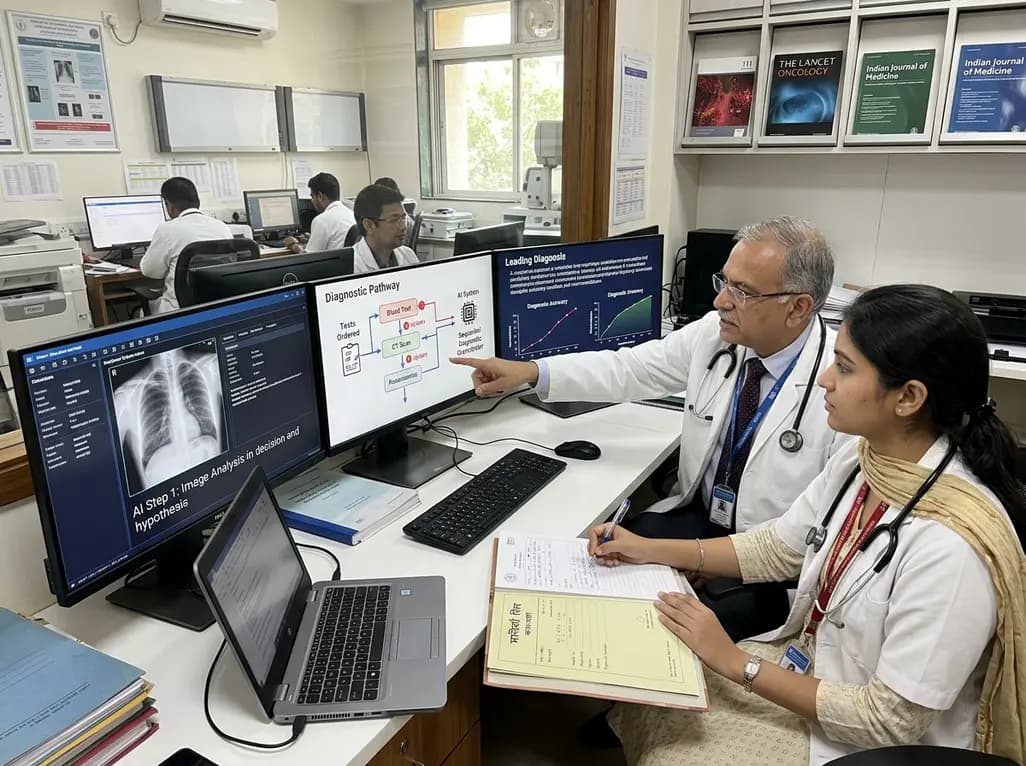
A breakthrough peer-reviewed study demonstrates that a sequential AI diagnosis system can mirror real-world clinical reasoning. By ordering stepwise tests and updating hypotheses dynamically, this multi-agent orchestrator achieved superior diagnostic accuracy while reducing investigative costs.
Today

A prenatal case highlights severe glutaric acidemia type II presenting as bilateral hyperechoic cystic kidneys at 18 weeks. Whole-exome sequencing revealed a novel homozygous ETFDH frameshift variant, demonstrating the power of rapid genetic testing in fetal renal anomalies.
Today

Review how tailored exercise programs benefit frail older patients with heart failure. Explore pathophysiological mechanisms, individualized training prescriptions, and strategies to overcome adherence barriers in clinical practice.
Yesterday

This comparative study evaluates posterior labral tears with and without glenohumeral instability, highlighting distinct demographic patterns, MRI underestimation in stable shoulders, and successful arthroscopic repair outcomes.
Yesterday

A clinical study demonstrates that early intervention with tocilizumab, either as monotherapy or bridged with corticosteroids, achieves significant proptosis reduction and resolves active inflammation in treatment-naive thyroid eye disease.
Yesterday
