.webp&w=384&q=75)

Loading, please wait...
Loading, please wait...
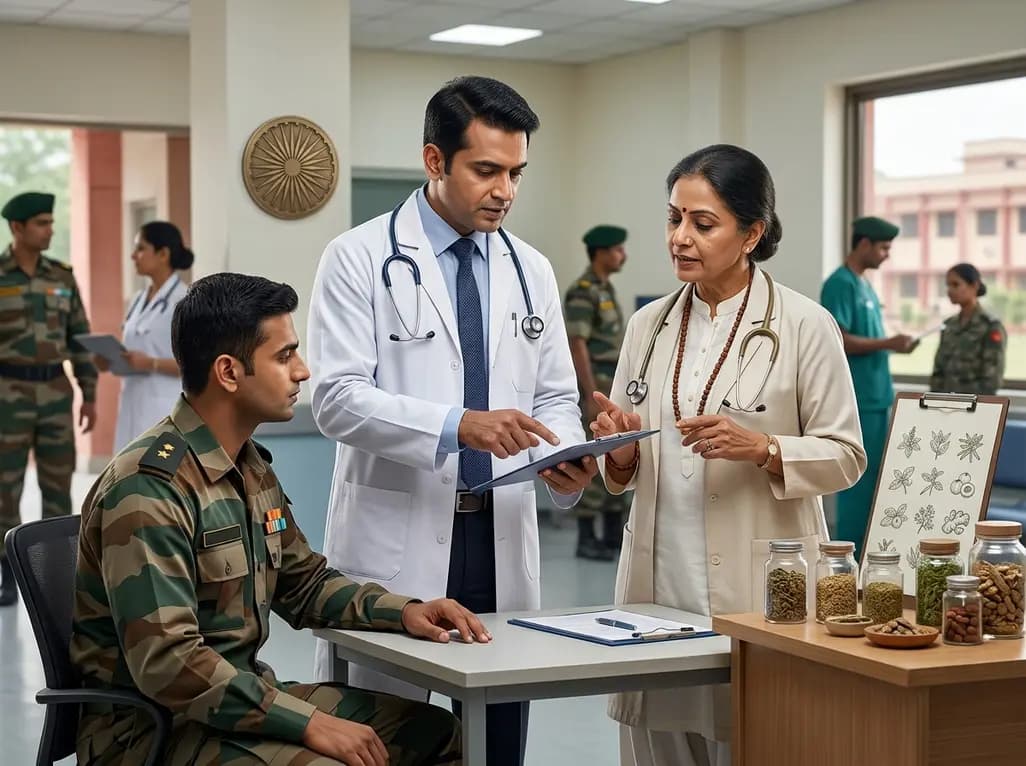
The Union Ministry of Ayush has officially submitted a landmark proposal to the Ministry of Defence requesting a comprehensive AYUSH services expansion across all military and field hospitals in India. Union Minister of State (Independent Charge) for Ayush, Prataprao Jadhav, addressed a formal letter to Defence Minister Rajnath Singh advocating for dedicated outpatient departments (OPDs). Consequently, this initiative seeks to integrate traditional Indian systems of medicine into the existing medical infrastructure supporting armed forces personnel. Modern defense medical centers already provide world-class clinical care to soldiers. However, incorporating traditional systems like Ayurveda, Yoga, Unani, Siddha, and Homeopathy offers a broader spectrum of wellness options. Furthermore, soldiers often operate under extreme environmental stress and severe physical exertion. Integrating traditional modalities alongside conventional protocols enhances overall health resilience. The proposed expansion does not aim to replace conventional clinical methods. Instead, it creates an integrative healthcare model where traditional therapies complement emergency, surgical, and acute clinical services. As a result, defense personnel will gain broader access to holistic, evidence-based wellness modalities tailored to demanding military conditions.
Integrating traditional medicine into mainstream defense healthcare represents a progressive approach to military wellness. Currently, a few defense institutions already feature AYUSH centers, but most military and field hospitals lack dedicated facilities. Therefore, expanding these services ensures equitable access to holistic remedies across all operational commands. Modern military medical teams routinely handle complex trauma, combat injuries, and acute infectious illnesses. Nevertheless, long-term health maintenance requires robust preventive strategies. Traditional systems excel in managing chronic physical strain, functional digestive disorders, and metabolic imbalances. Moreover, holistic practices emphasize individualized regimen adjustments based on seasonal and geographical exposures. When soldiers deploy to high-altitude sectors or desert environments, their bodies experience distinct physiological strain. Combining modern physiological monitoring with time-tested traditional wellness concepts creates a resilient health framework. Additionally, integrative OPDs allow medical officers to offer structured lifestyle consultations alongside routine clinical care. Consequently, soldiers benefit from comprehensive interventions that support both operational readiness and post-deployment recovery.
Preventive and rehabilitative care remain vital components of military medical management. Soldiers frequently face harsh climates, sleep disruption, and prolonged physical fatigue. Fortunately, traditional health modalities offer specialized preventive protocols that fortify bodily endurance and immune resilience. For instance, structured daily routines, therapeutic nutrition, and herbal adaptogens help personnel adapt to environmental stressors. In addition, physical rehabilitation represents another crucial domain where integrative care excels. Musculoskeletal injuries, joint stiffness, and chronic back discomfort commonly affect active-duty service members. By incorporating targeted physical therapies, specialized oil applications, and guided movement practices, recovery times can improve significantly. Furthermore, integrative wellness strategies promote faster recovery following grueling field exercises or tactical deployments. Mental well-being also benefits tremendously from these holistic methods. Mind-body techniques such as breathing exercises and structured relaxation reduce stress levels effectively. Consequently, introducing dedicated OPDs into field and military facilities addresses both physiological and psychological wellness needs systematically.
Establishing dedicated outpatient facilities within field hospitals requires structured planning and standard clinical protocols. The Ministry of Ayush has expressed full readiness to provide technical expertise, professional guidelines, and qualified human resources. To ensure smooth implementation, the ministry proposed signing a formal Memorandum of Understanding (MoU) with the Ministry of Defence. Furthermore, standardizing treatment protocols remains essential to maintain high clinical standards across all military commands. Qualified practitioners will conduct detailed consultations, ensuring that traditional therapies align seamlessly with ongoing conventional treatments. Electronic health records will track patient progress and document clinical outcomes accurately. In addition, field hospitals located in forward operational zones present unique logistical requirements. Therefore, treatment offerings in field units will prioritize portable, low-maintenance therapies such as lifestyle counseling, specialized exercises, and standardized formulations. Meanwhile, larger military hospitals can house full-fledged centers with specialized therapeutic procedures. Through this phased implementation strategy, the defense healthcare system can deliver consistent, high-quality integrative care nationwide.
The collaboration between the defense and traditional medicine ministries reflects a broader national strategy to promote integrative health delivery. Historically, conventional medicine and traditional systems functioned in separate administrative silos. However, contemporary healthcare models increasingly recognize the value of combining diverse medical traditions. By establishing formal inter-ministerial cooperation, both entities can share research data, optimize resource utilization, and develop joint training programs. Furthermore, defense medical officers will receive orientation regarding traditional health principles, facilitating smooth cross-referrals between departments. Similarly, traditional medical practitioners working in military settings will adhere to strict military medical regulations and institutional protocols. This mutual cooperation ensures safe, patient-centric care while preventing drug interactions or conflicting clinical advice. Eventually, this integrative blueprint in defense healthcare may serve as an exemplary model for civil public health systems across the country. Through sustained collaboration, India continues to lead the global movement toward evidence-based integrative medicine.
Q1: What is the main objective of the proposed AYUSH OPD expansion in military hospitals?
The main objective is to integrate traditional medicine systems into military healthcare to strengthen preventive, promotive, and rehabilitative care for defense personnel. By establishing dedicated outpatient departments, soldiers gain broader access to holistic treatments that complement existing modern medical services without replacing conventional care frameworks.
Q2: How will traditional medicine benefit soldiers serving in challenging field environments?
Traditional medicine offers evidence-based lifestyle management, stress reduction practices, and physical rehabilitation techniques tailored for extreme operational conditions. Modalities like therapeutic exercises and adaptogenic support help soldiers manage physical strain, adapt to harsh climates, recover faster from injuries, and maintain long-term physical and mental resilience during field deployments.
Q3: Will AYUSH treatments replace conventional medical care in defense facilities?
No, the proposal explicitly aims to integrate traditional therapies with the existing healthcare framework rather than replace conventional services. Modern medicine will remain the primary approach for emergency, surgical, and acute care, while traditional modalities provide complementary support for preventive care, chronic conditions, and rehabilitation.
Disclaimer: This content is for informational and educational purposes only. It does not constitute medical advice or replace professional judgment. Refer to the latest local and national guidelines for clinical practice.
References

Read summarized clinical updates, watch expert medical content, and earn CME certifications right from your smartphone.
Open your smartphone camera to scan and install.





Union Minister Prataprao Jadhav has proposed establishing AYUSH outpatient departments across all military and field hospitals in India. The initiative aims to integrate traditional medicine systems with conventional healthcare, enhancing preventive care and holistic wellness for armed forces personnel.
2 months ago

Novel diimide and hydrazone scaffolds, particularly compound #C4, synergistically reactivate latent HIV-1 when combined with JQ1 or PKC activators. Demonstrating donor-matched proviral transcription ex vivo and non-canonical signaling, these findings advance shock and kill strategies toward reservoir eradication.
Today

A comparative cohort study evaluates vNOTES vs TLH hysterectomy for benign conditions, demonstrating shorter operative duration, faster return to daily activities, and equivalent female sexual function scores without increased dyspareunia.
Today

Review how tailored exercise programs benefit frail older patients with heart failure. Explore pathophysiological mechanisms, individualized training prescriptions, and strategies to overcome adherence barriers in clinical practice.
Yesterday

This comparative study evaluates posterior labral tears with and without glenohumeral instability, highlighting distinct demographic patterns, MRI underestimation in stable shoulders, and successful arthroscopic repair outcomes.
Yesterday

A clinical study demonstrates that early intervention with tocilizumab, either as monotherapy or bridged with corticosteroids, achieves significant proptosis reduction and resolves active inflammation in treatment-naive thyroid eye disease.
Today
