.webp&w=384&q=75)

Loading, please wait...
Loading, please wait...
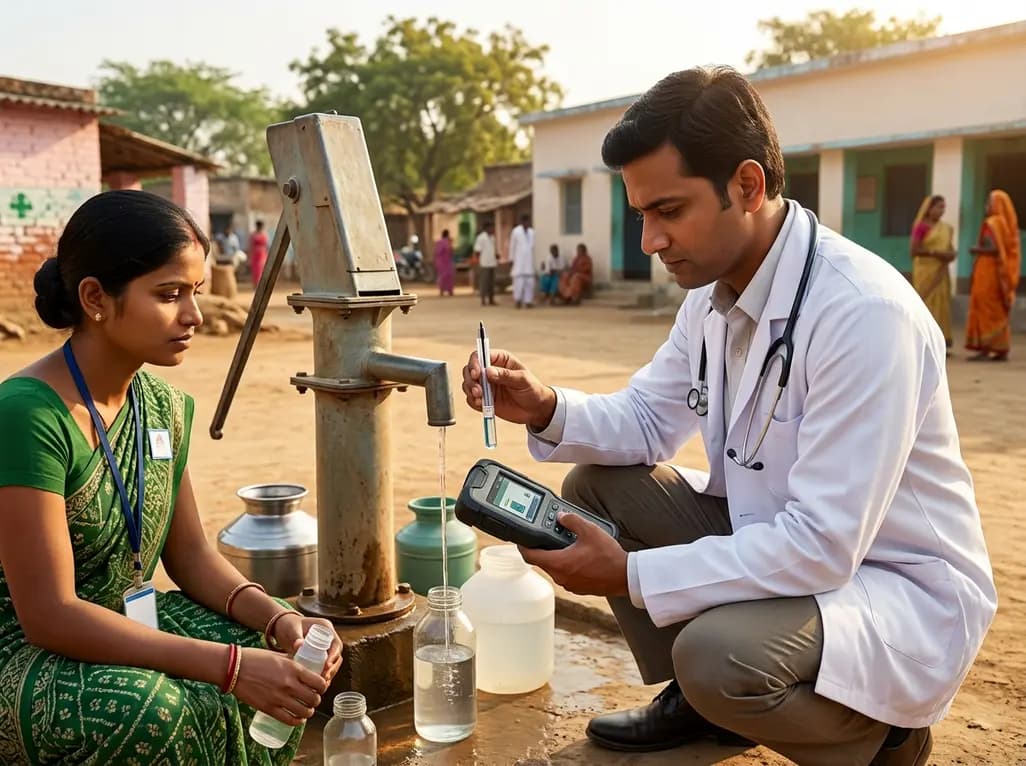
Researchers at the Indian Institute of Technology (IIT) Bhubaneswar have designed an innovative arsenic detection device called ArsenSafe. This handheld tool offers a rapid, highly accurate solution to a pressing public health challenge in India. Specifically, the device enables on-site drinking water testing without requiring expensive laboratory infrastructure.
A startup named Nano Semic developed this breakthrough technology. Faculty members Sayan Dey and Akshay K lead this venture, which operates within the IIT Bhubaneswar incubator. Furthermore, the system employs a specialized reduced graphene oxide (rGO) sensing mechanism. Consequently, users can operate the device with minimal training or technical set-up. Additionally, the team integrated machine learning algorithms to enhance both the accuracy and sensitivity of the device.
Arsenic contamination in groundwater poses severe risks to human health, including skin lesions, cardiovascular disease, and cancer. Therefore, quick detection is crucial for safety. In Odisha, official studies identified critical arsenic contamination in five major districts, including Gajapati, Ganjam, and Bhadrak. Specifically, these regional water sources exceeded the Bureau of Indian Standards permissible limit of 0.01 mg/l. Fortunately, ArsenSafe can detect extremely low arsenic concentrations in alignment with World Health Organisation standards.
The prototype has already achieved a high Technology Readiness Level. Moreover, researchers successfully tested the device on water samples from the IIT campus and surrounding rural areas. As a result, public health departments, non-governmental organizations, and individual households can soon deploy the device. Ultimately, this portable technology could drastically reduce chronic exposure to toxic heavy metals across vulnerable regions.
Q1: What is ArsenSafe?
ArsenSafe is a portable, handheld device designed by IIT Bhubaneswar researchers to rapidly and accurately detect arsenic contamination in drinking water.
Q2: How does this new arsenic detection device work?
The device uses a reduced graphene oxide (rGO)-based sensing system. Additionally, it integrates nanotechnology with machine learning to measure trace levels of arsenic without needing a laboratory setup.
Q3: Why is arsenic contamination in drinking water dangerous?
Chronic exposure to arsenic-contaminated water can lead to severe health issues, such as skin lesions, cardiovascular diseases, diabetes, and various cancers.
Disclaimer: This content is for informational and educational purposes only. It does not constitute medical advice or replace professional judgment. Refer to the latest local and national guidelines for clinical practice.
References

Read summarized clinical updates, watch expert medical content, and earn CME certifications right from your smartphone.
Open your smartphone camera to scan and install.





Indian researchers have built ArsenSafe, a handheld rGO-based sensor that uses nanotechnology and machine learning to rapidly detect trace arsenic in drinking water. This device could revolutionize field testing across rural India, addressing a critical public health crisis without complex laboratory setups.
4 months ago

Novel diimide and hydrazone scaffolds, particularly compound #C4, synergistically reactivate latent HIV-1 when combined with JQ1 or PKC activators. Demonstrating donor-matched proviral transcription ex vivo and non-canonical signaling, these findings advance shock and kill strategies toward reservoir eradication.
Today

A comparative cohort study evaluates vNOTES vs TLH hysterectomy for benign conditions, demonstrating shorter operative duration, faster return to daily activities, and equivalent female sexual function scores without increased dyspareunia.
Today

Review how tailored exercise programs benefit frail older patients with heart failure. Explore pathophysiological mechanisms, individualized training prescriptions, and strategies to overcome adherence barriers in clinical practice.
Yesterday

This comparative study evaluates posterior labral tears with and without glenohumeral instability, highlighting distinct demographic patterns, MRI underestimation in stable shoulders, and successful arthroscopic repair outcomes.
Yesterday

A clinical study demonstrates that early intervention with tocilizumab, either as monotherapy or bridged with corticosteroids, achieves significant proptosis reduction and resolves active inflammation in treatment-naive thyroid eye disease.
Today
