.webp&w=384&q=75)

Loading, please wait...
Loading, please wait...
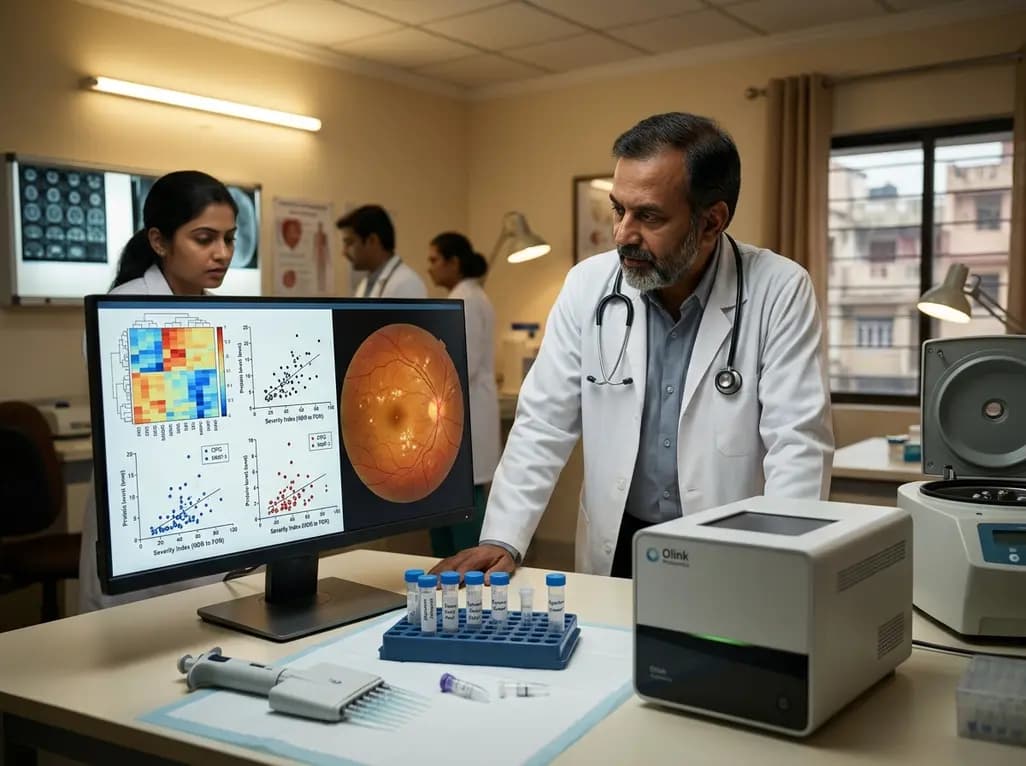
Diabetic retinopathy (DR) remains a significant health concern in India, often leading to irreversible vision loss if not detected early. As the number of diabetes cases continues to rise, clinicians require better tools for risk assessment and disease monitoring. One promising area of research involves identifying aqueous humor inflammatory biomarkers that can predict disease progression. Chronic low-grade inflammation is a known driver of the microvascular changes that characterize diabetic retinopathy. However, the precise molecular mechanisms and specific markers for different stages of the disease have been difficult to pinpoint. Recent studies suggest that the eye's internal fluid contains a wealth of information regarding its inflammatory state. By analyzing these protein profiles, we can gain insights into the localized pathological processes. Consequently, researchers are turning to advanced proteomic techniques to map these inflammatory proteins across various DR stages. This study provides a comprehensive analysis of these biomarkers, offering a new perspective on how we can manage this complex condition more effectively.
To explore the inflammatory landscape of the eye, scientists utilized the Olink Proximity Extension Assay (PEA) technology. This high-multiplex platform allows for the simultaneous detection of dozens of proteins with exceptional sensitivity and specificity. The researchers analyzed aqueous humor (AH) samples from three distinct groups: a control group, patients with nonproliferative diabetic retinopathy (NPDR), and those with proliferative diabetic retinopathy (PDR). Traditionally, the small volume of AH obtainable during surgery limited the depth of proteomic analysis. However, PEA overcomes this challenge by using DNA-tagged antibodies, which requires only a few microliters of sample. This technological advancement allows for a more detailed assessment of the localized immune response than previously possible. Furthermore, focusing on the aqueous humor ensures that the biomarkers identified are directly related to ocular health rather than systemic inflammation. By systematically profiling 92 inflammation-related proteins, the study successfully identified specific molecular signatures associated with disease severity. This approach represents a major step forward in our ability to monitor the ocular environment in diabetic patients.
The study identified three primary proteins that showed significant elevation in patients with diabetic retinopathy. Osteoprotegerin (OPG), Matrix Metalloproteinase-1 (MMP-1), and CUB Domain-Containing Protein 1 (CDCP1) were found at much higher levels in the NPDR and PDR groups compared to the controls. Interestingly, the expression of these proteins increased progressively as the disease became more severe. PDR patients exhibited the highest concentrations, suggesting that these proteins are closely linked to the neovascular complications of advanced retinopathy. MMP-1 is involved in the breakdown of the extracellular matrix, which can contribute to vascular instability. Similarly, CDCP1 plays a role in cell signaling and may promote the pathological blood vessel growth seen in the proliferative stage. The progressive nature of these aqueous humor inflammatory biomarkers makes them ideal candidates for disease staging. For clinicians in India, using these markers could improve the accuracy of patient stratification. Instead of relying solely on visual inspection, doctors can use molecular data to identify patients at the highest risk for progression. This objective approach to monitoring is essential for timely intervention and vision preservation.
Pathway analysis provided deeper insights into the biological processes driving the progression of diabetic retinopathy. The researchers discovered significant enrichment in core inflammatory pathways, most notably the IL-17 and TNF signaling pathways. These pathways are well-known mediators of immune responses and have been implicated in various diabetic complications. Specifically, the IL-17 pathway contributes to the recruitment of inflammatory cells and the production of cytokines that damage the blood-retinal barrier. Meanwhile, TNF signaling is a major driver of endothelial cell death and microvascular dysfunction. When these pathways are persistently active, they create a pro-inflammatory environment that accelerates retinal damage. Additionally, the involvement of these pathways highlights potential targets for new therapeutic interventions. By modulating the IL-17 or TNF pathways within the eye, clinicians might be able to slow or even halt the progression of retinopathy. Consequently, these findings offer a roadmap for developing more effective, targeted treatments for diabetic patients who do not respond well to current therapies.
Among the identified biomarkers, Osteoprotegerin (OPG) emerged as a particularly robust indicator of disease severity. The researchers selected OPG for validation in an independent cohort due to its high fold change and clear differential expression across groups. OPG is traditionally known for its role in bone metabolism, but its importance in vascular health is increasingly recognized. In the context of the eye, elevated OPG levels in the aqueous humor reflect the intense inflammatory stress associated with diabetic retinopathy. The validation phase confirmed that OPG levels accurately distinguish between control, NPDR, and PDR patients. This consistency makes OPG a highly reliable marker for clinical use. Furthermore, the statistical strength of OPG suggests that it could be a central component of a diagnostic protein panel. For Indian ophthalmologists, having access to such a marker could revolutionize how high-risk patients are tracked. Instead of waiting for visible signs of proliferation, clinicians could use OPG levels to predict who is likely to progress. This proactive approach to care is essential for reducing the burden of blindness caused by diabetes.
In summary, the use of Olink proteomics has opened new avenues for understanding the inflammatory mechanisms of diabetic retinopathy. By identifying OPG, MMP-1, and CDCP1 as key aqueous humor inflammatory biomarkers, this study provides a new framework for disease assessment. These markers offer a precise way to stratify patients based on their molecular risk profile, ensuring that those at highest risk receive early attention. For healthcare providers in India, integrating these molecular insights into clinical practice could significantly improve outcomes for diabetic patients. Moreover, the discovery of enriched IL-17 and TNF pathways suggests that targeted anti-inflammatory therapies may hold promise for future treatment. As our understanding of the ocular microenvironment continues to grow, we can move closer to the goal of precision medicine in ophthalmology. Ultimately, the goal is to preserve vision and improve the quality of life for the millions of individuals living with diabetes. By bridging the gap between molecular biology and clinical care, we can better fight the complications of this global epidemic.
Aqueous humor inflammatory biomarkers are critical because they provide a localized view of the ocular environment. Unlike systemic markers, these proteins directly reflect the immune and metabolic changes occurring within the eye. By identifying specific markers like OPG and MMP-1, clinicians can more accurately stage the severity of retinopathy. This allows for better prediction of disease progression and helps in tailoring personalized management strategies for high-risk patients.
Olink Proximity Extension Assay (PEA) technology offers high specificity and sensitivity while requiring extremely small sample volumes. This is particularly advantageous for ophthalmology, where obtaining large amounts of aqueous humor is difficult. PEA allows researchers to analyze nearly a hundred proteins simultaneously from a few microliters of fluid. This multiplexing capability accelerates the identification of complex molecular signatures that were previously hidden, paving the way for advanced diagnostic tools.
Osteoprotegerin (OPG) is considered a reliable marker because it exhibits a significant and progressive increase in concentration as diabetic retinopathy advances. Validation studies show that OPG levels clearly differentiate between healthy eyes, nonproliferative retinopathy, and proliferative retinopathy. This robustness across different patient cohorts makes it an ideal candidate for clinical diagnostic panels. Its role in both vascular health and inflammation further supports its relevance as a key indicator of retinal damage.
Disclaimer: This content is for informational and educational purposes only. It is not intended to provide medical advice or to substitute for professional clinical judgment. Readers should consult with qualified healthcare professionals for diagnosis and treatment. Refer to the latest local and national guidelines for clinical practice.
References
1. Li Y et al. Olink Proteomics Analysis Reveals Aqueous Humor Inflammatory Biomarkers in Patients with Different Stages of Diabetic Retinopathy. J Proteome Res. 2026 Jul 09. doi: 10.1021/acs.jproteome.6c00185. PMID: 42423034.
2. Chen Y et al. Levels of Inflammatory Cytokines IL-1β, IL-6, IL-8, IL-17A, and TNF-α in Aqueous Humour of Patients with Diabetic Retinopathy. J Diabetes Res. 2018; 2018: 146154. doi: 10.1155/2018/146154.
3. Oh IK et al. Inflammatory and angiogenic factors in the aqueous humor and the relationship to diabetic retinopathy. Curr Eye Res. 2010; 35(12): 1116-1127. doi: 10.3109/02713683.2010.518625.

Read summarized clinical updates, watch expert medical content, and earn CME certifications right from your smartphone.
Open your smartphone camera to scan and install.





A recent study utilizing Olink Proteomics identifies key inflammatory biomarkers in the aqueous humor, such as OPG and MMP-1, providing new insights into the staging and molecular progression of diabetic retinopathy across different severity levels.
3 months ago

Novel diimide and hydrazone scaffolds, particularly compound #C4, synergistically reactivate latent HIV-1 when combined with JQ1 or PKC activators. Demonstrating donor-matched proviral transcription ex vivo and non-canonical signaling, these findings advance shock and kill strategies toward reservoir eradication.
Today

A cross-sectional study reveals that maternal RSV vaccination coverage reached only 43.7% in Argentina, with maternal vaccine knowledge being the sole independent predictor of uptake. Clinicians play a crucial role in eliminating informational and structural barriers to optimize infant health.
Today

Review how tailored exercise programs benefit frail older patients with heart failure. Explore pathophysiological mechanisms, individualized training prescriptions, and strategies to overcome adherence barriers in clinical practice.
Yesterday

This comparative study evaluates posterior labral tears with and without glenohumeral instability, highlighting distinct demographic patterns, MRI underestimation in stable shoulders, and successful arthroscopic repair outcomes.
Yesterday

A clinical study demonstrates that early intervention with tocilizumab, either as monotherapy or bridged with corticosteroids, achieves significant proptosis reduction and resolves active inflammation in treatment-naive thyroid eye disease.
Yesterday
