.webp&w=384&q=75)

Loading, please wait...
Loading, please wait...
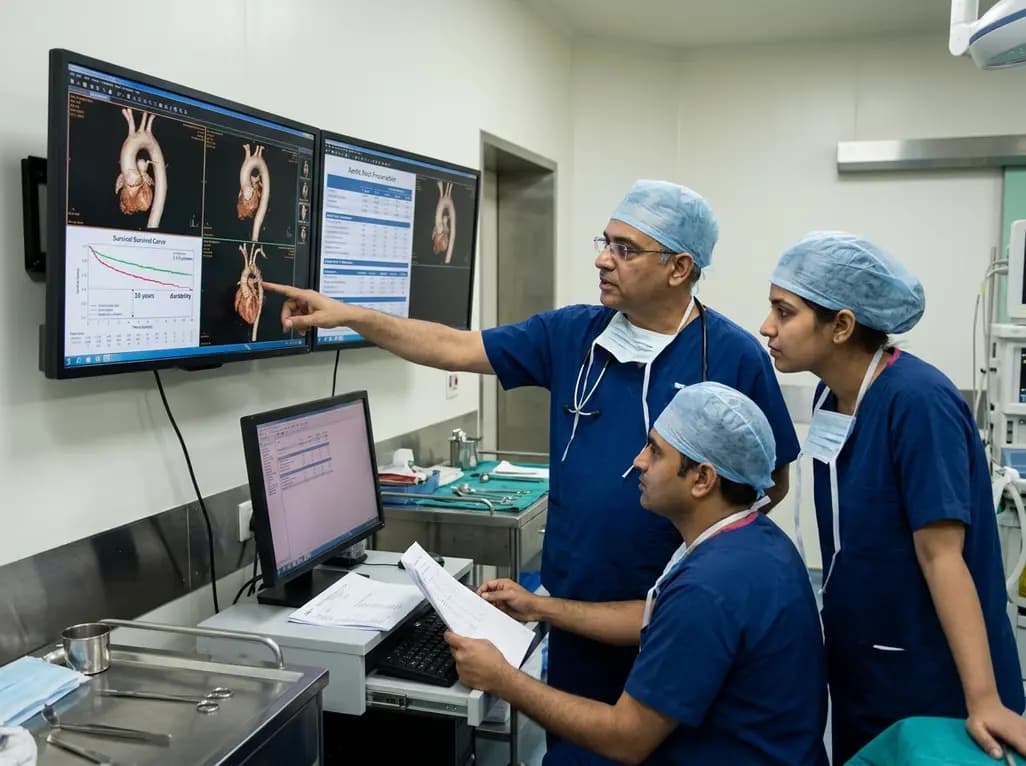
Acute type A aortic dissection represents a catastrophic surgical emergency that demands immediate, highly coordinated intervention. During emergency surgical repair, surgeons must choose between total root replacement and aortic root preservation to restore stable cardiovascular hemodynamics. Consequently, preserving the native aortic valve leaflets and sinus tissue remains an attractive option when pathology permits. Clinicians frequently debate whether significant baseline regurgitation impairs long-term repair durability. Recent clinical evidence now offers critical clarity regarding the long-term durability and safety of conservative root reconstruction across large operative cohorts.
Surgeons frequently encounter acute dissection flaps that extend into the aortic sinuses, which destabilizes normal commissural suspension. In this critical scenario, aortic root preservation reconstructs native geometry while avoiding prosthetic valve implantation. A recent comprehensive investigation evaluated 1,333 consecutive patients who underwent surgical repair for acute type A dissection across nineteen years. The researchers stratified patients into two distinct cohorts: an aortic regurgitation group with moderate-to-severe insufficiency and a non-regurgitation group with mild or absent dysfunction.
Importantly, the overall 30-day operative mortality reached 11.3% across the entire multi-year cohort. Patients presenting with significant baseline regurgitation experienced higher crude early mortality than those with preserved valve competence, recording 15.2% versus 9.9%. However, comprehensive multivariate adjustment confirmed that preoperative aortic regurgitation was not an independent predictor of early postoperative death. Instead, profound preoperative malperfusion, advanced shock, and acute hemodynamic collapse determined early mortality risks. Therefore, conservative root repair offers comparable immediate procedural safety when surgical teams execute sound anatomical patient selection.
Surgeons must complete a thorough anatomical assessment before selecting conservative root reconstruction during emergency sternotomy. Specifically, preservation remains preferred unless distinct pathological contraindications prevent safe repair. Clinicians generally avoid conservative repair when encountering severely fragmented intimal tissue, extensive sinus destruction, or primary cusp prolapse with fenestration. Furthermore, significant preexisting sinus dilation exceeding 45 millimeters or confirmed connective tissue disorders mandate formal root replacement.
When native leaflets remain pliable and intact, surgeons restore competent valve geometry by resuspending displaced commissural posts. In addition, surgical teams reconstruct dissected sinus walls using biological glues, Teflon felts, or adventitial inversion sutures. Consequently, this conservative strategy noticeably shortens cardiopulmonary bypass duration and aortic cross-clamp intervals compared with total root replacement. Shorter operative durations provide immense physiological benefits to unstable patients presenting with profound metabolic acidosis or cardiac tamponade. Thus, preserving the native root minimizes surgical trauma while eliminating lifelong anticoagulation risks.
Long-term survival serves as the definitive benchmark when evaluating the durability of proximal aortic reconstruction techniques. Notably, the clinical trial demonstrated remarkable long-term survival that remained comparable between patient groups over ten years of follow-up. Overall survival at ten years reached 93.6% in the significant regurgitation group and 92.3% in the non-regurgitation group. These compelling figures demonstrate that baseline aortic insufficiency does not jeopardize extended survival after successful commissural reconstruction.
Furthermore, maintaining the native valve apparatus protects patients against mechanical and biological prosthesis complications. Patients who retain their natural valve avoid lifelong oral anticoagulants, which substantially minimizes fatal hemorrhagic complications. Similarly, native valve preservation prevents prosthetic valve endocarditis, structural valve deterioration, and early reoperation related to conduit failure. Therefore, conservative reconstruction preserves normal cardiovascular hemodynamics effectively, provided the initial surgical repair restores leaflet coaptation geometry.
Although survival rates remain excellent, surgeons must critically evaluate the durability of the repaired valve mechanism over extended periods. In the published cohort, freedom from recurrent aortic regurgitation at ten years stood at 88.0% among patients with preoperative regurgitation. In contrast, patients without baseline regurgitation demonstrated a 97.1% freedom from recurrent insufficiency over the identical timeframe. This difference proves statistically significant, illustrating that severe commissural detachment introduces subtle residual vulnerabilities into the reconstructed root.
Nevertheless, an 88% durability rate at ten years reflects outstanding mid-term stability for an emergency reconstructive procedure. Because recurrent valve incompetence typically develops gradually, surgical teams can plan elective reinterventions rather than emergency rescue operations. Regular outpatient surveillance empowers cardiologists to detect progressive regurgitation before severe left ventricular remodeling occurs. In addition, secondary elective root operations carry substantially lower operative risks than emergency dissection repairs. Hence, clinical teams can safely pursue preservation while enforcing structured longitudinal monitoring.
Delivering exceptional surgical outcomes requires close alignment between cardiothoracic surgeons, cardiac anesthesiologists, and intensive care clinicians. Intraoperative transesophageal echocardiography serves as an essential tool during both initial lesion characterization and post-repair quality assessment. Specifically, imaging teams must meticulously examine leaflet coaptation height, coaptation length, and residual regurgitant jet width before the patient leaves bypass. When transesophageal imaging detects significant residual regurgitation, surgeons should promptly revise the repair or transition to formal root replacement.
Following surgical repair, strict medical therapy protects the reconstructed aortic sinuses against progressive aneurysmal dilatation. Aggressive blood pressure control targeting systolic levels under 120 mmHg reduces cyclic hydraulic stress across newly repaired aortic tissues. Consequently, clinicians prioritize beta-adrenergic blockers and angiotensin receptor blockers to suppress arterial wall shear stress. Ultimately, combining precise surgical reconstruction with vigilant hemodynamic management ensures outstanding long-term survival across institutional aortic surgery programs.
Yes, surgeons can safely perform aortic root preservation even in the presence of severe baseline regurgitation. Multivariate analyses confirm that preoperative regurgitation does not independently elevate early mortality when surgeons successfully reconstruct the commissures. Furthermore, ten-year overall survival remains equivalent between patients with and without baseline regurgitation. However, these patients face a slightly higher risk of late recurrent regurgitation, necessitating consistent long-term echocardiographic surveillance to detect late failure early.
Surgeons avoid conservative root repair when the intimal tear directly destroys the aortic valve leaflets or disrupts the coronary ostia beyond reconstructive salvage. Additionally, a preexisting aortic sinus diameter exceeding 45 millimeters, severe intrinsic leaflet fenestration, or extensive circumferential root necrosis mandate complete replacement. Patients with diagnosed hereditary connective tissue disorders, such as Marfan syndrome, also require full aortic root replacement to prevent rapid future root aneurysmal degeneration and catastrophic recurrent dissection.
Clinicians recommend obtaining baseline predischarge transthoracic echocardiography and contrast-enhanced computed tomography angiography before hospital departure. Subsequently, patients should undergo repeat clinical evaluations and echocardiographic imaging at six months and twelve months postoperatively. Following the first year, annual echocardiographic surveillance alongside periodic cross-sectional vascular imaging remains mandatory. This systematic approach ensures prompt identification of progressive sinus dilatation, pseudoaneurysm formation, or worsening aortic insufficiency before symptomatic ventricular dysfunction emerges.
Disclaimer: This content is for informational and educational purposes only and should not be considered medical advice. Healthcare professionals should rely on their clinical judgment and refer to the latest local and national guidelines for clinical practice.
References

Read summarized clinical updates, watch expert medical content, and earn CME certifications right from your smartphone.
Open your smartphone camera to scan and install.





A landmark study of 1,333 patients demonstrates that aortic root preservation provides robust 10-year durability in acute type A aortic dissection, even with significant baseline aortic regurgitation. Preoperative regurgitation did not independently increase early mortality.
last month

As monsoon seasons elevate arboviral disease threats, Tamil Nadu has initiated an ICMR-monitored evaluation of the tetravalent dengue vaccine in Tenkasi district. Clinicians emphasize clinical monitoring, public prevention, and high-quality early pediatric care to reduce disease morbidity across endemic regions.
Today

A comparative cohort study evaluates vNOTES vs TLH hysterectomy for benign conditions, demonstrating shorter operative duration, faster return to daily activities, and equivalent female sexual function scores without increased dyspareunia.
Today

Review how tailored exercise programs benefit frail older patients with heart failure. Explore pathophysiological mechanisms, individualized training prescriptions, and strategies to overcome adherence barriers in clinical practice.
Today

This comparative study evaluates posterior labral tears with and without glenohumeral instability, highlighting distinct demographic patterns, MRI underestimation in stable shoulders, and successful arthroscopic repair outcomes.
Today

A clinical study demonstrates that early intervention with tocilizumab, either as monotherapy or bridged with corticosteroids, achieves significant proptosis reduction and resolves active inflammation in treatment-naive thyroid eye disease.
Today
