.webp&w=384&q=75)

Loading, please wait...
Loading, please wait...
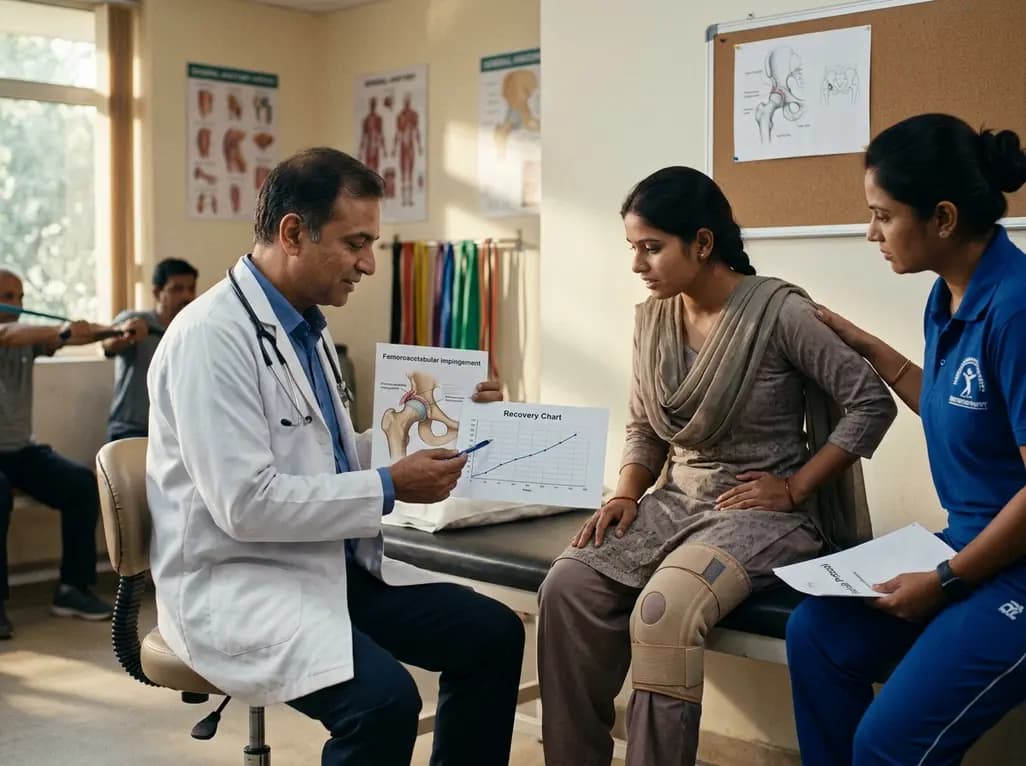
Femoroacetabular impingement syndrome causes substantial hip pain and mechanical dysfunction in young, athletic individuals. Over the last decade, arthroscopic correction has become the standard treatment for symptomatic impingement and acetabular labral pathology. However, clinicians recognize that patient factors substantially influence hip arthroscopy recovery patterns. Specifically, generalized ligamentous laxity presents unique biomechanical challenges that alter rehabilitation speed and functional progression. Consequently, orthopedic specialists frequently evaluate hypermobility using standardized scoring systems to anticipate potential surgical complexities.
Generalized ligamentous laxity describes excessive joint mobility beyond typical physiological limits across multiple anatomical regions. Clinicians routinely evaluate systemic hypermobility using the validated Beighton scoring system. In patients with femoroacetabular impingement, underlying hypermobility significantly complicates native hip kinematics. Because systemic tissue elasticity reduces static restraint, the acetabular labrum and hip capsule endure heightened shear stresses. Consequently, micro-instability frequently coexists with mechanical impingement, predisposing patients to premature labral tearing and chondral degradation. Moreover, young active females demonstrate a higher prevalence of joint hypermobility, which often delays initial diagnosis. When standard non-operative measures fail, surgeons offer arthroscopic intervention to repair damaged tissue and correct bony abnormalities. However, surgeons must carefully distinguish dynamic hypermobility from isolated structural femoroacetabular impingement. If surgical teams overlook underlying laxity, patients face an elevated risk of persistent micro-instability postoperatively. Therefore, thorough preoperative clinical evaluation remains vital for guiding individualized surgical strategy and realistic patient expectations.
To clarify clinical pathways, investigators conducted a rigorous propensity-matched study analyzing long-term outcomes from a single-institution registry spanning a decade. The researchers reviewed patients undergoing primary arthroscopic surgery for symptomatic femoroacetabular impingement syndrome and concurrent labral tears. Specifically, the team categorized participants using a Beighton score threshold of four or higher to define severe generalized laxity. To eliminate confounding variables, researchers matched hypermobile patients to control subjects based on age, sex, and body mass index. Furthermore, investigators tracked patient-reported outcome measures longitudinally from preoperative baseline to short- and mid-term follow-up intervals exceeding two years. Standardized metrics included the modified Harris Hip Score, the Nonarthritic Hip Score, and the International Hip Outcome Tool-12. Additionally, the team recorded the Hip Outcome Score-Sport Scale alongside Visual Analogue Scale pain ratings. This rigorous matching methodology allowed researchers to isolate ligamentous laxity as an independent variable influencing functional restoration.
The comparative analysis revealed substantial distinctions in postoperative recovery velocity between the two propensity-matched cohorts. Most notably, individuals presenting with severe generalized ligamentous laxity exhibited a slower hip arthroscopy recovery trajectory during early rehabilitation. Although both groups achieved remarkable total gains in pain relief, laxity patients progressed more gradually through early milestones. Furthermore, early post-surgical functional scores lagged behind the tightly matched control group, especially regarding vigorous athletic tasks. Consequently, hypermobile patients reported intermittent groin soreness and delayed strength recovery in the early postoperative months. In contrast, the control cohort achieved the minimal clinically important difference and significant functional benchmarks far more rapidly. Fortunately, mid-term evaluations at the two-year mark demonstrated comparable overall success rates between both cohorts. Thus, severe ligamentous laxity delays functional velocity without compromising ultimate symptom resolution or patient satisfaction. As a result, surgeons can reassure hypermobile patients that patience during early convalescence leads to robust mid-term joint preservation.
These clinical findings carry direct implications for intraoperative decision-making during hip preservation procedures. In hypermobile individuals, preserving or enhancing structural joint stability takes precedence over aggressive bone resection. When surgeons perform capsulotomy to visualize the joint, the vulnerable capsule loses critical resting tension. Therefore, routine complete capsular closure or targeted capsular plication becomes essential for hypermobile patients to prevent secondary iatrogenic instability. Moreover, surgeons should meticulously avoid over-resecting the acetabular rim or femoral head-neck junction. Because excessive osseous resection further diminishes mechanical containment in an already loose joint articulation, conservative osteoplasty is vital. Additionally, anatomical labral repair utilizing strong suture anchors restores the fluid seal and stabilizes dynamic contact pressures. By prioritizing precise stabilization maneuvers, the surgical team protects delicate chondral surfaces from abnormal shear forces. Consequently, surgical teams can neutralize the biomechanical liabilities imposed by systemic tissue compliance. Ultimately, implementing these stabilizing surgical refinements guarantees that hypermobile patients maintain joint integrity while progressing toward full functional recovery.
Postoperative physical therapy requires substantial modification when rehabilitating athletes and active patients with baseline ligamentous laxity. Because hypermobility increases dynamic joint displacement, physical therapists must avoid aggressive early passive stretching. Instead, therapists should emphasize neuromuscular control, closed-chain kinetic loading, and peritrochanteric muscle strengthening. Specifically, establishing robust activation of the gluteus medius, deep external rotators, and core stabilizing musculature provides necessary dynamic stability. Furthermore, clinicians often recommend extended protective weight-bearing and temporary external bracing to protect the plicated capsule. As a result, the rehabilitation team allows biological tissue healing to mature before introducing high-impact activities. In addition, progressive return-to-sport testing should incorporate strict objective criteria rather than arbitrary calendar timelines. Moreover, comprehensive patient education regarding recovery expectations prevents premature discouragement during slower functional phases. Ultimately, when multidisciplinary teams coordinate conservative rehabilitation, patients navigate the delayed trajectory successfully and regain peak athletic performance safely.
Generalized ligamentous laxity significantly slows the rate of functional recovery following hip arthroscopy. Although hypermobile patients ultimately achieve favorable pain relief and joint function at two years, their early recovery curve remains delayed. Because reduced capsular restraint creates dynamic joint instability, surrounding muscles must work harder to stabilize the hip joint. Consequently, patients experience prolonged postoperative soreness, slower strength gains, and delayed clearance for athletic participation compared to patients with normal tissue mobility.
Capsular plication tightens an abnormally loose hip capsule, restoring mechanical stability to the articulation. In hypermobile individuals, standard capsular incisions can induce persistent micro-instability and chronic pain if left unclosed. Therefore, surgeons routinely perform capsular plication to reef the redundant tissue, optimizing femoral head containment. Furthermore, stabilizing the capsule preserves the essential intra-articular fluid seal and protects repaired labral tissue, ensuring a safe postoperative progression without developing recurrent joint laxity.
Physical therapists should prioritize dynamic neuromuscular stabilization over aggressive stretching for hypermobile hip patients. Because joint tissues possess excessive baseline laxity, premature passive motion risks overstretching healing capsular plications. Therapists therefore emphasize closed-chain strengthening of the gluteal musculature, deep hip rotators, and core stabilizers. Additionally, clinicians extend protective weight-bearing phases and delay high-impact sporting clearance, ensuring that muscular control adequately compensates for baseline ligamentous laxity throughout the extended recovery process.
Disclaimer: This content is for informational and educational purposes only and does not substitute for professional medical advice, diagnosis, or treatment. Refer to the latest local and national guidelines for clinical practice.
References

Read summarized clinical updates, watch expert medical content, and earn CME certifications right from your smartphone.
Open your smartphone camera to scan and install.





A propensity-matched study reveals that patients with severe generalized ligamentous laxity experience a slower recovery trajectory after hip arthroscopy for femoroacetabular impingement. While final two-year outcomes remain favorable, tailored rehabilitation and capsular management are critical.
last month

Novel diimide and hydrazone scaffolds, particularly compound #C4, synergistically reactivate latent HIV-1 when combined with JQ1 or PKC activators. Demonstrating donor-matched proviral transcription ex vivo and non-canonical signaling, these findings advance shock and kill strategies toward reservoir eradication.
Today

A cross-sectional study reveals that maternal RSV vaccination coverage reached only 43.7% in Argentina, with maternal vaccine knowledge being the sole independent predictor of uptake. Clinicians play a crucial role in eliminating informational and structural barriers to optimize infant health.
Today

Review how tailored exercise programs benefit frail older patients with heart failure. Explore pathophysiological mechanisms, individualized training prescriptions, and strategies to overcome adherence barriers in clinical practice.
Yesterday

This comparative study evaluates posterior labral tears with and without glenohumeral instability, highlighting distinct demographic patterns, MRI underestimation in stable shoulders, and successful arthroscopic repair outcomes.
Yesterday

A clinical study demonstrates that early intervention with tocilizumab, either as monotherapy or bridged with corticosteroids, achieves significant proptosis reduction and resolves active inflammation in treatment-naive thyroid eye disease.
Yesterday
