.webp&w=384&q=75)

Loading, please wait...
Loading, please wait...

Antibiotic resistance genes are showing a uniform presence across major Indian urban centers. Specifically, a recent study by the CSIR-Centre for Cellular and Microbiology (CCMB) has analyzed wastewater from four metro cities. Consequently, researchers discovered that while local bacteria vary, the underlying resistance mechanisms remain strikingly similar. Furthermore, this surveillance method offers a broader perspective on community health. Moreover, it provides a real-time tracking system for drug-resistant pathogens. Therefore, these findings are critical for future public health strategies.
The research team examined 447 wastewater samples from Delhi, Mumbai, Kolkata, and Chennai. Interestingly, they found that specific bacterial species dominate differently in each city. For instance, Kolkata shows a higher abundance of Pseudomonas aeruginosa. In contrast, Chennai and Mumbai exhibit more Klebsiella pneumoniae. However, despite these variations, the antibiotic resistance genes remained consistent across all sites. This consistency suggests a shared antimicrobial resistance (AMR) pattern across urban India. Scientists believe that local environmental factors shape the microbial communities, yet the survival tools remain identical. Consequently, the mechanisms used by bacteria to fight antibiotics are becoming standardized across geographic boundaries.
Antibiotic resistance genes help bacteria survive medications in several ways. Specifically, some genes strengthen the bacterial cell wall to block drug entry. Other genes enable bacteria to metabolize or destroy antibiotic molecules entirely. Additionally, some bacteria develop pumps to expel the drugs from their systems. Furthermore, these survival tools are not just passed to offspring. Bacteria can share these genes with their neighbors through horizontal gene transfer. This process allows resistance to spread rapidly across diverse microbial populations. The study also noted that genes for tetracycline and beta-lactam resistance spread more easily than others. Consequently, understanding these transmission dynamics is vital for controlling AMR.
Wastewater-based surveillance is emerging as a cost-effective public health tool. Specifically, it works well even in resource-limited settings. Researchers developed a protocol that allows sample storage at 4°C for seven days. This flexibility makes it possible to transport samples to central testing hubs without losing data quality. Moreover, sewage-based monitoring can detect outbreaks much earlier than traditional clinical testing. It captures data from the entire community, including asymptomatic carriers. Therefore, wider participation in this surveillance will strengthen India’s defense against drug-resistant pathogens.
Q1: How does wastewater surveillance help track antibiotic resistance?
It provides a community-wide view of resistance patterns. This method detects drug-resistant pathogens in real time, even before clinical outbreaks occur.
Q2: Do different Indian cities have different types of bacteria?
Yes, the study found varying bacterial dominance. For example, Kolkata showed more Pseudomonas aeruginosa, while Chennai and Mumbai had more Klebsiella pneumoniae.
Q3: Which antibiotic resistance genes spread most easily?
According to the CCMB study, genes conferring resistance to tetracyclines and beta-lactams spread more easily than those linked to macrolides.
Disclaimer: This content is for informational and educational purposes only. It does not constitute medical advice or replace professional judgment. Refer to the latest local and national guidelines for clinical practice.
References

Read summarized clinical updates, watch expert medical content, and earn CME certifications right from your smartphone.
Open your smartphone camera to scan and install.





A CCMB study reveals similar antibiotic resistance genes in the wastewater of major Indian cities, enabling early detection and tracking of drug resistance....
6 months ago
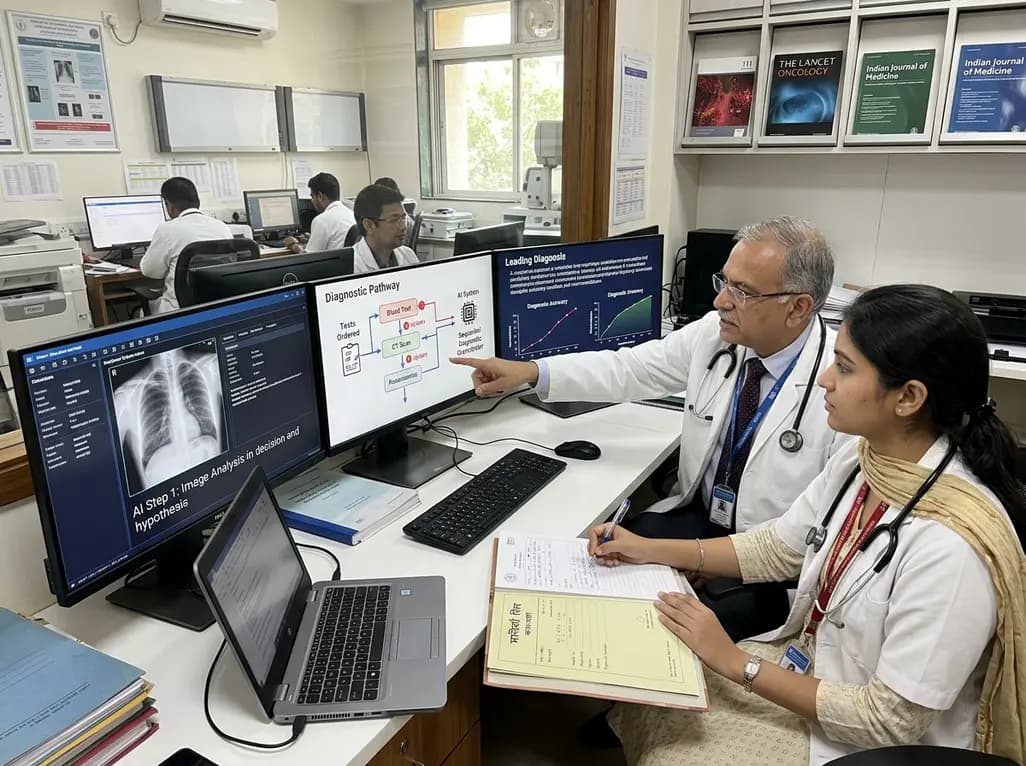
A breakthrough peer-reviewed study demonstrates that a sequential AI diagnosis system can mirror real-world clinical reasoning. By ordering stepwise tests and updating hypotheses dynamically, this multi-agent orchestrator achieved superior diagnostic accuracy while reducing investigative costs.
Today

A prenatal case highlights severe glutaric acidemia type II presenting as bilateral hyperechoic cystic kidneys at 18 weeks. Whole-exome sequencing revealed a novel homozygous ETFDH frameshift variant, demonstrating the power of rapid genetic testing in fetal renal anomalies.
Today

Review how tailored exercise programs benefit frail older patients with heart failure. Explore pathophysiological mechanisms, individualized training prescriptions, and strategies to overcome adherence barriers in clinical practice.
Yesterday

This comparative study evaluates posterior labral tears with and without glenohumeral instability, highlighting distinct demographic patterns, MRI underestimation in stable shoulders, and successful arthroscopic repair outcomes.
Yesterday

A clinical study demonstrates that early intervention with tocilizumab, either as monotherapy or bridged with corticosteroids, achieves significant proptosis reduction and resolves active inflammation in treatment-naive thyroid eye disease.
Yesterday
