.webp&w=384&q=75)

Loading, please wait...
Loading, please wait...
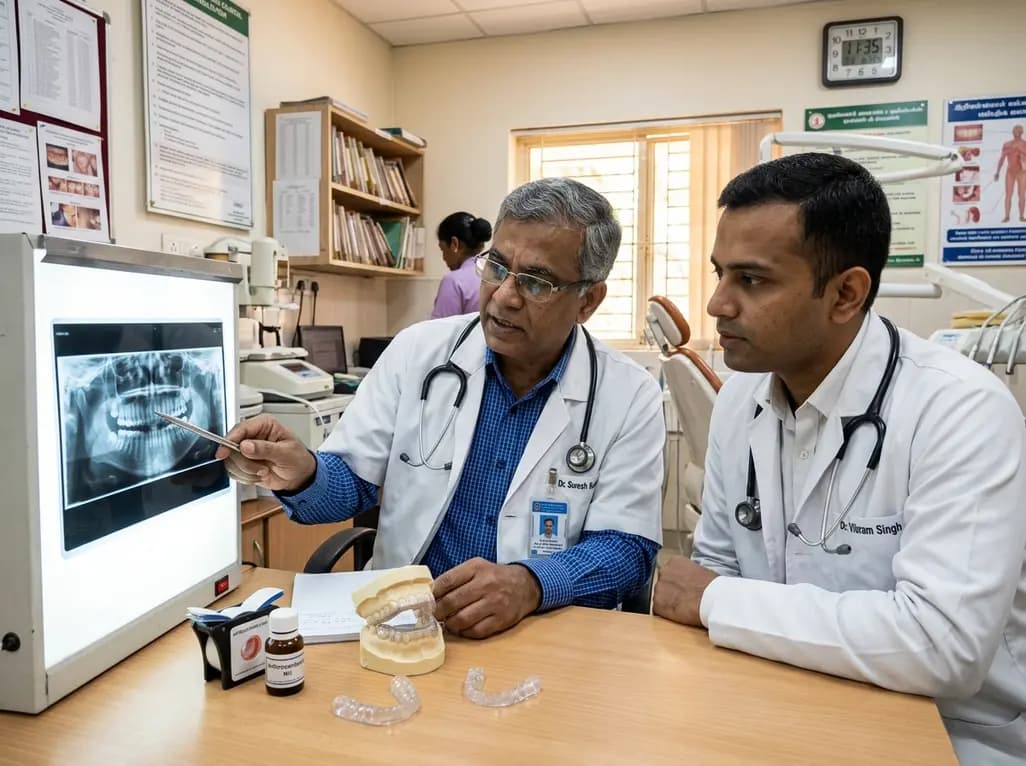
Temporomandibular disorders frequently present with internal derangement, predominantly manifesting as disc displacement with reduction. Dental practitioners regularly manage this distressing condition using diverse conservative interventions. Among these intraoral appliances, anterior repositioning splints have gained widespread popularity for altering mandibular posture and alleviating clicking. These specific devices purposefully position the mandible forward, thereby unloading tender retrodiscal tissues and recapturing the displaced disc during jaw closure. Consequently, dental specialists often recommend them to diminish clicking sounds, reduce muscle guarding, and relieve joint soreness. However, clinicians continue to debate their relative superiority when comparing them against conventional flat-plane appliances. Specifically, critical questions persist regarding whether forcibly advancing the jaw delivers tangible functional improvements over traditional stabilization guards. Furthermore, broad variations in wear protocols complicate evidence-based decision-making in routine dental practices. Therefore, establishing clear comparative evidence remains essential to define the precise therapeutic role of these appliances in modern workflows. Additionally, Indian practitioners frequently encounter patients with chronic joint sounds who seek non-invasive relief before considering surgical consultation. Addressing these clinical dilemmas requires synthesizing high-quality evidence from rigorous randomized trials.
A recent Bayesian network meta-analysis comprehensively evaluated conservative and minimally invasive modalities for temporomandibular disc displacement. The researchers systematically synthesized evidence across twelve randomized controlled trials to establish clear comparative effectiveness metrics. Specifically, seven trials reported maximum mouth opening, while eight trials documented joint and muscular pain reductions. The investigators applied mean difference as the principal effect measure across all clinical comparisons. Furthermore, the statistical framework employed the surface under the cumulative ranking curve to rank competing interventions objectively. To ensure methodological rigor, the investigators performed a dedicated sensitivity analysis that excluded a study with an implausibly narrow standard deviation. Consequently, this analytical check validated the robustness of the primary pain rankings without altering overall conclusions. Notably, the certainty of evidence across all comparisons ranged strictly from very low to moderate according to GRADE criteria. Indeed, no single treatment comparison achieved high certainty, highlighting persistent methodological heterogeneity in temporomandibular research. Nevertheless, this network meta-analysis provides the most structured quantitative synthesis to date. Thus, it offers healthcare providers valuable probabilistic guidance regarding relative treatment efficacy in daily practice.
Restoring comfortable mandibular mobility represents a primary therapeutic objective when treating patients who suffer from joint restriction. In this network meta-analysis evaluating ten competing therapies, arthrocentesis achieved the highest ranking for improving maximum mouth opening. Specifically, arthrocentesis demonstrated a surface under the cumulative ranking curve value of 76.2 percent. In striking contrast, anterior repositioning splints ranked eighth among the ten evaluated options, achieving a modest score of 38.3 percent. When comparing arthrocentesis directly with anterior repositioning devices, the mean difference reached 6.78 millimeters in favor of arthrocentesis. However, because the 95 percent credible interval spanned broadly from negative 17.57 to 4.01 millimeters, this comparison did not reach statistical significance. Consequently, researchers could not confirm absolute superiority through strict inferential thresholds. Nevertheless, cumulative ranking probabilities strongly favor minimally invasive lavage over mechanical posturing appliances. Arthrocentesis physically flushes out inflammatory cytokines and releases vacuum effects within the joint cavity. Conversely, intraoral splints merely shift mandibular posture without directly addressing intracapsular adhesions. Therefore, practitioners treating marked jaw hypomobility should not rely primarily on repositioning devices, as minimally invasive articular interventions offer superior restorative potential.
Alleviating persistent orofacial pain remains the primary concern for patients seeking care for temporomandibular joint disc derangement. Across twelve evaluated interventions, the network meta-analysis identified clear differences in analgesic performance. Notably, the traditional stabilization splint ranked first overall, achieving the highest cumulative ranking score of 77.7 percent. Anterior repositioning splints followed closely in second position, recording a commendable score of 65.9 percent. In contrast, untreated control groups ranked lowest across all arms, registering a score of only 11.1 percent. Statistical analysis revealed that anterior repositioning splints significantly outperformed untreated controls. Specifically, they achieved a substantial mean difference of 4.60 with a credible interval of 2.01 to 7.19. However, when investigators compared anterior repositioning appliances directly against stabilization splints, they found no statistically significant difference. Specifically, the mean difference was 0.69, accompanied by a 95 percent credible interval spanning from 0.64 to 2.02. Thus, while repositioning devices clearly reduce joint discomfort compared to no intervention, they do not surpass conventional stabilization guards. Because stabilization splints achieve comparable pain relief without forcing altered mandibular postures, they retain a distinct clinical advantage. Consequently, clinicians can achieve excellent analgesia using less intrusive appliance designs.
Determining the optimal treatment pathway requires clinicians to weigh comparative therapeutic efficacy against practical biological risks. Because anterior repositioning appliances ranked poorly for mouth opening, evidence questions their routine use. Furthermore, they showed no analgesic superiority over stabilization splints to justify standard first-line selection. Repositioning devices introduce notable clinical risks that demand careful, continuous supervision. By deliberately maintaining the mandible in a protruded relationship, these appliances risk inducing irreversible dental complications. Most notably, prolonged continuous wear frequently causes posterior open bites, intrusion of posterior teeth, and persistent masticatory muscle fatigue. In contrast, flat-plane stabilization splints distribute occlusal contacts evenly across the dental arch without repositioning the mandibular condyle. Consequently, stabilization appliances protect articular structures while presenting minimal danger of altering the patient dental occlusion. Additionally, magnetic resonance imaging studies confirm that permanent anatomical disc recapture rarely persists once repositioning therapy ends. Therefore, dental clinicians should initiate conservative management using flat stabilization splints combined with patient education, self-care routines, and gentle physical therapy. Clinicians should reserve repositioning devices strictly for select cases experiencing painful morning jaw locking refractory to conservative splinting.
Stabilization splints provide equivalent or superior pain reduction while avoiding the severe occlusal complications associated with mandibular repositioning. Unlike repositioning appliances that advance the jaw forward, stabilization splints distribute forces evenly without altering natural tooth contacts. Furthermore, prolonged repositioning therapy often induces posterior open bites and permanent muscular reprogramming. Consequently, clinical guidelines prioritize stabilization splints as a safer, highly predictable first-line conservative intervention for managing internal joint derangements.
Current scientific evidence indicates that repositioning appliances rarely achieve permanent anatomical disc recapture. Although these devices hold the condyle forward during active wear, the disc usually shifts forward again after appliance removal. Therefore, therapeutic success primarily results from unloading inflamed retrodiscal tissues. This mechanical decompression allows tissue adaptation and relieves pain without permanently altering articular disc anatomy. Consequently, clinicians should not promise permanent mechanical disc recapture when prescribing these oral devices.
According to recent network meta-analytic data, temporomandibular joint arthrocentesis ranks highest for improving maximum mouth opening. Minimally invasive arthrocentesis physically washes out inflammatory mediators and releases intra-articular adhesions through controlled hydraulic distension. In contrast, repositioning splints ranked eighth out of ten treatments for mouth opening. Therefore, clinicians managing severe jaw restriction should consider early arthrocentesis or structured physical therapy rather than relying exclusively on oral splint therapy.
Disclaimer: This content is for informational and educational purposes only... Refer to the latest local and national guidelines for clinical practice.
References

Read summarized clinical updates, watch expert medical content, and earn CME certifications right from your smartphone.
Open your smartphone camera to scan and install.





A network meta-analysis demonstrates that while anterior repositioning splints reduce pain in temporomandibular disc displacement with reduction, stabilization splints achieve superior overall ranking, and arthrocentesis provides superior maximum mouth opening.
Today

Discover how to identify superimposed entrapment neuropathy in diabetic patients. This review details clinical evaluation, surgical decompression evidence, and a structured algorithm for primary care referrals to prevent ulcers and preserve limb function.
Today

A retrospective cohort study evaluated 1,000 low-risk singleton births to assess maternal and neonatal outcomes during office-hours versus off-hours. Off-hours deliveries were significantly associated with higher odds of intrapartum cesarean sections and episiotomies, highlighting critical obstetric staffing considerations.
Today
New clinical evidence demonstrates a shift away from strict exercise restrictions in genetic heart disease. While patients with channelopathies engage in more vigorous activity than those with cardiomyopathies, shared decision-making and individualized risk assessments ensure safe, beneficial exercise participation.
Today
Researchers have engineered an artificial sensory-pain integrated receptor using a multi-threshold organic synaptic transistor. The system distinguishes benign touch from noxious stimuli, enabling safer, more responsive prosthetic limbs with built-in memory and simplified hardware architecture.
Today
Medical robotics is transitioning beyond operative suites into diagnostics, cardiology, and endocrinology. Explore how innovations in tele-robotics, AI integration, and nanomedicine are overcoming geographical barriers and transforming precision healthcare delivery across India's evolving disease landscape.
Today
