.webp&w=384&q=75)

Loading, please wait...
Loading, please wait...

Advanced ammonia capture MOFs represent a critical leap in environmental toxicology and industrial safety. Researchers recently published a study in Angewandte Chemie regarding a new material, ALP-MOF-4. This framework transitions from a hydrogen-bonded structure to a robust metal-organic framework. Consequently, it demonstrates exceptional tolerance and reversibility during gas uptake cycles. For medical professionals, this advancement promises better air purification systems in high-risk industrial or clinical environments.
Ammonia exposure poses significant risks to respiratory health, especially in agricultural and chemical manufacturing settings. Traditional sorbents often lack the stability or capacity needed for effective purification. However, ALP-MOF-4 addresses these limitations through a unique ligand substitution strategy. Specifically, it features open metal sites and acidic groups that work cooperatively. Therefore, the material achieves a packing density comparable to liquid ammonia at room temperature.
The transformation from ALP-HOF-1 to ALP-MOF-4 creates a specialized environment for selective gas capture. Furthermore, the framework retains its capacity even after multiple adsorption and desorption cycles. Notably, the system reduces effluent ammonia levels to below 50 ppm in mixed gas streams. This performance is crucial because even trace ammonia can cause mucous membrane irritation. Moreover, the durability of ALP-MOF-4 suggests long-term potential for sustainable air filtration.
From a clinical perspective, improving air quality reduces the incidence of chronic respiratory distress. Additionally, these materials could eventually integrate into protective equipment for emergency responders. Because ALP-MOF-4 is highly recyclable, it offers a cost-effective solution for large-scale environmental management. Finally, this research provides design principles for future frameworks targeting other toxic gases. Such innovations are vital for maintaining public health standards in rapidly industrializing regions.
These frameworks efficiently remove toxic ammonia from the air. By reducing exposure, they prevent respiratory irritation and long-term lung damage in industrial workers and the general public.
ALP-MOF-4 undergoes an isostructural transformation that enhances its durability. Unlike older materials, it maintains high capture capacity over many cycles, even when exposed to trace amounts of the gas.
Yes, ammonia is a common industrial pollutant in fertilizers and chemical manufacturing. Enhanced capture technology helps India meet stricter environmental safety standards and protect urban air quality.
Disclaimer: This content is for informational and educational purposes only. It does not constitute medical advice or professional diagnostic services. Refer to the latest local and national guidelines for clinical practice.
References
Yu XL et al. Isostructural Transformation From a Hydrogen-Bonded Metal-Complex Framework to a Metal-Organic Framework for Enhanced Ammonia Tolerance. Angew Chem Int Ed Engl. 2026 Apr 07. doi: 10.1002/anie.4524818. PMID: 41944135.
Jiao Y et al. Ammonia Storage in Metal-Organic Framework Materials: Recent Developments in Design and Characterization. Acc Chem Res. 2024 Oct 04. doi: 10.1021/acs.accounts.4c00421.
Vikrant K et al. Metal–organic frameworks (MOFs): potential and challenges for capture and abatement of ammonia. J Mater Chem A. 2017;5(44):22877-22896. doi: 10.1039/C7TA07759F.

Read summarized clinical updates, watch expert medical content, and earn CME certifications right from your smartphone.
Open your smartphone camera to scan and install.





A study in Angewandte Chemie reveals how ALP-MOF-4 enhances ammonia capture, offering significant potential for air purification and industrial safety....
6 months ago
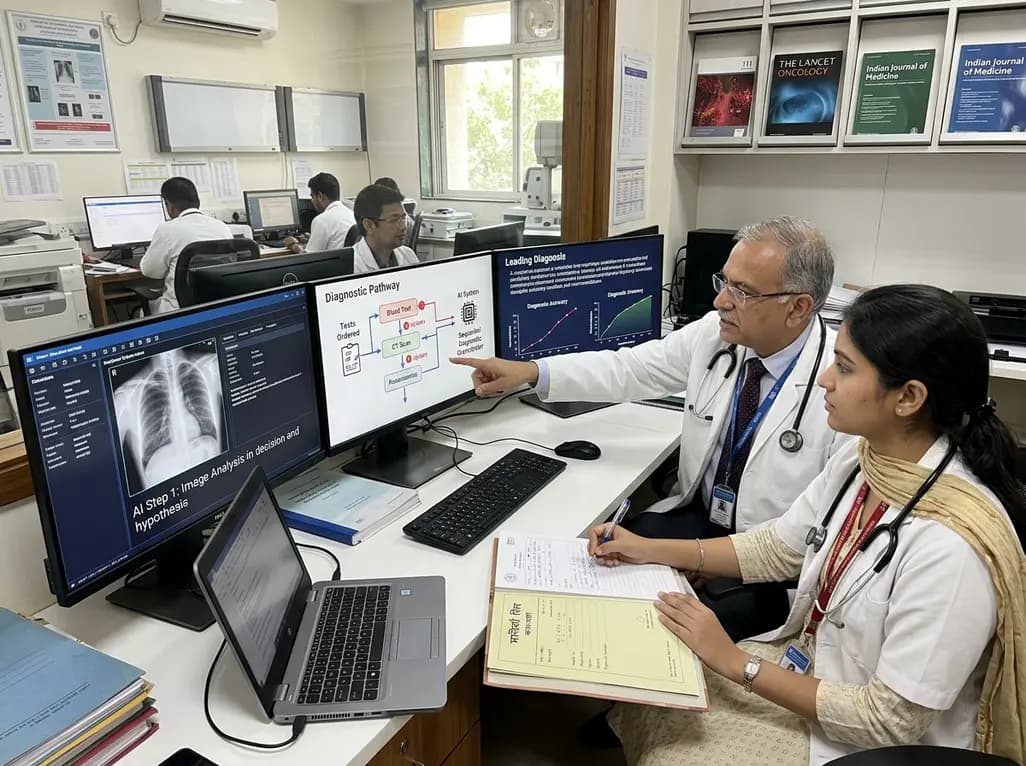
A breakthrough peer-reviewed study demonstrates that a sequential AI diagnosis system can mirror real-world clinical reasoning. By ordering stepwise tests and updating hypotheses dynamically, this multi-agent orchestrator achieved superior diagnostic accuracy while reducing investigative costs.
Today

A prenatal case highlights severe glutaric acidemia type II presenting as bilateral hyperechoic cystic kidneys at 18 weeks. Whole-exome sequencing revealed a novel homozygous ETFDH frameshift variant, demonstrating the power of rapid genetic testing in fetal renal anomalies.
Today

Review how tailored exercise programs benefit frail older patients with heart failure. Explore pathophysiological mechanisms, individualized training prescriptions, and strategies to overcome adherence barriers in clinical practice.
Yesterday

This comparative study evaluates posterior labral tears with and without glenohumeral instability, highlighting distinct demographic patterns, MRI underestimation in stable shoulders, and successful arthroscopic repair outcomes.
Yesterday

A clinical study demonstrates that early intervention with tocilizumab, either as monotherapy or bridged with corticosteroids, achieves significant proptosis reduction and resolves active inflammation in treatment-naive thyroid eye disease.
Yesterday
