

Loading, please wait...
Loading, please wait...

Clinical documentation has long driven physician exhaustion across outpatient clinics and busy hospital wards. In recent years, healthcare technology vendors have actively promoted ambient digital scribes as transformative solutions to eliminate this charting burden. These artificial intelligence systems capture room dialogue during consultations and automatically generate structured clinical notes. However, recent sociotechnical analyses challenge the seductive narrative of effortless automation. Clinicians and healthcare administrators must recognize that digital transcription tools do not merely reduce clerical tasks. Instead, they profoundly restructure cognitive labor, accountability, and clinical risk across modern medical practice.
The rapid market adoption of ambient digital scribes relies primarily on two seductive assumptions. First, technology advocates presume that natural language algorithms can cleanly automate the synthesis of complex medical encounters. Second, health administrators assume that clinicians can reliably detect and correct residual machine errors during final note sign-off. Consequently, leaders view these tools as straightforward plug-and-play replacements for manual charting.
However, sociotechnical research reveals that clinical documentation is never a simple mechanical recording exercise. Composing a medical chart represents a critical cognitive process where physicians synthesize conflicting diagnostic clues, clarify therapeutic intent, and record clinical reasoning. When an automated platform captures room audio, it merely records acoustic signals rather than clinical intent. Therefore, substituting machine-generated summaries for human synthesis disrupts essential reflective thinking. Furthermore, marketing narratives frequently overlook the complex social context of healthcare encounters. Patients share ambiguous symptoms, family members interject contradictory timelines, and physicians pivot between multiple differential diagnoses. Digital algorithms frequently struggle to reconcile these nuances, generating notes that look polished but fail to reflect actual diagnostic uncertainty. As a result, healthcare teams inherit superficially attractive documents that conceal significant factual discrepancies, ultimately distorting the official clinical record.
Deploying artificial intelligence tools does not eliminate clinical documentation labor; rather, it fundamentally transforms and redistributes that effort. Instead of writing original notes from scratch, clinicians must now read, verify, edit, and sign machine-generated narratives. This shift alters the nature of physician cognitive workload. Writing a note requires active generative recall, whereas auditing text requires sustained vigilance and critical editing skills.
In practice, editing artificial summaries often demands equal or greater mental effort than direct charting. Clinicians must meticulously cross-examine generated prose against fleeting conversational memory, particularly when they sign notes hours after clinic visits. Moreover, automated tools tend to produce generic, templated text that obscures idiosyncratic clinical nuances. When doctors must constantly trim extraneous verbosity or correct subtle algorithmic hallucinations, anticipated time savings rapidly erode. In addition, this workflow shift creates administrative spillover across the department. Staff nurses and downstream consulting specialists often spend extra time verifying ambiguous statements in automated notes. Consequently, clerical burdens do not disappear from the healthcare facility. Instead, the organization merely transfers cognitive work across different clinical roles and later phases of patient care, creating unmeasured operational friction.
Health system leaders frequently describe clinician verification as an infallible safety net that mitigates automated errors. Nevertheless, human factors engineering demonstrates that relying exclusively on end-user auditing creates dangerous systemic vulnerabilities. Large language models generate syntactically fluent, highly convincing text even when underlying clinical facts are inaccurate. Because machine outputs appear authoritative and grammatically flawless, physicians naturally succumb to automation bias and conduct cursory chart reviews.
Furthermore, modern clinical environments severely undermine thorough verification. Severe time constraints, excessive outpatient patient volumes, and organizational productivity quotas push clinicians toward rapid note approval. Under intense operational pressure, detecting subtle omissions or minor factual shifts becomes nearly impossible. For example, an ambient tool might mistakenly drop a critical negative finding, swap left and right anatomical markers, or alter medication dosages. Because these subtle errors do not disrupt the overall prose flow, hurried clinicians easily miss them. Therefore, treating physician sign-off as a fail-safe control mechanism represents an organizational fallacy. Ultimately, expecting overworked practitioners to catch polished algorithmic mistakes places an unfair legal and moral burden directly on individual healthcare providers.
The unintended consequences of automated documentation extend far beyond the immediate physician consultation room. In contemporary hospital networks, clinical notes serve multiple operational masters, including billing departments, quality auditors, interprofessional care teams, and legal reviewers. When ambient systems inject errors into electronic records, those mistakes propagate downstream with compounding velocity.
For instance, an inaccurate diagnostic phrase recorded during an outpatient visit may automatically populate inpatient admission histories, problem lists, and pharmacy validation queues. Consequently, downstream clinicians may act upon false data, initiating inappropriate diagnostic workups or prescribing contraindicated medications. In addition, ambient documentation can alter doctor-patient communication dynamics. When physicians know an ambient device records every spoken word, they may deliberately alter their conversational style. Specifically, doctors might verbalize explicit clinical impressions out loud, which can alarm vulnerable patients or compromise confidential social histories. Furthermore, ambient scribes may capture private conversations involving accompanying family members without explicit consent. In multifaceted hospital systems, these cascading failures disrupt care coordination, inflate medicolegal liability, and erode patient trust. Thus, healthcare organizations cannot treat documentation automation as an isolated departmental upgrade.
To safely integrate ambient digital scribes, healthcare organizations must abandon simplistic technology substitution models. Instead, healthcare executives, clinical informatics teams, and frontline physicians must collaborate through participatory sociotechnical design. This holistic approach examines how software, human workflows, organizational incentives, and physical environments interact as an interdependent ecosystem.
First, institutions must define explicit task boundaries regarding what artificial intelligence tools should and should not document. For example, ambient tools may capably summarize routine review of systems, but humans must retain exclusive control over complex clinical reasoning, differential diagnoses, and end-of-life discussions. Second, healthcare administrators must redesign clinical schedules to provide dedicated, protected time for thoughtful chart auditing rather than demanding increased patient throughput. Third, hospitals should implement robust organizational learning protocols. When clinicians encounter documentation anomalies, the institution must systematically log, analyze, and learn from these software discrepancies rather than blaming individual providers. Moreover, software vendors must improve user interface design by visually highlighting AI-generated assertions and linking them directly to source audio timestamps. By combining thoughtful human-in-the-loop safeguards with institutional support, health systems can harness technological innovation without compromising clinical safety.
Ambient digital scribes shift the physician's administrative role from actively composing narrative notes to systematically auditing artificial intelligence text. While this technology eliminates manual typing during consultations, it introduces substantial verification and editing responsibilities. Clinicians must carefully compare algorithmically generated records against their conversational memory under strict time constraints. Furthermore, downstream clinical team members often perform additional reconciliation tasks to clarify vague or incomplete machine summaries.
Physician review cannot serve as an absolute safety barrier because automated scribes produce syntactically fluent, highly plausible notes that encourage superficial inspection. In addition, severe clinical time pressures, heavy outpatient schedules, and cognitive fatigue weaken auditing vigilance. Consequently, practitioners frequently miss subtle factual inversions, omitted negative symptoms, and hallucinated diagnostic details that blend seamlessly into professionally formatted medical charts during busy clinical shifts.
Healthcare organizations must establish clear boundaries defining which clinical sections artificial intelligence can draft and which require manual physician authorship. Furthermore, administrators should grant protected auditing time rather than leveraging documentation speed to increase patient volume quotas. Additionally, hospitals must institute transparent incident reporting systems to track algorithmic errors and deploy user interfaces that link generated statements directly to verified conversational transcripts.
Disclaimer: This content is for informational and educational purposes only and does not substitute for independent professional clinical judgment. Refer to the latest local and national guidelines for clinical practice.
References

Read summarized clinical updates, watch expert medical content, and earn CME certifications right from your smartphone.
Open your smartphone camera to scan and install.





Ambient digital scribes promise effortless medical documentation, but a critical sociotechnical commentary reveals that AI alters rather than eliminates charting work. Discover how shifting cognitive burdens, oversight risks, and workflow redesign impact clinical safety and healthcare practice.
Today

A new comparative study demonstrates that intraoperative imprint cytology achieves 96.6% diagnostic accuracy in ovarian tumours, outperforming frozen section in sensitivity for borderline lesions and offering an accessible, rapid alternative for resource-constrained surgical centres.
Today

Thoracic aortic aneurysm lacks etiologic medical therapy. A new study reveals that targeting specific αV integrins with Cilengitide attenuates TGF-β and mechanotransduction pathways, effectively limiting pro-fibrotic remodeling and aortic bulb dilation in both syndromic and sporadic disease models.
Today
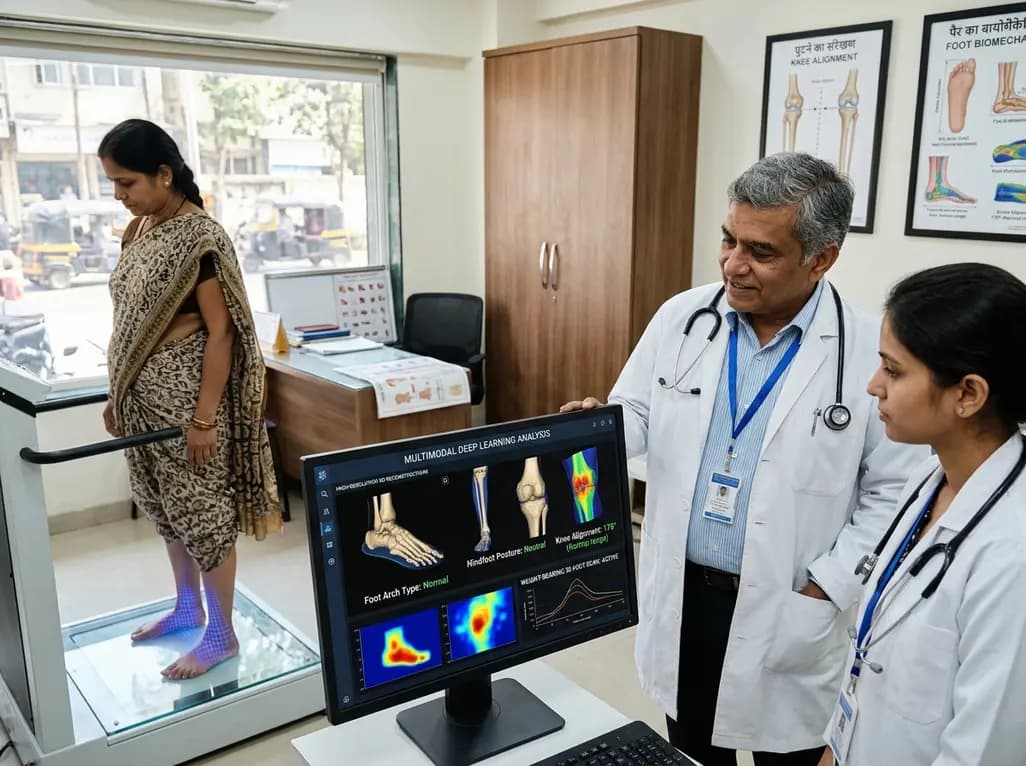
A multimodal deep learning framework utilizing weight-bearing 3D foot scans accurately screens lower-limb alignment, including arch type, hindfoot posture, and knee alignment, offering an accessible, radiation-free alternative to radiography for early biomechanical triage.
Today

A real-world retrospective study demonstrates that combining intravitreal ranibizumab with focal/grid macular laser significantly improves visual acuity and central macular thickness compared to laser monotherapy in patients with center-involved diabetic macular edema.
Today
