.webp&w=384&q=75)

Loading, please wait...
Loading, please wait...
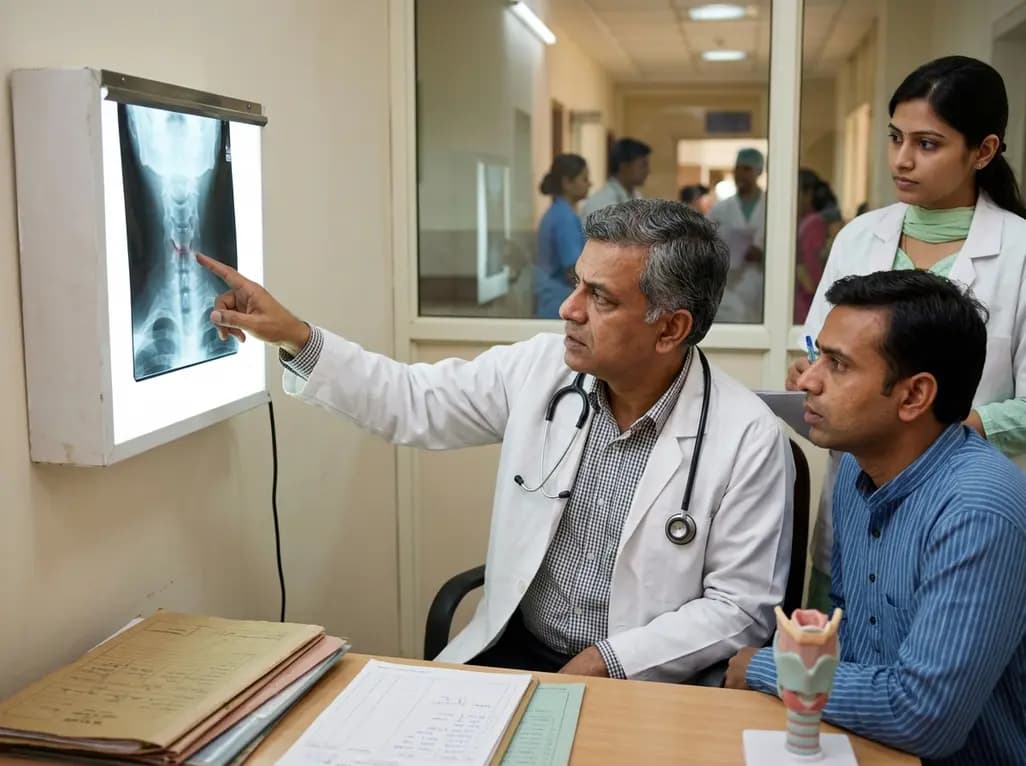
Laryngeal chondrosarcoma represents an uncommon mesenchymal malignancy that originates predominantly from the cartilaginous framework of the larynx. Although these cartilaginous tumors usually exhibit slow, indolent growth patterns, clinicians encounter notable dilemmas when selecting optimal interventions. The historical management paradigm heavily relied on radical extirpation, yet modern head and neck surgery increasingly champions organ preservation to safeguard phonation and respiration. Nevertheless, conservative resections present inherent oncologic trade-offs that demand long-term evaluation.
Laryngeal chondrosarcoma accounts for less than one percent of all primary laryngeal neoplasms. Most of these lesions arise from the hyaline cartilage of the cricoid ring, particularly along its posterior lamina. Alternatively, the thyroid cartilage serves as another recognized site of involvement, while epiglottic or arytenoid tumors occur far less frequently. Patients typically present with progressive hoarseness, persistent dyspnea, stridor, or dysphagia that mimics chronic benign airway disease. Consequently, diagnosis often occurs at an advanced local stage after significant intraluminal airway narrowing. High-resolution computed tomography typically shows a well-circumscribed submucosal lesion characterized by classic coarse, popcorn-like chondroid calcifications. Magnetic resonance imaging further delineates soft-tissue extension, cartilage destruction, and intraluminal airway encroachment. Histologically, pathologists classify these tumors into grade I (well-differentiated), grade II (moderately differentiated), or grade III (poorly differentiated) sarcomas. Dedifferentiated variants represent an aggressive form that carries high metastatic risk. Therefore, establishing accurate preoperative grading remains paramount for predicting biological behavior and planning appropriate surgical boundaries.
Historically, surgeons considered total laryngectomy the definitive gold standard for complete disease eradication. However, contemporary oncology emphasizes functional organ preservation, recognizing that low-grade cartilaginous lesions rarely metastasize early. Consequently, head and neck surgeons frequently select conservative partial resections, open thyrotomy debulking, or transoral endoscopic laser excision. These conservative modalities strive to protect baseline vocal quality and prevent permanent tracheostomies. Nevertheless, organ preservation requires meticulous case selection because incomplete macroscopic clearance poses substantial hazards. In particular, cricoid cartilage involvement complicates partial resections because the cricoid ring provides essential structural support to the upper subglottic airway. When surgeons excise significant portions of the cricoid framework, structural collapse or progressive cicatricial stenosis can rapidly compromise the upper airway lumen. Therefore, while endoscopic debulking delivers immediate symptom relief, it fundamentally leaves microscopic disease in situ. As a result, clinicians must carefully weigh the immediate functional perks of organ preservation against the cumulative risk of progressive local tissue destruction.
Long-term outcomes from institutional cohorts reveal crucial prognostic factors that govern patient trajectories. Specifically, a landmark longitudinal investigation at Helsinki University Hospital evaluated twenty patients with laryngeal chondrosarcoma over a twenty-three-year follow-up period. While eighty percent of patients primarily underwent larynx-preserving surgery, long-term airway sequelae emerged among high-risk subsets. In patients harboring cricoid tumors treated conservatively, secondary reoperations due to local tumor recurrence or persistent growth correlated significantly with permanent tracheostomy placement. Moreover, histologic transformation from low- or intermediate-grade tumors into poorly differentiated or dedifferentiated phenotypes substantially heightened the risk of definitive airway loss. Repeated surgical manipulations within the delicate cartilaginous skeleton inevitably cause progressive scar formation and dynamic airway collapse. Furthermore, recurrent tumors often invade adjacent neurovascular structures, inducing bilateral vocal cord paralysis that necessitates permanent tracheostomy. Consequently, conservative surgery does not guarantee permanent functional preservation, particularly when tumors exhibit biological progression or recurrent mechanical narrowing.
Although practitioners generally consider low-grade chondrosarcomas relatively indolent, histologic upgrading remains an underappreciated threat during prolonged surveillance. Indeed, low- and intermediate-grade tumors can undergo clonal evolution and dedifferentiate into aggressive, high-grade sarcomatous phenotypes. The clinical findings confirm that two patients experienced distant metastases and two succumbed directly to disease-related mortality. Because dedifferentiated lesions lack typical chondroid restraint, they invade extralaryngeal soft tissues and disseminate hematogenously to the pulmonary parenchyma. Furthermore, conventional radiotherapy and systemic chemotherapy offer minimal therapeutic efficacy against cartilaginous neoplasms due to their low mitotic index and bradytrophic matrix. Therefore, aggressive salvage surgery remains the primary remaining option when high-grade transformation occurs. Total laryngectomy becomes imperative when salvage conservative resection fails or when extensive dedifferentiation destroys the structural integrity of the larynx. Consequently, multidisciplinary teams must maintain heightened suspicion for rapid clinical acceleration, as sudden tumor growth usually signals aggressive biological dedifferentiation.
Given the prolonged natural history of cartilaginous neoplasms, clinicians must implement structured, lifelong surveillance strategies. Initial follow-up requires regular serial flexible laryngoscopy coupled with thin-slice computed tomography every six to twelve months during the initial five years. Subsequently, annual cross-sectional imaging remains necessary because recurrences can manifest more than a decade after the index resection. Clinicians should also obtain baseline chest imaging to monitor for occult pulmonary metastatic spread. In addition, when imaging detects interval tumor enlargement or luminal encroachment, prompt re-biopsy is critical to rule out histologic upgrading. Indian head and neck oncology practices encounter distinct logistical challenges, such as variable patient follow-up compliance and geographic distance from tertiary centers. Therefore, surgeons operating in resource-variable settings must balance the advantages of organ-preserving surgery against the availability of rigorous lifelong monitoring. If strict surveillance cannot be assured, primary radical resection may sometimes offer a safer definitive therapeutic pathway.
Effective management of laryngeal chondrosarcoma necessitates close collaboration among otolaryngologists, head and neck oncologists, thoracic specialists, and pathologists. Pathologists must thoroughly examine all debulked or resected specimens to identify subtle focal areas of hypercellularity, nuclear pleomorphism, or mitotic activity. Similarly, speech and language pathologists play a vital role in evaluating post-treatment vocal efficiency and swallowing mechanics. When conservative resections trigger progressive stenosis, airway specialists can explore reconstructive interventions, such as cricotracheal resection with primary end-to-end anastomosis. Nevertheless, clinicians must recognize when repeated conservative debulking ceases to be beneficial. When recurrence accelerates or histology upgrades, clinging to organ preservation compromises long-term oncologic safety. Ultimately, treating teams must establish clear surgical thresholds that clearly trigger conversion to total laryngectomy. By integrating rigorous clinical evaluations with proactive patient counseling, tertiary care teams can optimize both survival outcomes and functional quality of life.
The anatomical origin profoundly influences surgical strategy. Cricoid cartilage tumors present substantial reconstructive challenges because removing large portions destabilizes the subglottic airway framework. Consequently, surgeons frequently attempt conservative endoscopic debulking or partial cricoidectomy, which carries higher recurrence rates. In contrast, tumors arising from the thyroid lamina or epiglottis allow straightforward wide local resections without sacrificing structural stability, yielding superior functional preservation and lower risks of post-treatment airway compromise.
Histologic grade directly dictates tumor behavior and metastatic potential. Grade I tumors behave indolently and virtually never metastasize, justifying conservative, larynx-preserving surgical approaches. However, grade II and grade III tumors exhibit higher recurrence rates, aggressive local tissue invasion, and greater propensities for hematogenous dissemination. Furthermore, transformation from low-grade to dedifferentiated histology drastically worsens survival outcomes, immediately necessitating aggressive radical surgery rather than repeated conservative debulking procedures.
Postoperative surveillance requires lifelong clinical and radiological monitoring due to the risk of late recurrences. Surgeons recommend flexible fiberoptic laryngoscopy every three to six months initially, combined with cross-sectional computed tomography annually. Serial imaging detects asymptomatic recurrence or structural luminal collapse early. Furthermore, clinicians must perform regular chest radiography or computed tomography to identify pulmonary metastases, while prompt re-biopsy remains essential whenever patients develop accelerated tumor regrowth or progressive hoarseness.
Disclaimer: This content is for informational and educational purposes only and does not constitute medical advice or establish a doctor-patient relationship. Healthcare professionals should exercise their clinical judgment when interpreting and applying this information. While every effort has been made to ensure accuracy, clinical presentations and management protocols may vary across different healthcare settings. Refer to the latest local and national guidelines for clinical practice.
References

Read summarized clinical updates, watch expert medical content, and earn CME certifications right from your smartphone.
Open your smartphone camera to scan and install.





A Helsinki University Hospital study reveals that in cricoid chondrosarcoma managed conservatively, reoperation for recurrence and dedifferentiation significantly elevate permanent tracheostomy risks, highlighting the critical need for vigilant lifelong surveillance.
Today
Direct transition from early arthritis clinics to a dedicated, streamlined rheumatoid arthritis clinic prevents follow-up delays, maintains DMARD doses, and halts biomarker escalation compared to general rheumatology referral.
Today

A school-based intervention using the Health Action Process Approach (HAPA) significantly enhanced adolescents' perceived benefits of consulting healthcare providers and promoted proactive menstrual health behaviors, offering key clinical insights for managing adolescent dysmenorrhea and endometriosis.
Today

A multicenter propensity-matched study evaluated DOAC plus single versus dual antiplatelet therapy after carotid artery stenting. Findings revealed comparable intracranial hemorrhage and ischemic stroke rates, supporting DOAC plus SAPT as a viable antithrombotic strategy in high-risk patients.
Today
A cross-sectional study reveals that sarcopenic obesity independently increases functional impairment and severe disc degeneration in patients with degenerative lumbar spinal stenosis, highlighting the need for body composition assessment.
Today

Non-invasive biospecimen sampling offers exciting opportunities for stress medicine. This article examines a pioneering protocol comparing cortisol, inflammatory cytokines, and metabolic markers across blood plasma, whole saliva, and oral mucosal transudate during baseline and acute stress states.
Today
