.webp&w=384&q=75)

Loading, please wait...
Loading, please wait...
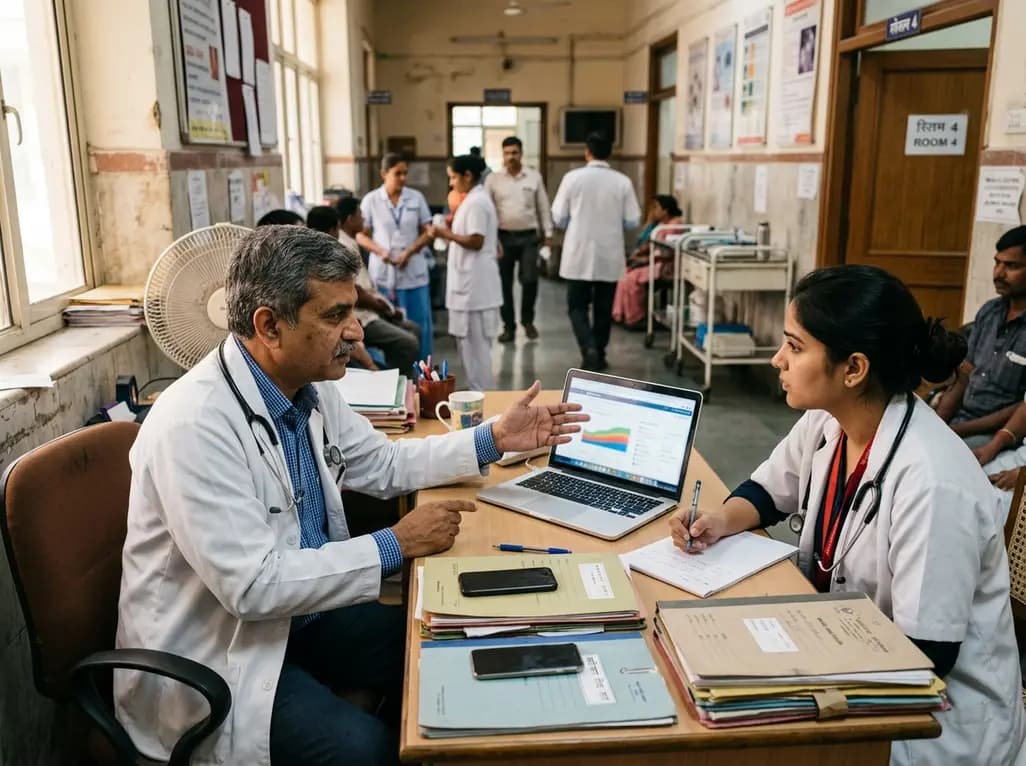
The All India Institute of Medical Sciences (AIIMS), New Delhi, has officially introduced comprehensive AIIMS social media guidelines to govern digital activities. Consequently, this directive applies immediately to all students, resident doctors, faculty, and administrative staff. The administration designed this policy to safeguard the institution's reputation and protect patient privacy. Furthermore, the rising influence of digital content creators within healthcare spaces necessitated these boundaries. This article provides a detailed breakdown of these rules, exploring their implications for Indian medical professionals.
Under the newly enacted rules, AIIMS has restricted the unauthorized use of its name, logo, emblem, or branding across all communication channels. Specifically, individuals cannot create event posters, promotional banners, or digital content using official logos without prior written approval. This restriction extends to individual profiles on platforms like Instagram, Facebook, and X that might convey an official association. Historically, many student associations operated accounts that closely mimicked the official AIIMS voice. Now, the administration wants to eliminate any potential confusion among the general public. Additionally, the guidelines explicitly target videos, Reels, and blogs that leverage the institute's prestigious branding for personal promotion. Therefore, medical professionals must exercise extreme caution when designing promotional materials for clinical symposia. If an organization or individual publishes material implying official AIIMS sponsorship without clear authorization, they will face immediate administrative consequences. This proactive measure ensures that the institute maintains absolute control over its public image. Consequently, all affiliated entities must verify their alignment with these strict branding protocols before uploading any media.
Patient confidentiality remains the cornerstone of modern clinical ethics, and AIIMS has significantly reinforced this principle within its digital framework. Under the new policy, doctors, students, and employees are strictly prohibited from sharing patient details, clinical images, or case descriptions online. Strikingly, this prohibition remains active even if the patient is entirely unidentifiable or if their face is obscured. Healthcare workers often share interesting diagnostic scans or unique surgical cases to foster peer education. However, the guidelines clarify that such activities violate statutory laws unless authorized through formal institutional channels. The policy explicitly cites legal obligations under the Indian Medical Council Regulations, 2002, and the Digital Personal Data Protection Act, 2023. Violating these rules can expose both the individual and the hospital to severe legal liability. Therefore, medical practitioners must recognize that online anonymity is often fragile. A seemingly harmless post about a rare condition can easily be linked back to a specific ward, compromising patient trust. To prevent these ethical breaches, AIIMS has mandated that all clinical content must remain entirely off public networks. By adhering to these strict rules, the institution aims to uphold patient trust and fulfill its statutory legal responsibilities.
The newly issued office memorandum casts an exceptionally wide net, ensuring comprehensive oversight across the entire campus. Specifically, the guidelines apply to undergraduate students, postgraduate scholars, super-specialty trainees, and resident doctors. Furthermore, faculty members, researchers, administrative personnel, and even third-party collaborators must adhere strictly to these digital codes. Student organizations, such as the Resident Doctors' Association (RDA), must also comply with the directive. Many doctors mistakenly believe that personal social media accounts are exempt from institutional policies. However, the administration clarified that any online presence reflecting institutional affiliation falls under this regulatory umbrella. If an employee's personal blog or video channel mentions AIIMS or implies a representative role, the guidelines apply immediately. Consequently, individuals must clearly distinguish their personal opinions from official institutional viewpoints. This extensive coverage ensures that all communication radiating from the institute aligns with its core values. By standardizing digital conduct across all hierarchical levels, AIIMS seeks to minimize the risks associated with unauthorized public statements. Therefore, every stakeholder must review the memorandum thoroughly to understand their individual responsibilities under the new framework.
For departments and student bodies that operate official social media accounts, the institute has established a highly structured governance framework. Firstly, administrators must register all such digital handles with their respective departments. These registered accounts must provide the full names and institutional email addresses of the individuals managing them. Additionally, each department must appoint a dedicated media coordinator who will oversee and approve all outgoing content. The policy also mandates clear labeling of published material to distinguish between student-generated content and official departmental updates. Furthermore, the guidelines strictly prohibit administrators from posting politically sensitive, religiously biased, or defamatory content. Maintaining a professional and objective tone that aligns with AIIMS values is non-negotiable. If an official account wishes to engage in sponsored content or brand collaborations, it must secure special clearance beforehand. Through these rigorous checks, AIIMS aims to prevent public relations crises resulting from unvetted posts. Consequently, departments must establish clear workflows to ensure every post undergoes rigorous review before sharing. This systemic approach guarantees that institutional communication remains professional, reliable, and compliant with broader administrative standards.
Beyond branding and patient privacy, the new social media guidelines place a strong emphasis on maintaining academic integrity. Specifically, the document warns students and employees against sharing confidential academic materials, such as examination papers, question banks, or answer keys. In recent years, the online sharing of study resources has expanded rapidly, occasionally crossing ethical boundaries. AIIMS has made it clear that distributing copyrighted institutional materials without express authorization constitutes a serious policy violation. Furthermore, the guidelines direct students to avoid plagiarism and academic dishonesty when participating in digital medical forums. Engaging in unprofessional online disputes, sharing unverified scientific claims, or copying research work can severely damage an academic career. By enforcing these rules, the institution seeks to preserve the high standards of medical education for which it is globally renowned. If an individual is found guilty of circulating restricted academic data, they will face severe disciplinary action. Consequently, resident doctors and students must remain vigilant and respect intellectual property rights in all virtual spaces. Promoting a culture of honesty online is essential to protecting the educational legacy of India's premier medical institute.
To ensure compliance, AIIMS has outlined severe disciplinary and legal consequences for individuals who violate these newly established rules. If an unauthorized post or account is discovered, the administration will issue immediate takedown directives, requiring removal within twelve hours. Furthermore, severe violations can lead to suspension from academic programs, withholding of certificates, or termination of employment. The institute also reserves the right to derecognize student associations that repeatedly ignore the policy. In cases where patient confidentiality is breached, the offending party may face legal prosecution under the DPDP Act, 2023. Therefore, adhering to these rules is not merely an administrative request but a legal necessity. Medical students and resident doctors must realize that digital professionalism is an integral component of modern clinical practice. A single thoughtless post can have devastating consequences for a clinician's career and the institution's public standing. By implementing these strict penalties, AIIMS sends a clear message about the seriousness of digital accountability. Consequently, all students and staff members must transition to these new standards of online conduct immediately to avoid severe administrative or legal repercussions.
Q1: Who is covered under the new AIIMS social media guidelines?
The new guidelines apply to a very broad audience connected to AIIMS New Delhi. Specifically, they cover all undergraduate and postgraduate students, resident doctors, super-specialty trainees, and doctoral fellows. Additionally, the policy applies to faculty members, administrative staff, researchers, and recognized student associations. Even third-party collaborators and outside invitees granted temporary access to the institute's facilities must strictly adhere to these digital conduct rules.
Q2: Can doctors share anonymous patient cases or X-rays on personal social media?
No, the new policy strictly prohibits the sharing of any patient details, clinical photographs, or diagnostic images online. This restriction remains in place even if the patient is not identifiable or their personal data is fully anonymized. The institute enforced this measure to maintain legal compliance with both the Indian Medical Council Regulations, 2002, and the Digital Personal Data Protection Act, 2023, protecting patient privacy at all costs.
Q3: What happens if an employee or student violates these social media rules?
Violating these rules can lead to serious disciplinary and legal actions. The administration may issue immediate content takedown notices, which must be executed within twelve hours. Furthermore, individuals can face written warnings, suspension from academic courses, or even termination of their employment. Serious breaches involving patient privacy can also trigger legal prosecution under national data protection laws, emphasizing the critical importance of digital compliance.
Disclaimer: This content is for informational and educational purposes only. It does not constitute medical advice or replace professional judgment. Refer to the latest local and national guidelines for clinical practice.
References

Read summarized clinical updates, watch expert medical content, and earn CME certifications right from your smartphone.
Open your smartphone camera to scan and install.





AIIMS New Delhi has introduced comprehensive social media guidelines for all students, residents, and staff. The strict policy bans the unauthorized use of the institute's name, logo, and branding while reinforcing patient confidentiality rules under the Digital Personal Data Protection Act, 2023.
3 months ago

A breakthrough study evaluated H5N1 transmission efficiency across mammalian isolates. Researchers discovered that human-derived D1.1 harboring the PB2 D701N mutation spread efficiently in ferrets, unlike strains carrying PB2 E627K. This finding highlights critical genetic markers for zoonotic surveillance.
Today

A comparative cohort study evaluates vNOTES vs TLH hysterectomy for benign conditions, demonstrating shorter operative duration, faster return to daily activities, and equivalent female sexual function scores without increased dyspareunia.
Today

Review how tailored exercise programs benefit frail older patients with heart failure. Explore pathophysiological mechanisms, individualized training prescriptions, and strategies to overcome adherence barriers in clinical practice.
Yesterday

This comparative study evaluates posterior labral tears with and without glenohumeral instability, highlighting distinct demographic patterns, MRI underestimation in stable shoulders, and successful arthroscopic repair outcomes.
Yesterday

A clinical study demonstrates that early intervention with tocilizumab, either as monotherapy or bridged with corticosteroids, achieves significant proptosis reduction and resolves active inflammation in treatment-naive thyroid eye disease.
Today
