.webp&w=384&q=75)

Loading, please wait...
Loading, please wait...

AIIMS Delhi has achieved a significant milestone by completing 1,000 robotic surgeries. This accomplishment demonstrates the growing adoption of robotic surgery in India within the public health sector. Dr. Hemanga K. Bhattacharjee led the first procedure in November 2024. Currently, the hospital offers these advanced procedures without any additional cost to patients. This technological shift represents a major leap in how surgeons perform complex operations.
Robotic surgery in India offers several key advantages over conventional techniques. Firstly, the surgeon operates from a specialized console that provides a highly magnified, three-dimensional view. Consequently, this enhanced visibility allows for extreme precision during delicate procedures. Secondly, robotic arms eliminate hand tremors and provide greater flexibility than human wrists. Furthermore, patients often experience less pain, reduced bleeding, and much faster recovery times. These benefits are particularly significant for pelvic surgeries and cancer operations.
Historically, high installation and maintenance costs limited the expansion of robotic systems. However, AIIMS Delhi provides these robotic-assisted surgeries for free to its patients. Notably, private hospitals usually charge several lakh rupees for the same advanced procedures. Although AIIMS currently has one robot in the surgical department, they select cases carefully. Dr. Bhattacharjee noted that while AIIMS leads the way, high costs remain a major barrier for other public hospitals. Therefore, they prioritize patients who will benefit the most from this advanced technology.
The program also focuses heavily on training the next generation of Indian surgeons. Resident doctors now undergo extensive training on dedicated robotic systems at the hospital. AIIMS recently installed a second training robot to enhance this educational initiative. Looking forward, experts believe artificial intelligence might soon assist in certain surgical tasks. Nevertheless, it will take time before such automated systems become part of routine surgery.
Q1: What are the main benefits of robotic surgery?
The technology offers enhanced precision, less post-operative pain, and faster recovery times compared to traditional open surgery.
Q2: Which robotic system is used at AIIMS Delhi?
AIIMS Delhi primarily uses the da Vinci robotic surgical system for its clinical procedures and training programs.
Q3: Is robotic surgery expensive for patients at AIIMS?
No, AIIMS Delhi performs robot-assisted surgeries free of additional cost to patients in the public health sector.
Disclaimer: This content is for informational and educational purposes only. It does not constitute medical advice or replace professional judgment. Refer to the latest local and national guidelines for clinical practice.
References

Read summarized clinical updates, watch expert medical content, and earn CME certifications right from your smartphone.
Open your smartphone camera to scan and install.





AIIMS Delhi marks a milestone with 1,000 robotic surgeries, offering advanced, precision-based procedures for free to enhance patient recovery and outcomes....
7 months ago
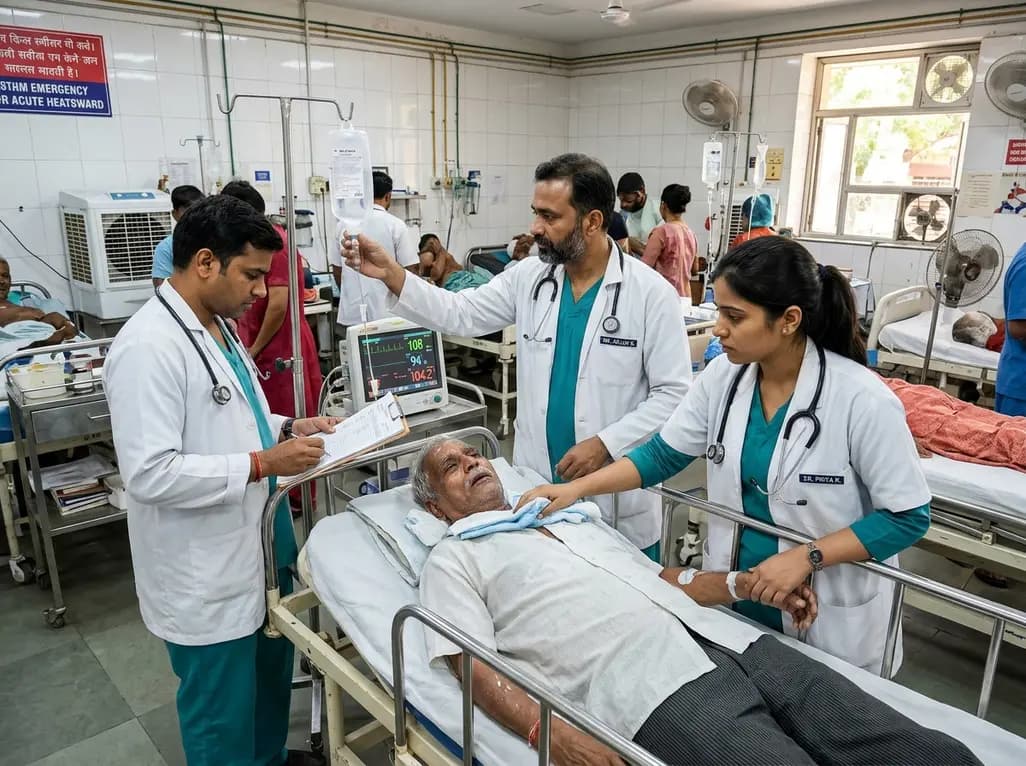
Recent epidemiological data reveals a dramatic surge in summer heat mortality driven by human-induced climate warming. This analysis explores the pathophysiological impacts on cardiac and renal systems, diagnostic dilemmas in death certification, and essential emergency cooling protocols for acute clinical care.
Today

Odisha has established India's first state-level clinical protocol specifically tailored for pregnant women with sickle cell disease. Developed with NHM and UNICEF, the framework provides structured antenatal screening, crisis mitigation, standardized referral pathways, and specialized interdisciplinary care.
Today

India is advancing preventive healthcare by integrating genomics, artificial intelligence, and quantum technologies. With the SANGAM programme sequencing one million Indian genomes, clinicians can unlock personalized therapies, detect cardiometabolic risks early, and curb the burden of diabetes and heart disease.
Today

A randomized controlled trial demonstrates that an eight-week dual-task training intervention significantly improves static and dynamic postural control over standard balance exercises in individuals with chronic ankle instability, addressing critical neurocognitive deficits during athletic and daily activities.
Today

A retrospective cohort study of 7,716 ICU patients from the MIMIC-IV database demonstrates that Gradient Boosting Decision Trees significantly outperform traditional SOFA scores in predicting in-hospital mortality among patients with sepsis and diabetes, with SHAP analysis providing clinical interpretability.
Today
