.webp&w=384&q=75)

Loading, please wait...
Loading, please wait...
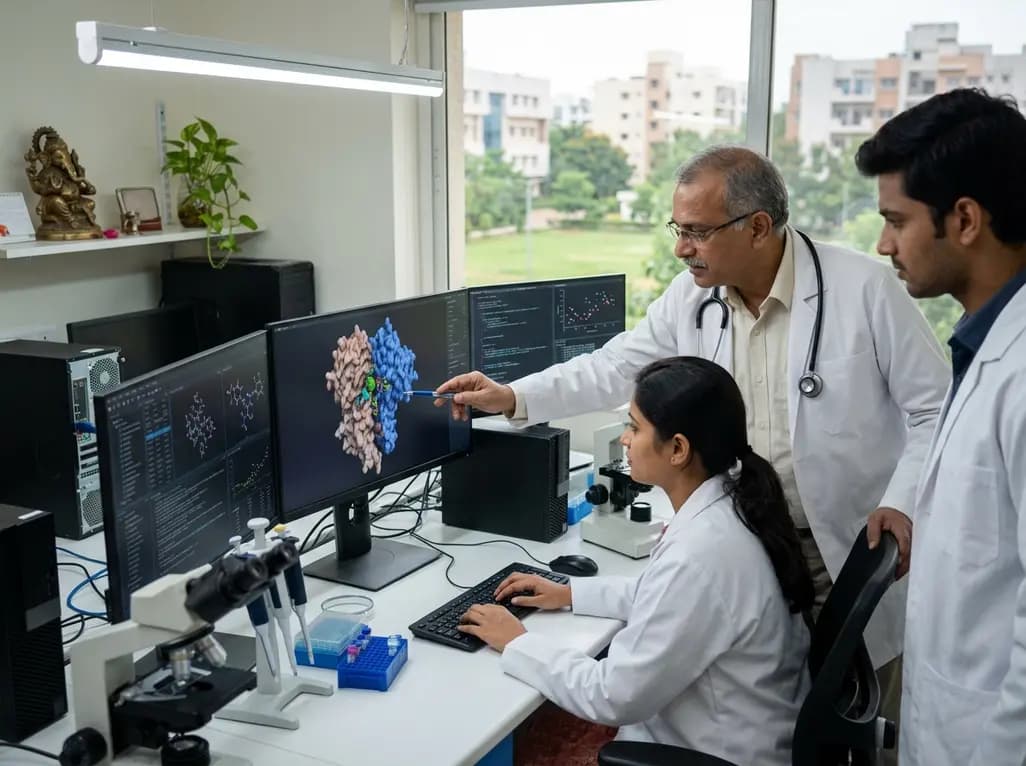
AI-enforced ultra-large virtual screening is currently revolutionizing how we identify binders for challenging targets. In a landmark study, researchers targeted the CD28 immune receptor. This receptor is critical for T-cell activation but remains notoriously difficult to modulate with small molecules. Specifically, traditional screening methods often fail due to the receptor's shallow, solvent-exposed protein-protein interfaces. Consequently, the researchers utilized the PyRMD2Dock platform to overcome existing computational bottlenecks.
First, they docked a diverse subset of 2.4 million molecules. Next, they used these data to train 672 classification models. Subsequently, these models screened 46 million compounds from the Enamine REAL Diversity Space. This AI virtual screening CD28 approach identified 232 highly prioritized ligands. Ultimately, the experimental validation of 150 candidates yielded several potent binders.
Specifically, lead compounds 100 and 104 demonstrated submicromolar affinities of 343.8 nM and 407.1 nM. These molecules successfully disrupted the CD28-CD80 interaction. Moreover, the compounds reduced cytokine secretion in primary human tumor-PBMC models. In addition, this study validates PyRMD2Dock as a scalable protocol for mining massive chemical libraries. Therefore, this breakthrough offers a new path for discovering modulators for "undruggable" immune receptors.
CD28 is a critical costimulatory receptor on T-cells. It binds to CD80 or CD86 on antigen-presenting cells to provide the "second signal" required for full T-cell activation and survival.
Targeting CD28 is challenging because its binding interface is shallow and solvent-exposed. Unlike typical enzymes with deep pockets, these protein-protein interfaces lack the structural features usually required for high-affinity small-molecule binding.
AI improves screening by rapidly analyzing millions of compounds that would be computationally impossible to dock using traditional methods. It learns from a smaller subset of data to predict high-affinity binders across massive chemical libraries.
Disclaimer: This content is for informational and educational purposes only. It does not constitute medical advice or a professional relationship. Refer to the latest local and national guidelines for clinical practice.
References
Upadhyay S et al. AI-Enforced Ultra-Large Virtual Screening Discovers Potent CD28 Binders. J Chem Inf Model. 2026 Jun 11. doi: 10.1021/acs.jcim.6c00859. PMID: 42273851.
Amendola G, Cosconati S. PyRMD: AI-powered Virtual Screening. J Chem Inf Model. 2021;61(10):4905-4914. doi: 10.1021/acs.jcim.1c00653.
Roggia M et al. Streamlining Large Chemical Library Docking with Artificial Intelligence: the PyRMD2Dock Approach. J Chem Inf Model. 2024. doi: 10.1021/acs.jcim.4c00072.

Read summarized clinical updates, watch expert medical content, and earn CME certifications right from your smartphone.
Open your smartphone camera to scan and install.





A pioneering study using the PyRMD2Dock AI platform screened 46 million compounds to identify potent CD28 binders. These lead compounds effectively disrupt CD28-CD80 interactions and reduce cytokine levels, providing a scalable solution for targeting challenging immune receptors in oncology and rheumatology.
4 months ago

As monsoon seasons elevate arboviral disease threats, Tamil Nadu has initiated an ICMR-monitored evaluation of the tetravalent dengue vaccine in Tenkasi district. Clinicians emphasize clinical monitoring, public prevention, and high-quality early pediatric care to reduce disease morbidity across endemic regions.
Today

Leucine Rich Bio has introduced South Asia's first comprehensive vaginal microbiome test, BugSpeaks. By profiling microbial dysbiosis, pathogens, and antimicrobial resistance, this next-generation diagnostic platform provides clinicians with deeper insights into recurrent infections, fertility, and reproductive health.
Today

Review how tailored exercise programs benefit frail older patients with heart failure. Explore pathophysiological mechanisms, individualized training prescriptions, and strategies to overcome adherence barriers in clinical practice.
Today

This comparative study evaluates posterior labral tears with and without glenohumeral instability, highlighting distinct demographic patterns, MRI underestimation in stable shoulders, and successful arthroscopic repair outcomes.
Today

A clinical study demonstrates that early intervention with tocilizumab, either as monotherapy or bridged with corticosteroids, achieves significant proptosis reduction and resolves active inflammation in treatment-naive thyroid eye disease.
Today
