.webp&w=384&q=75)

Loading, please wait...
Loading, please wait...
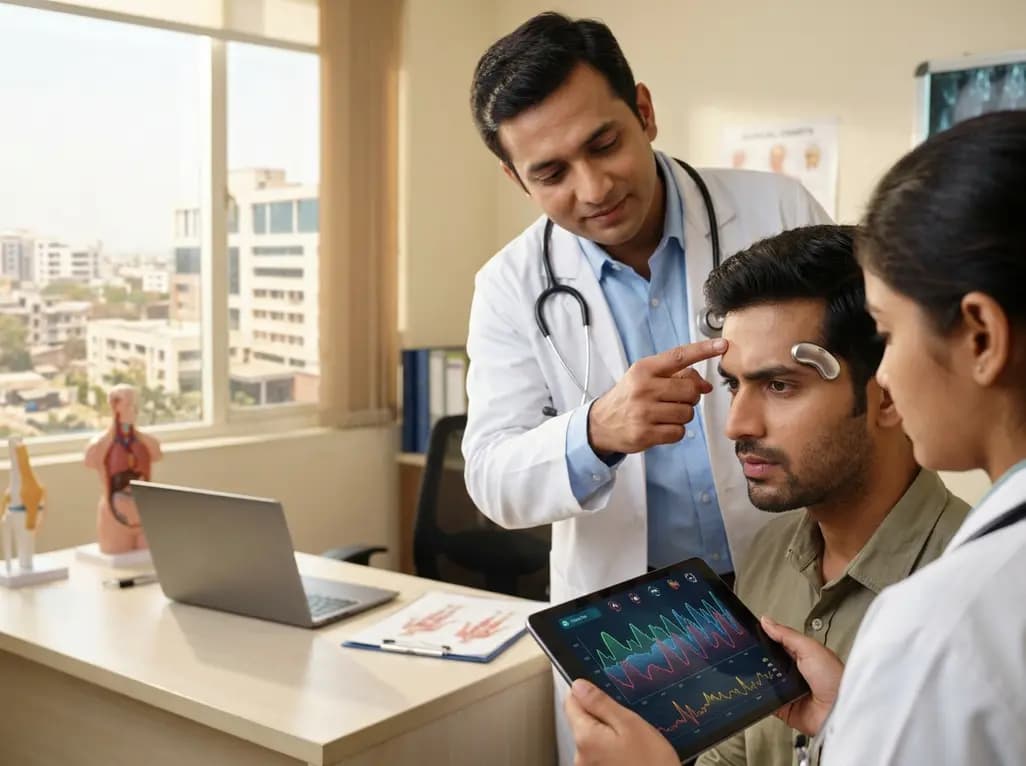
The emergence of next-generation health technology platforms is shifting consumer wellness from reactive tracking to continuous, real-time physiological assessment. Eternal founder Deepinder Goyal has recently introduced the novel temple wearable device, developed by his healthtech startup Temple. Designed to monitor microvascular blood flow directly from the temporal region of the skull, this unique device aims to capture continuous physiological data. Unlike traditional consumer wearables that measure cardiovascular signals at the wrist or digit, the platform extracts complex vascular dynamics near the brain. As the company targets a funding valuation of nearly 500 million dollars and sets an initial indicative price around 80,000 Indian rupees, healthcare clinicians are examining the potential medical and physiological implications of head-based continuous tracking tools.
The commercial health technology landscape has experienced significant expansion over recent years, transitioning from basic step counting to sophisticated multi-sensor biometric monitoring. The pebble-shaped temple wearable device represents a substantial departure from established form factors like smartwatches or smart rings. Market reports indicate that the company is seeking fresh capital to achieve a valuation of approximately 500 million dollars, following an earlier funding round that secured 54 million dollars. The indicative device pricing of roughly 80,000 Indian rupees includes a software subscription with lifetime platform access alongside ongoing supplies of medical-grade adhesive tape. This pricing strategy positions the hardware within the premium wellness market. The initial target demographic comprises high-performance athletes, corporate executives, and longevity-focused individuals seeking actionable biometric feedback. Furthermore, the substantial valuation expansion reflects growing global investor confidence in non-invasive human performance monitoring solutions. By transitioning biometric sensing to the temporal arterial site, developers hope to provide deeper insights into metabolic exertion, daily recovery patterns, and autonomic vascular responses. Consequently, this premium wearable platform attempts to bridge consumer health devices with advanced physiological research tools, generating considerable interest across medical technology circles.
Positioning a biometric sensor on the temporal area offers distinct physiological advantages compared to peripheral monitoring sites such as the wrist or fingers. The superficial temporal artery and surrounding tissue beds possess a dense capillary network supplied directly from internal and external carotid vascular systems. Furthermore, peripheral sites often suffer from vasoconstriction, skin movement artifacts, and variable extremity perfusion caused by cold ambient temperatures or localized stress. In contrast, cranial blood circulation remains highly regulated, ensuring steady hemodynamic signaling even during environmental variations. By monitoring localized blood flow dynamics in the head region, sensors can detect subtle changes in microvascular tone, pulse wave velocity, and continuous vascular compliance. These signals directly reflect autonomic nervous system fluctuations, capturing shifts between sympathetic fight-or-flight states and parasympathetic restorative periods. Additionally, continuous cranial hemodynamics can provide early indications of metabolic stress, mental fatigue, and acute vascular exertion during intense physical activity. Physicians evaluating continuous monitoring tools recognize that cranial site dynamics offer closer proximity to central autonomic command centers. Therefore, gathering raw optical and pressure signals from the temple region could potentially yield richer, cleaner baseline physiological data than conventional photoplethysmography sensors worn on peripheral extremities.
Central to the operational architecture of the platform is a proprietary mathematical score designated as Entropy. Displayed on a numerical scale ranging from 1 to 250, this live metric updates every second on the application interface. The developer describes Entropy as a quantitative representation of the real-time metabolic and sympathetic expenditure required to maintain bodily homeostasis. Under baseline resting conditions, a lower score signifies optimal physiological efficiency, indicating that the organism operates with minimal stress cost. Conversely, when an individual undergoes physical exertion, acute psychological stress, caffeine intake, or heavy dietary loads, the Entropy value increases rapidly to mirror heightened physiological exertion. As recovery occurs through rest, deep breathing, or sleep, the score ideally drops back toward baseline. The system tracks both peak maximum values and baseline minimum readings over long-time horizons. Clinicians note that the underlying physiological concept relies on measuring how efficiently an individual transitions between intense exertion and deep rest. However, because Entropy represents an aggregated algorithmic output combining multiple hemodynamic signals, understanding its exact derivation requires greater algorithmic transparency.
The clinical discourse surrounding longevity and healthy aging increasingly emphasizes metabolic flexibility, autonomic balance, and rapid cardiovascular stress recovery. Continuous microvascular monitoring through a temporal device could offer sports medicine specialists and clinicians new paradigms for evaluating stress adaptation. In elite athletic training, monitoring real-time recovery metrics helps prevent overtraining syndrome and optimizes workout load distribution. Furthermore, in preventive cardiology and internal medicine, understanding an individual's resting metabolic load and autonomic recovery curve provides valuable context regarding systemic resilience. Devices that continuously capture vascular responsiveness during daily stressors like cold exposure, fasting, or intense exercise can help users adjust lifestyle habits systematically. Consequently, individuals can modify dietary habits, sleep hygiene, and stress mitigation techniques based on immediate physiological feedback. However, clinicians caution that commercial metric tracking should complement, rather than replace, established diagnostic biomarkers such as blood pressure, HbA1c, lipid profiles, and standardized autonomic testing. While real-time feedback encourages positive health behaviors, healthcare providers must guide patients in interpreting novel proprietary scores within a comprehensive clinical context.
Despite the commercial enthusiasm surrounding novel health wearables, medical experts maintain a cautious and rigorous perspective regarding new health parameters. Senior medical researchers and clinical specialists highlight that introducing a novel physiological score requires comprehensive peer-reviewed validation and clinical testing. While measuring microvascular blood flow near the brain is scientifically plausible, transforming raw optical signals into an authoritative metabolic metric demands rigorous scientific scrutiny. Independent clinical trials must demonstrate clear correlations between the device's numerical readings and validated physiological markers like indirect calorimetry, heart rate variability, or blood lactate levels. Furthermore, medical professionals emphasize the necessity of proving clinical utility, showing that monitoring these readings produces tangible improvements in health outcomes. Without published peer-reviewed validation, novel scoring systems run the risk of being categorized as high-end consumer gadgets rather than validated diagnostic instruments. For Indian healthcare providers, educating patients about the distinction between consumer wellness algorithms and regulated diagnostic medical tools remains essential. Moving forward, collaborative research partnerships between technology developers and academic medical institutions will prove crucial in establishing the clinical credibility and safety of novel head-worn biometric devices.
Q1: How does the temple-worn device differ from conventional smartwatches?
Unlike conventional smartwatches or fitness bands that capture photoplethysmography signals from peripheral blood vessels at the wrist, this device measures microvascular blood flow directly from the temporal region near the forehead. The temporal area offers a highly vascularized surface with stable arterial circulation, minimizing movement artifacts and vasoconstriction disruptions common in hand or finger sensors, thereby generating distinct physiological metrics.
Q2: What is the Entropy metric used in the Temple health platform?
Entropy is a proprietary physiological score displayed on a scale from 1 to 250 that updates continuously every second. It calculates the real-time metabolic and autonomic demand placed on the body during daily activities, stress, exercise, and rest. Lower scores during resting states indicate higher physiological efficiency, whereas higher scores reflect physical or mental strain, allowing users to track recovery speed and stress capacity.
Q3: Is the Temple wearable device considered a certified medical diagnostic tool?
Currently, the device is marketed primarily as an advanced wellness and continuous performance tracking tool rather than a certified clinical diagnostic instrument. Although it offers continuous monitoring of microvascular signals, healthcare professionals emphasize that proprietary metrics like Entropy require extensive peer-reviewed scientific studies and regulatory clinical validation before they can be used for clinical diagnosis or treatment planning.
Disclaimer: This content is for informational and educational purposes only. It does not constitute medical advice or replace professional judgment. Refer to the latest local and national guidelines for clinical practice.
References

Read summarized clinical updates, watch expert medical content, and earn CME certifications right from your smartphone.
Open your smartphone camera to scan and install.





Deepinder Goyal's healthtech startup Temple is raising capital at a $500 million valuation and pricing its temporal wearable at Rs 80,000. Worn on the side of the forehead, the device tracks microvascular blood flow and real-time Entropy to monitor physiological stress, metabolic expenditure, and recovery.
last month

A multicenter clinical study evaluates fucosylated alpha-1-acid glycoprotein (P-AGP-FR) as an accurate noninvasive fibrosis marker in chronic hepatitis B and C, demonstrating strong correlation with histological staging and superior specificity compared to conventional surrogate indices.
Today
The ClinGen Prenatal Gene Curation Expert Panel evaluated 63 disease relationships across 61 genes, establishing clinical validity for severe fetal phenotypes like hydrops and stillbirth to enhance prenatal genomic interpretation and clinical care.
Yesterday

A cohort study demonstrates that the weight-adjusted waist index predicts all-cause and cardiovascular mortality more accurately than BMI and conventional adiposity metrics, offering clinicians a practical anthropometric tool for superior cardiometabolic risk stratification.
Today

New research reveals that HOXD13 regulates primary cilia signalling and genomic stability in distal synovial fibroblasts, uncovering why conditions like rheumatoid arthritis target specific joints.
Today

A real-world observational study evaluates pediatric isolated growth hormone deficiency patients transitioning to once-weekly somatrogon, showing sustained height velocity, early IGF-1 shifts, and stabilized BMI.
Today
