

Loading, please wait...
Loading, please wait...

Audiological education demands a delicate balance between technical mastery and nuanced interpersonal communication. Historically, trainees honed their diagnostic consultation skills primarily through direct patient contact or resource-intensive standardized patient actors. However, contemporary health education increasingly leverages advanced digital tools to bridge the gap between classroom theory and real-world clinical appointments. An AI virtual client platform offers an interactive simulated learning environment where postgraduate audiology students engage in realistic conversational appointments. In a landmark educational study, twenty-six students enrolled in a Master of Audiology Studies program completed four weekly full-day placements centered on conversational simulated consultations. These digital platforms reproduce genuine conversational dynamics, requiring trainees to respond naturally to varied patient personas. Consequently, learners can rehearse essential greeting protocols, establish clinical rapport, and practice diagnostic interview techniques before encountering vulnerable individuals. Furthermore, this controlled digital framework enables trainees to repeat complex scenarios without the fear of causing client distress. Medical educators emphasize that early clinical exposure often triggers substantial apprehension among novice practitioners. Therefore, incorporating conversational digital avatars presents an accessible pathway to standardize core consultation competencies. By democratizing access to high-fidelity clinical simulations, academic institutions can consistently prepare students for the complex social demands of adult audiology practice.
Clinical confidence often dictates how effectively a healthcare trainee transitions from observational learning to independent practice. In this structured evaluation, researchers administered comprehensive pre-simulation and post-simulation questionnaires to quantify shifts in student confidence and situational anxiety. Students reported statistically significant increases in their confidence across multiple interpersonal domains. Specifically, participants demonstrated marked improvements in conducting themselves professionally and ethically, greeting adult clients, and steering structured diagnostic interviews. Interestingly, baseline anxiety regarding direct patient engagement was generally low among participants, and post-simulation levels remained comfortably controlled. Furthermore, the simulation significantly reduced student anxiety regarding the specific act of delivering clinical feedback during computer-based training sessions. Trainees consistently felt well prepared for the exercise, noting that the simulation reinforced didactic concepts delivered during academic lectures. Qualitative feedback reinforced these quantitative outcomes, as learners highlighted tangible improvements in clinical decision-making and diagnostic reasoning. Moreover, the simulated learning environment provided a safe, non-judgmental space for students to make mistakes, reflect on their communication strategies, and iteratively refine their responses. Consequently, the combination of immediate experiential learning and self-paced exploration solidified foundational patient-interaction skills, demonstrating the psychological utility of digital client representations in early clinical training.
Obtaining an accurate, comprehensive case history represents the cornerstone of effective otolaryngological and audiological diagnosis. Clinicians must deftly navigate symptom chronicity, noise exposure histories, ototoxic medication usage, and psychosocial consequences of hearing loss. Novice students, however, frequently struggle to balance conversational empathy with systematic information gathering. The artificial intelligence platform simulated realistic patient disclosures, prompting trainees to deploy active listening and targeted probing questions. As a result, students reported significant gains in their perceived capability to extract vital diagnostic information efficiently. They learned how to interpret open-ended patient remarks and follow up on critical red flags, such as unilateral tinnitus or sudden sensorineural changes. In addition, qualitative thematic analysis revealed that students greatly appreciated the platform's ability to mirror diverse conversational styles and emotional tones. This dynamic interaction pushed learners beyond rigid, rote-memorized questionnaires into authentic, responsive dialogue. Furthermore, practicing within this digital setting cultivated greater cognitive flexibility, enabling students to formulate real-time clinical hypotheses during the interview. Therefore, interactive virtual encounters do not merely impart factual knowledge. Instead, they actively cultivate the subtle communicative instincts necessary for comprehensive audiological assessments.
Modern medical education programs face severe clinical placement constraints, heightened faculty workloads, and unpredictable patient availability. In countries like India, where patient volumes are massive but clinical supervision time is constrained, scalable simulation tools offer substantial value. Integrating virtual client technologies into otolaryngology and audiology training can alleviate preceptor burdens by ensuring students master basic interviewing competencies before entering busy outpatient departments. Moreover, standardized digital cases guarantee uniform clinical exposure across an entire cohort of trainees. Every student encounters identical baseline conditions, ensuring equity in skill acquisition and assessment. Faculty members can also monitor trainee interaction transcripts, pinpointing common diagnostic errors or communication gaps across the class. Consequently, academic programs can tailor classroom remediation to address specific systematic weaknesses before external hospital postings commence. Furthermore, the flexibility of computer-based simulations empowers students to practice asynchronously, accommodating diverse learning curves and self-directed study schedules. By shifting initial trial-and-error learning away from real patients, training programs simultaneously uphold patient safety and heighten clinical preparedness. Ultimately, these virtual learning systems serve as powerful pedagogical adjuncts that enhance curriculum delivery without displacing indispensable bedside mentorship.
While student experiences with digital simulation platforms remain overwhelmingly positive, several technical and educational challenges warrant careful consideration. Currently, self-reported confidence and anxiety measures dominate early literature, providing valuable insights into learner perceptions but leaving objective clinical outcomes unverified. Medical educators must urgently investigate whether these self-reported improvements translate into superior performance during real-world patient consultations. For instance, future clinical trials must examine objective structured clinical examination scores and diagnostic accuracy metrics in supervised clinical environments. Additionally, natural language processing models must continually evolve to understand diverse regional dialects, vernacular phrases, and culturally distinct communication styles. This linguistic adaptability is especially vital in heterogeneous healthcare ecosystems, such as South Asia, where multilingual communication dominates daily clinical interactions. Furthermore, institutions must invest in adequate technological infrastructure, data privacy compliance, and faculty training to ensure seamless institutional integration. As generative algorithms become more sophisticated, academic bodies should establish rigorous quality-assurance frameworks to validate simulated patient responses against standard clinical guidelines. By methodically addressing these technological and empirical hurdles, health professions educators can maximize the authentic diagnostic potential of synthetic client simulations.
An AI virtual client platform improves history-taking skills by engaging learners in natural, responsive dialogues with synthetic patients. Trainees must listen actively, formulate probing follow-up questions, and adapt to realistic patient disclosures in real time. Consequently, students move past rigid checklists, learning how to uncover subtle symptoms and clinical red flags. This continuous, low-stakes rehearsal builds cognitive flexibility and systematically sharpens structured diagnostic interviewing techniques before students enter real outpatient clinics.
No, virtual client simulations cannot fully replace live clinical rotations in medical or audiology curricula. While digital avatars excel at standardizing communication practice and reducing novice anxiety, they cannot reproduce tactile examinations, unpredictable clinical emergencies, or profound human empathy. Therefore, digital platforms function as supportive educational adjuncts rather than replacements. They adequately prepare students for clinical placements, allowing trainees to maximize the educational yield of actual supervised patient encounters.
Simulated learning environments offer substantial logistical benefits, including high scalability, 24/7 asynchronous accessibility, and uniform training standards across entire student cohorts. Academic institutions can eliminate the high costs and scheduling conflicts associated with standardized human actors. Furthermore, virtual environments allow students to repeat challenging consultation scenarios indefinitely without consuming faculty supervision hours. Consequently, medical colleges can maintain rigorous training standards despite growing class sizes and limited hospital placement capacity.
Disclaimer: This content is for informational and educational purposes only and does not constitute medical or regulatory advice. Healthcare professionals should exercise independent clinical judgment. Refer to the latest local and national guidelines for clinical practice.
References

Read summarized clinical updates, watch expert medical content, and earn CME certifications right from your smartphone.
Open your smartphone camera to scan and install.





A landmark audiology study reveals that an AI virtual client platform significantly elevates student confidence in client engagement, ethics, and case-history taking while decreasing simulation anxiety. This scalable tool offers promising potential for modern otolaryngology and healthcare communication curricula.
Today

A multicenter cohort study reveals that the 30-minute C-peptide response during OGTT independently predicts cystic fibrosis-related diabetes in patients with normal glucose tolerance, offering an early risk-stratification biomarker.
Today

The GESS-AEEM consensus establishes a clear clinical implementation framework for testosterone therapy in postmenopausal women with hypoactive sexual desire disorder, focusing on transdermal dosing, precise laboratory monitoring, and safety communication.
Today

A Bayesian component network meta-analysis of 130 RCTs reveals that self-monitoring and gamification provide the clearest positive effects in mHealth physical activity interventions, while social comparison may have adverse psychological trade-offs.
Today
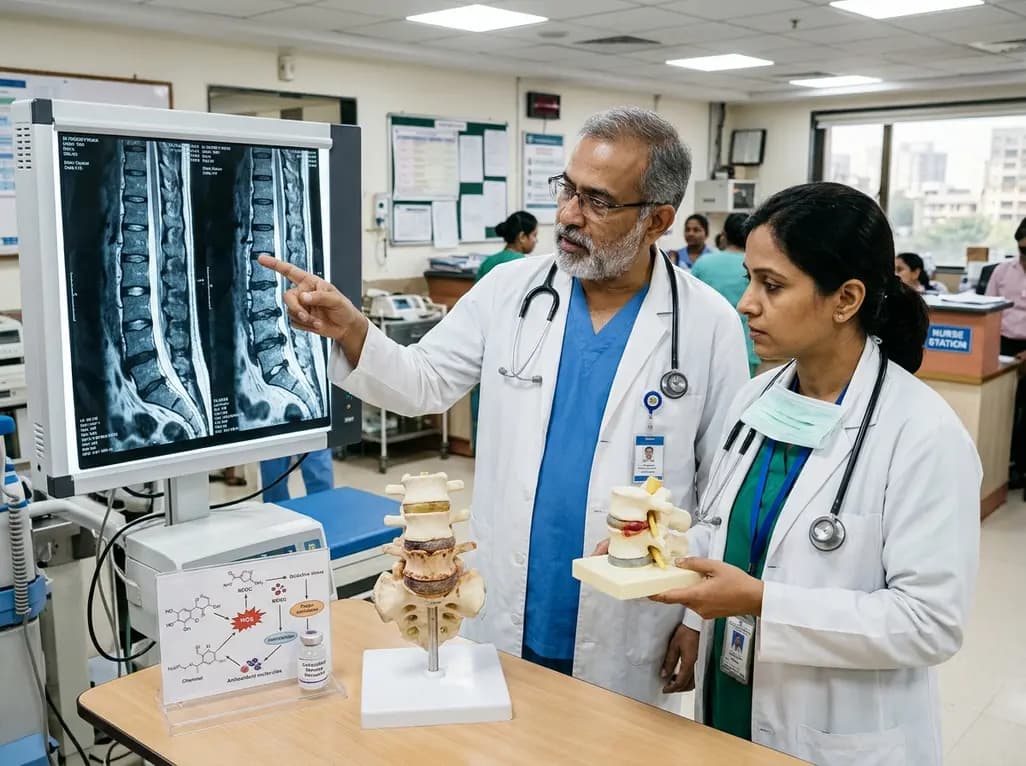
Intervertebral disc degeneration is a primary driver of chronic low back pain. Emerging evidence highlights reactive oxygen species and redox imbalance as central mechanisms. Targeted antioxidant strategies and biomaterial delivery systems offer promising disease-modifying therapies for spine health.
Today

As digital nutrition platforms and automated diet algorithms expand into chronic disease management, clinicians must prioritize verified biochemical outcomes over user engagement metrics. Learn how medical oversight, culturally tailored nutrition, and comprehensive testing safeguard long-term patient health.
Today
