.webp&w=384&q=75)

Loading, please wait...
Loading, please wait...
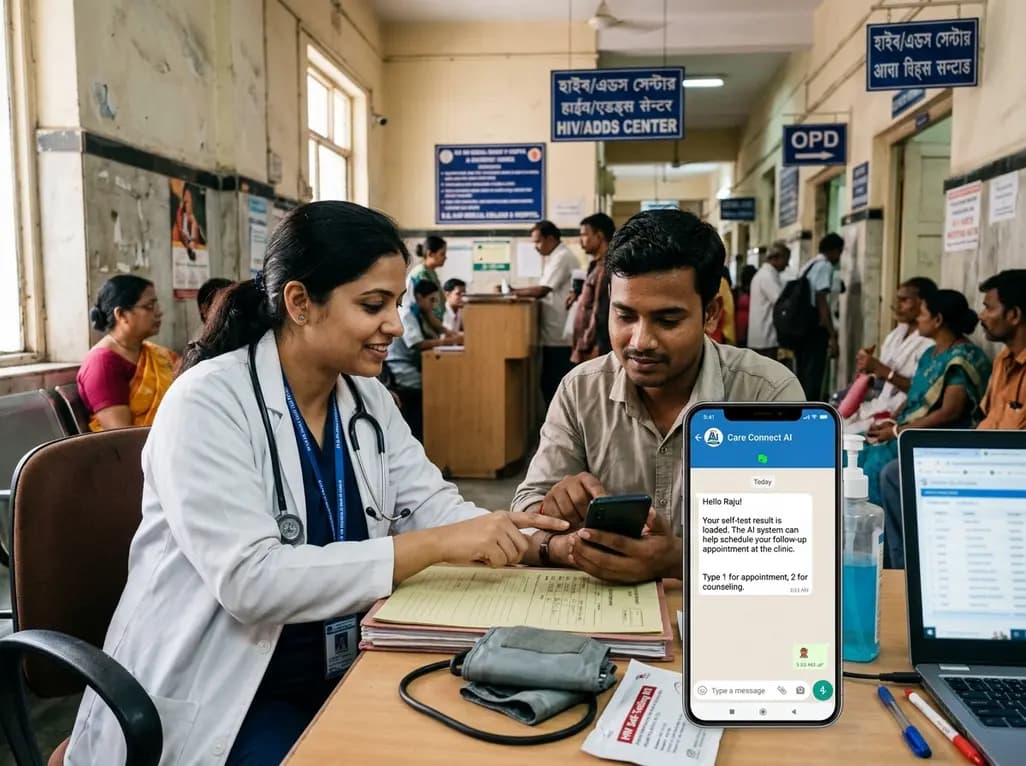
HIV self-testing has revolutionized diagnostic access by offering individuals privacy, convenience, and autonomy in knowing their status. However, achieving effective HIV self-testing linkage remains a formidable bottleneck in the global continuum of care. Although self-administered testing kits effectively bypass hospital-based stigmatization and logistical barriers, many users do not transition from receiving a test result to accessing formal healthcare services. In fact, individuals frequently encounter post-test uncertainty, distress, and confusion regarding where to seek confirmatory diagnostics or preventive counseling. Consequently, unassisted testing can lead to lost opportunities for early antiretroviral therapy initiation or pre-exposure prophylaxis engagement.
Furthermore, traditional follow-up methods, such as telephone calls or physical outreach, often compromise patient confidentiality and strain overburdened community health workers. In resource-constrained environments, healthcare providers struggle to monitor decentralized testing cohorts systematically. To address this persistent gap, clinicians and researchers have turned toward digital health solutions. Specifically, artificial intelligence conversational agents delivered through ubiquitous messaging platforms represent a scalable mechanism to bridge self-care with structured health systems. By providing immediate, personalized, and empathetic post-test guidance, these intelligent platforms help demystify next steps and motivate individuals to complete clinical linkage promptly.
A recent mixed-methods investigation evaluated the acceptability, usability, and clinical appropriateness of an innovative digital platform known as Your Path. Developed to facilitate post-test care engagement, the conversational tool delivers structured guidance through WhatsApp, an application widely utilized across diverse socioeconomic strata. The study enrolled one hundred community participants alongside multidisciplinary healthcare professionals from South Africa. Researchers randomly assigned participants mock reactive or non-reactive test outcomes before engaging in simulated testing sessions guided by the artificial intelligence assistant.
During each interaction, the platform provided step-by-step testing instructions, assisted in result interpretation, delivered empathetic reassurance, and offered tailored navigation toward nearby healthcare facilities. To capture comprehensive outcomes, investigators administered pre-test and post-test assessments measuring healthcare-seeking intentions alongside the validated System Usability Scale. In addition, researchers conducted in-depth qualitative interviews to capture nuanced participant experiences. Meanwhile, healthcare providers systematically analyzed chat transcripts to judge the factual accuracy, completeness, and safety of the recommendations. This rigorous mixed-methods methodology ensured that both user experience and clinical fidelity underwent thorough scientific scrutiny.
The quantitative and qualitative results revealed exceptionally high levels of user satisfaction and functional usability across diverse demographics. Overall, the digital intervention demonstrated an impressive mean System Usability Scale score of 81.6, which substantially exceeds standard industry benchmarks for digital health applications. Furthermore, approximately 83.7% of participants described the conversational interface as easy to navigate, and 76.4% completed their testing journey independently without requiring human technical assistance. Notably, 94.9% expressed a clear willingness to use the tool in future real-world encounters.
Beyond usability metrics, the intervention generated significant behavioral improvements. Specifically, 91.0% of community participants reported that interacting with the assistant positively influenced their intention to seek timely HIV services. The platform produced its most pronounced impact on user confidence, particularly among individuals receiving non-reactive results who required guidance regarding ongoing prevention and routine re-testing protocols. Qualitative interviews confirmed that participants valued the non-judgmental tone, instant responsiveness, and comprehensive privacy of the automated chat. Consequently, users felt empowered to make informed decisions regarding their reproductive and sexual health without fear of community stigma or clinical exposure.
Ensuring clinical accuracy is paramount when deploying artificial intelligence in diagnostic and referral workflows. In this evaluation, healthcare providers systematically reviewed interaction transcripts generated during user sessions to assess clinical safety and relevance. Clinicians concluded that the conversational assistant reliably communicated critical medical information, including the imperative need for confirmatory laboratory testing following reactive results. Moreover, providers affirmed that the tool appropriately triaged users toward prevention modalities, such as pre-exposure prophylaxis and barrier contraception, following non-reactive findings.
However, the evaluation also highlighted crucial areas for ongoing technological refinement. Specifically, approximately 15.3% of participants observed occasional variations in conversational responses or encountered phrasing that required clarification. Healthcare providers emphasized that conversational algorithms must strictly adhere to validated clinical guidelines and avoid ambiguous medical jargon. Furthermore, clinicians praised the automated generation of clinical summaries, noting that concise pre-visit summaries streamline outpatient intake and save valuable consultation time. Therefore, integrating structured clinician oversight during algorithmic training remains essential to maintain high diagnostic precision and safeguard patient well-being across real-world deployments.
Deploying artificial intelligence tools within public health programs requires careful consideration of infrastructure, data security, and local cultural norms. In low- and middle-income regions, digital interventions must function smoothly on entry-level smartphones and withstand variable internet connectivity. Because the platform operates within existing messaging applications, it eliminates the need for users to download memory-intensive standalone software. In addition, end-to-end encryption protocols within messaging applications help protect sensitive health data, thereby fostering greater patient trust.
Nevertheless, public health authorities must address existing digital divides to prevent disparities in healthcare access. For instance, rural populations, older individuals, or economically disadvantaged groups may possess lower digital literacy or lack reliable device access. Consequently, health systems should implement hybrid care models that combine automated artificial intelligence messaging with community health worker navigation. Furthermore, public health managers must integrate local languages, voice notes, and culturally resonant communication styles into conversational algorithms. When designed thoughtfully, digital tools alleviate administrative burdens on healthcare centers while extending the reach of vital sexual health services to historically marginalized communities.
India continues to expand its national HIV response under the National AIDS Control Organization, with an increasing focus on decentralized testing and proactive linkage strategies. Implementing automated conversational assistants could significantly enhance HIV self-testing programs across high-burden states and underserved populations in India. Because mobile penetration and messaging app adoption are extraordinarily high nationwide, conversational tools offer a cost-effective channel to deliver confidential post-test counseling directly to users.
Furthermore, integrating AI-driven guidance aligns seamlessly with India's Ayushman Bharat Digital Mission, which promotes interoperable digital health architecture. Clinicians in Indian primary healthcare centers, antiretroviral therapy centers, and targeted intervention clinics can utilize automated linkage tools to track referrals and reduce loss to follow-up. In addition, offering multilingual support in regional Indian languages ensures broad accessibility across diverse demographic groups. As national testing guidelines incorporate self-care modalities, conversational artificial intelligence can serve as a dependable, private, and scalable bridge between community screening and clinical management.
Conversational AI bridges the gap between home testing and clinical care by providing instant, stigma-free guidance. When individuals receive a reactive or non-reactive result, the conversational assistant offers clear explanations, psychological reassurance, and immediate navigation to accredited local health centers. Consequently, users experience reduced anxiety and uncertainty. Furthermore, automated follow-up prompts remind individuals to complete confirmatory diagnostic testing or initiate biomedical prevention pathways like pre-exposure prophylaxis promptly.
Healthcare providers assess whether conversational outputs deliver accurate diagnostic interpretation, appropriate counseling, and correct triage instructions. Clinicians review interaction transcripts to confirm that the tool avoids medical errors, handles ambiguous inquiries safely, and maintains privacy standards. In addition, providers evaluate whether the clinical summaries generated for health facilities accurately capture user status. Therefore, clinician oversight ensures automated platforms remain aligned with national management protocols and public health standards.
Yes, artificial intelligence conversational models can operate efficiently within messaging platforms like WhatsApp, which work reliably on low-bandwidth mobile networks. Moreover, these digital tools can support regional languages and audio-based interactions, enabling individuals with limited digital literacy to navigate diagnostic care easily. By eliminating transportation costs and overcoming social stigma, AI-driven linkage platforms expand outreach to marginalized and rural populations who face substantial barriers to facility-based testing.
Disclaimer: This content is for informational and educational purposes only and is not intended as medical advice. Always consult a qualified healthcare professional regarding any medical condition. Refer to the latest local and national guidelines for clinical practice.
References

Read summarized clinical updates, watch expert medical content, and earn CME certifications right from your smartphone.
Open your smartphone camera to scan and install.





A mixed-methods study evaluates an AI-powered WhatsApp tool designed to facilitate HIV self-testing linkage, demonstrating high usability, clinical appropriateness, and improved patient confidence.
last month

A review of incidental intestinal parasitic infections detected during colonoscopy, highlighting diagnostic morphology, the absence of peripheral eosinophilia, and tailored antihelminthic treatment.
Today

A nationwide South Korean study shows underreporting of smoking among women dropped from 57.4% to 36.4% between 2008 and 2021. However, over one-third of female smokers still conceal their habit, highlighting the critical role of cotinine verification in clinical risk assessment.
Today

PepsiCo and Monster Beverage have challenged the FSSAI ban on the energy drink label in Indian courts. While companies highlight supply disruptions, regulatory actions spotlight severe cardiovascular and metabolic risks associated with excessive caffeine, sugar, and taurine consumption, especially in adolescents.
Today
Persistent and recurrent musculoskeletal pain in youth athletes is often dismissed as simple growing pains. A developmentally informed biopsychosocial framework is essential to guide return-to-sport decisions, addressing biological vulnerabilities, psychological appraisals, and sociocultural expectations.
Today

A Bayesian multilevel meta-analysis reveals that aerobic training combined with moderate carbohydrate restriction modestly lowers HbA1c in type 2 diabetes. However, sparse data and very low certainty leave incremental benefits over exercise or diet alone unproven, highlighting the need for individualized care.
Yesterday
