

Loading, please wait...
Loading, please wait...

Auditory hypersensitivity represents a frequent, debilitating sensory challenge for autistic children and adults. Indeed, atypical auditory responsiveness affects over fifty percent of the neurodivergent population worldwide. Specifically, clinicians regularly encounter decreased sound tolerance across outpatient neurodevelopmental practices. Decreased sound tolerance encompasses distinct clinical phenomena, including hyperacusis, misophonia, and phonophobia. For instance, hyperacusis involves physical pain triggered by ordinary environmental decibels. In contrast, misophonia triggers severe emotional distress, such as rage or panic, in response to specific sounds. Consequently, sudden auditory inputs provoke intense autonomic arousal and behavioral dysregulation in vulnerable individuals. Furthermore, persistent acoustic distress disrupts classroom engagement, community integration, and emotional wellbeing. Traditional diagnostic evaluations often overlook the crucial distinction between general loudness hyperacusis and pattern-specific misophonia. Therefore, clinicians must carefully evaluate how acoustic processing anomalies influence behavioral patterns. Additionally, healthcare providers must recognize that auditory distress does not reflect oppositional behavior. Rather, central auditory gain alterations and aberrant sensory gating amplify perceived acoustic inputs. Because sensory trauma precipitates secondary psychiatric morbidity, timely clinical intervention remains paramount. Ultimately, responsive technological innovations offer promising strategies to manage acoustic overload in everyday settings.
To mitigate sensory overload, families routinely implement basic sound attenuation strategies. In fact, many individuals rely on physical ear protection throughout their daily routines. For example, parents frequently purchase passive ear defenders, industrial earmuffs, or disposable foam earplugs for autistic youth. Although these standard physical barriers reduce sound pressure levels, they create substantial functional handicaps. First, uniform sound dampening blocks essential speech signals, instructions, and environmental warning cues. As a result, users face severe communication challenges in noisy classrooms and busy social environments. Furthermore, continuous passive attenuation may paradoxically exacerbate central auditory gain over time. When individuals constantly deprive the auditory cortex of ambient sound, the brain compensates by increasing neural amplification. Consequently, patients become even more hypersensitive upon subsequent sound exposure. In addition, conspicuous headphones often attract unwanted social stigma among school-aged adolescents. Standard commercial noise-canceling headphones also suppress ambient sounds indiscriminately. Thus, they deprive wearers of meaningful acoustic context during daily activities. Because of these distinct drawbacks, clinicians increasingly recognize the necessity for adaptable, selective acoustic interventions that support social interaction.
Recent biomedical innovations provide promising methods to address sensory hypersensitivity dynamically. Specifically, an interdisciplinary study by Waite and colleagues evaluated a novel, intelligent sound management prototype. The system uses artificial intelligence algorithms to identify distressing environmental sounds in real time. Upon detecting an offensive acoustic profile, the technology instantly initiates one of three automated interventions. Moreover, the digital interface responds autonomously within milliseconds of acoustic detection. These interventions include active noise cancellation, acoustic masking, or artificial intelligence-based selective filtration. To evaluate user tolerance safely, investigators placed twenty autistic adolescents and adults into immersive virtual reality environments. Virtual reality offers an exceptionally controlled, ethically sound platform for sensory testing. Indeed, researchers can reproduce chaotic community scenes without triggering overwhelming real-world panic. Within these virtual scenarios, participants encountered authentic acoustic triggers while testing each operational mode. Crucially, the AI-driven selective filtration successfully attenuated target triggers while preserving conversational speech clarity. Thus, the system prevented sensory overstimulation without isolating the individual. By combining machine learning with immersive simulation, the authors established a reliable methodological standard for auditory neurotechnology development.
The virtual reality trials delivered robust empirical evidence supporting the clinical value of adaptive auditory technology. Across all experimental conditions, participants experienced significantly greater comfort during managed trials than when hearing unaltered sounds. Each tested feature effectively mitigated distress caused by acute acoustic triggers. However, participants voiced an overwhelming preference for the selective filtration feature because it maintained ambient situational awareness. Autistic participants emphasized that they do not desire artificial, silent isolation. In contrast, they strive to maintain social connection while minimizing distressing acoustic intrusion. Instead, users requested customizable, flexible controls that adapt to varying daily stress thresholds. Furthermore, participants contributed valuable practical insights to direct ongoing engineering refinements. For example, respondents recommended slimmer hardware profiles and adjustable sensitivity dials to match individual auditory comfort. Importantly, the virtual reality protocol demonstrated outstanding clinical safety throughout the study. No participants experienced severe distress, confirming that digital simulations provide safe, well-tolerated environments for sensory research. Consequently, these outcomes highlight the therapeutic feasibility of deploying responsive machine learning systems to manage sensory vulnerability.
These findings hold profound translational significance for pediatricians, psychiatrists, and neurologists managing sensory processing conditions. In noisy urban settings, neurodivergent individuals face intense acoustic overstimulation from traffic, crowded schoolrooms, and public events. Consequently, untreated sound sensitivity often leads to acute behavioral meltdowns, severe school absenteeism, and home confinement. Intelligent auditory devices can fundamentally transform rehabilitative support by filtering distressing noises while permitting continuous social communication. Consequently, assistive acoustic technology bridges the gap between sensory comfort and social inclusion. Furthermore, clinicians can utilize virtual reality assessments in hospital clinics to quantify sensory reactivity objectively. Introducing measured acoustic stimuli within safe virtual environments enables therapists to develop personalized sensory management plans. Moreover, future iterations of assistive neurotechnology should incorporate wearable physiological monitors to detect autonomic arousal proactively. If biometric indicators signal impending distress, the device can automatically increase acoustic buffering before a sensory crisis occurs. Therefore, integrating responsive artificial intelligence with clinical sensory therapy represents a transformative advancement. By adopting these emerging tools, healthcare professionals can empower autistic individuals to engage comfortably and confidently within their communities.
Decreased sound tolerance involves heightened emotional, behavioral, or physical discomfort in response to ordinary environmental sounds. It primarily encompasses hyperacusis, misophonia, and phonophobia, driven by altered central sensory gain and autonomic hyper-reactivity. In contrast, auditory processing disorder describes neurodevelopmental difficulties in decoding, interpreting, and discriminating spoken language despite normal peripheral hearing. While both conditions frequently co-occur in neurodivergent patients, decreased sound tolerance specifically causes sensory distress rather than linguistic misinterpretation.
Standard passive ear defenders indiscriminately block all incoming acoustic frequencies, impairing functional speech perception and environmental awareness. This blanket attenuation can compromise safety, disrupt social interaction, and inadvertently increase auditory hypersensitivity by upregulating central neurological gain over time. Conversely, AI-based selective filtration isolates and dampens distressing or aversive acoustic frequencies while preserving clear conversational speech. Consequently, users maintain communicative access and situational awareness while safeguarding their nervous system against sudden sensory overload.
Virtual reality provides an ecologically valid, highly controllable simulation of complex acoustic environments without subjecting patients to real-world trauma. Clinicians can introduce authentic auditory triggers, such as classroom noise or vehicular traffic, while rigorously monitoring subjective comfort and physiological reactivity. Furthermore, virtual environments allow researchers to systematically test assistive neurotechnologies and personalized filtration algorithms under repeatable laboratory conditions. Thus, digital simulations offer a safe, reliable, and standardized bridge between controlled laboratory research and everyday community living.
Disclaimer: This content is for informational and educational purposes only and does not constitute medical advice or establish a doctor-patient relationship. Healthcare professionals must exercise independent clinical judgment. Refer to the latest local and national guidelines for clinical practice.
References

Read summarized clinical updates, watch expert medical content, and earn CME certifications right from your smartphone.
Open your smartphone camera to scan and install.





A recent clinical study evaluates an AI-driven sound management technology in virtual reality for autistic individuals with decreased sound tolerance. By selectively filtering aversive triggers, the adaptive system enhances acoustic comfort and maintains situational awareness without communicative isolation.
Today

A recent cross-sectional study reveals that prolonged residence at high altitude significantly escalates foot frostbite risk among lowland migrants, with chronic mountain sickness acting as a significant physiological mediator through hyperviscosity and microcirculatory stasis.
Today

A litigation-derived series of 252 women highlights the risks of repeat revisions after midurethral sling surgery. Recurrent incontinence occurred in up to 60% of patients, and repeat revision rates reached 70%, emphasizing cautious patient selection and skilled multidisciplinary management.
Today
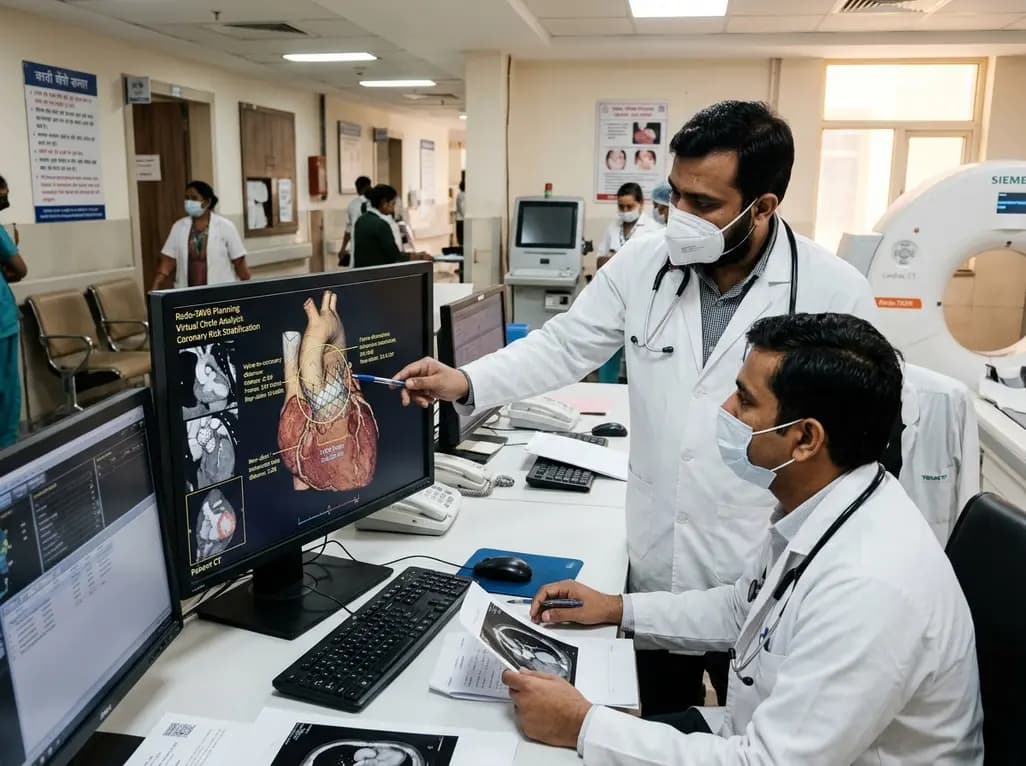
A multicenter study evaluating paired cardiac CT scans reveals that the virtual circle method reliably predicts index transcatheter valve frame expansion and changes in valve-to-aorta distance during redo-TAVR, offering accurate or conservative coronary risk stratification in 85% of cases.
Today

Explore joint-preserving correction of malunited anterior and posterior malleolar fractures. Discover how 3D CT imaging, anatomic reduction of the incisura, and restorative osteotomies prevent posttraumatic ankle osteoarthritis and restore biomechanical stability.
Today

India is poised to transform chronic disease management through wearable health technology. Discover how continuous remote monitoring and predictive algorithms empower clinicians to detect early cardiovascular signals, personalize metabolic interventions, and deliver equitable preventive care across populations.
Today
