.webp&w=384&q=75)

Loading, please wait...
Loading, please wait...
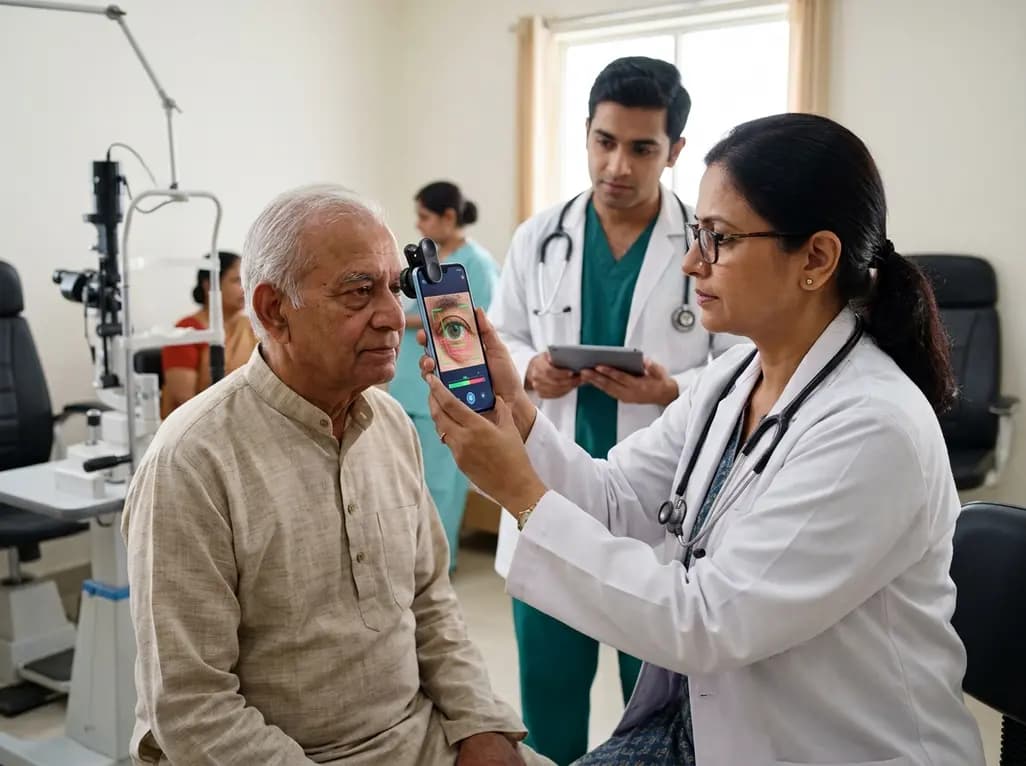
Detecting rare eye tumors early is critical for preserving vision and overall survival. However, clinicians often misdiagnose these lesions as benign due to their subtle presentation and a lack of accessible screening tools. Consequently, a clinical trial published in JAMA Ophthalmology recently evaluated a smartphone-based AI system designed specifically for proactive ocular surface malignancies screening. This model aims to bridge the gap between specialized care and the general population through mobile health technology.
The study, conducted in China, utilized a deep learning model called CaptureTumor. Researchers initially trained this AI using slit-lamp images from multiple centers over 12 years. They subsequently optimized the system for smartphone photography and deployed it through a widely disseminated mobile application. Participants captured images of suspected lesions using real-time AI guidance, which provided immediate risk stratification and triaged high-risk cases for expedited clinical referral.
The results of the trial are highly promising for public health. During real-world screening involving 614 participants, the smartphone-based system achieved an area under the curve (AUC) of 0.905. This performance is nearly comparable to traditional slit-lamp-based models. Furthermore, the application successfully identified 20 pathologically confirmed malignancies. Notably, 19 of these cases were new diagnoses. Because of this early detection, none of the participants required enucleation, which is a significant clinical victory.
Transitioning from hospital-based to at-home screening could dramatically change how we manage rare eye diseases. The AI demonstrated a sensitivity of 89.3% and a specificity of 95.9% at the population level. Moreover, the integration of media outreach reached over 250,000 individuals, proving the scalability of this model. This approach ensures that patients in underserved areas can access high-quality diagnostic guidance without immediate proximity to a tertiary eye care center.
For general practitioners and ophthalmologists, this technology represents a shift toward democratized ocular care. Additionally, the AI-guided photography instructions minimize user error, ensuring that the captured images are high quality for analysis. While this trial focuses on a specific population, its success suggests that AI-driven mobile health models are scalable. Such systems can effectively address inequities in healthcare delivery for vision-threatening conditions.
The app uses real-time AI-guided photography to help users capture high-quality images of eye lesions. It then applies a deep learning model to categorize the lesion as benign or malignant and provides a risk stratification to help triage high-risk cases for referral.
In the clinical trial, the smartphone-based AI achieved an AUC of 0.905, which is comparable to the 0.945 AUC achieved by the slit-lamp-based model. While not a replacement for a formal clinical exam, it serves as a highly effective screening and triage tool.
Self-screening allows for the early detection of subtle lesions that might otherwise be ignored or misdiagnosed as benign. Early identification often leads to less invasive surgical interventions and better preservation of vision.
Disclaimer: This content is for informational and educational purposes only and does not constitute medical advice, diagnosis, or treatment. Always seek the advice of your physician or other qualified health provider with any questions you may have regarding a medical condition. Refer to the latest local and national guidelines for clinical practice.
References
Wang R et al. Smartphone-Based Proactive Self-Screening for Ocular Surface Malignancies: A Nonrandomized Clinical Trial. JAMA Ophthalmol. 2026 Jun 04. doi: 10.1001/jamaophthalmol.2026.1609. PMID: 42240998.
Okumura Y, et al. A Feasibility of a Smartphone Application to Assist Diagnosis of Dry Eye. Poster Presented at: AAO 2023.
Rono H, et al. Smartphone-based screening for visual impairment in Kenyan school children: a cluster randomised controlled trial. Lancet Glob Health. 2018;6(8):e924-e932.
"
Read summarized clinical updates, watch expert medical content, and earn CME certifications right from your smartphone.
Open your smartphone camera to scan and install.





A clinical trial demonstrates that a smartphone-based AI system can effectively screen for rare ocular surface malignancies, improving early diagnosis....
4 months ago

Novel diimide and hydrazone scaffolds, particularly compound #C4, synergistically reactivate latent HIV-1 when combined with JQ1 or PKC activators. Demonstrating donor-matched proviral transcription ex vivo and non-canonical signaling, these findings advance shock and kill strategies toward reservoir eradication.
Today

A comparative cohort study evaluates vNOTES vs TLH hysterectomy for benign conditions, demonstrating shorter operative duration, faster return to daily activities, and equivalent female sexual function scores without increased dyspareunia.
Today

Review how tailored exercise programs benefit frail older patients with heart failure. Explore pathophysiological mechanisms, individualized training prescriptions, and strategies to overcome adherence barriers in clinical practice.
Yesterday

This comparative study evaluates posterior labral tears with and without glenohumeral instability, highlighting distinct demographic patterns, MRI underestimation in stable shoulders, and successful arthroscopic repair outcomes.
Yesterday

A clinical study demonstrates that early intervention with tocilizumab, either as monotherapy or bridged with corticosteroids, achieves significant proptosis reduction and resolves active inflammation in treatment-naive thyroid eye disease.
Today
